
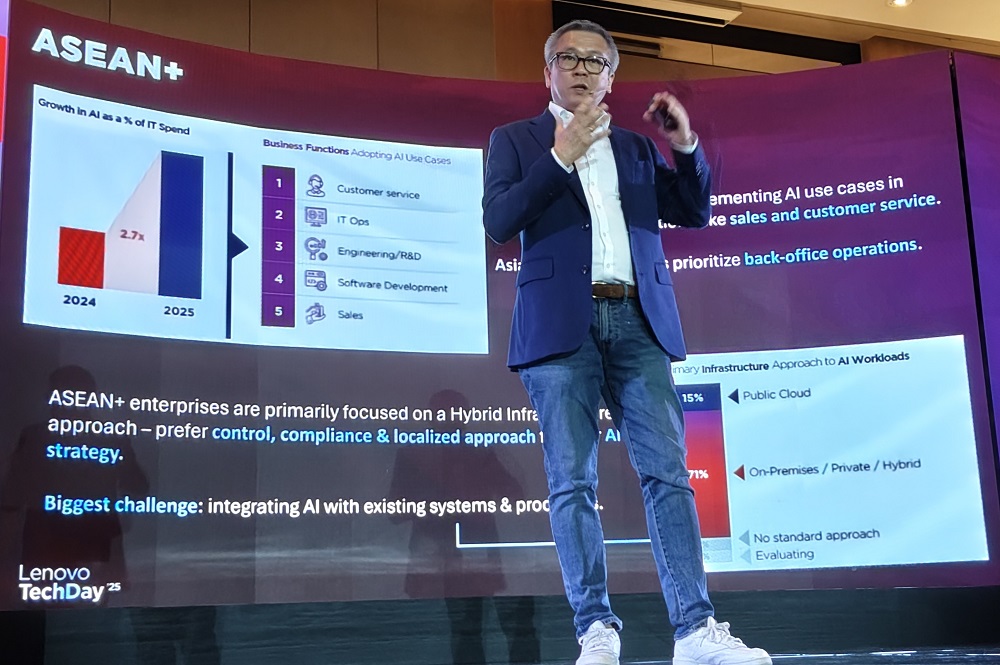
Computer manufacturer Lenovo Philippines celebrated its “TechDay 2025” last June 11, featuring discussions with industry clients about return on investment (ROI)-driven AI initiatives.
A recent study commissioned by Lenovo titled “CIO Playbook 2025 – It’s Time for AI-nomics” projects a 330% increase in AI spending for the Asia Pacific region and a 270% increase for Southeast Asian countries (Asean).
In the Philippines, the government is actively prioritizing innovation, digital infrastructure, and talent development as part of its national strategy. The focus is on enhancing critical sectors such as agriculture, manufacturing, business process outsourcing (BPO), and healthcare.
Government initiatives, including the National AI Roadmap (2021–2028) and plans for a National Center for AI Research, represent important steps towards a coordinated effort to foster research, skill development, and practical AI implementation, positioning the Philippines as a key player in the regional AI landscape.
However, despite the projected increase in spending, AI adoption is still in its early stages, with 47% of organizations in Asean either evaluating or planning to implement AI in the next year. This figure lags behind the Asia Pacific average of 56% and the global average of 49%.
The slow adoption pace is attributed to ROI challenges, as well as limited resources and AI expertise. There is also a growing need for ethical governance in AI, with only 25% of organizations in the Asia Pacific region fully enforcing AI governance, risk, and compliance (GRC) policies.
Additionally, the adoption of Generative AI is gaining momentum and is projected to account for 42% of AI implementation spending in 2025 across Asean. Use cases primarily involve IT operations and customer service, while innovation efforts focus on cybersecurity and software development.
Regarding hardware infrastructure, there is a strong preference for on-premise and hybrid solutions, with 68% of organizations in Asean opting for these platforms to ensure secure, low-latency environments, and operational flexibility.
During the event, Michael Ngan, president and general manager of Lenovo Philippines, stated, “With decades of presence in the Philippines, Lenovo remains deeply committed to supporting local enterprises in overcoming AI adoption challenges — from infrastructure readiness to skills development.
“Through our portfolio of AI-ready devices, solutions, infrastructure, and services, we are helping build a strong foundation for long-term growth, improved competitiveness, and inclusive participation in the AI-driven economy.”


