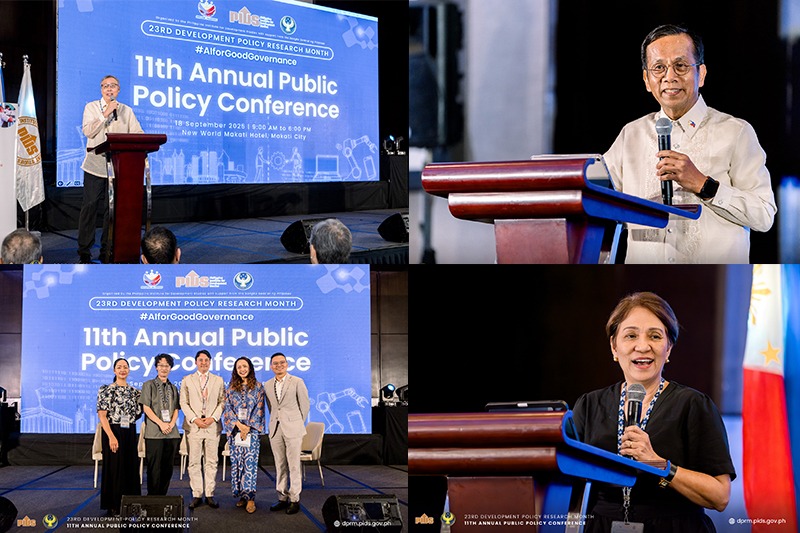
Artificial intelligence (AI) may deepen the digital divide in the Philippines unless the government urgently strengthens data systems, expands digital connectivity, and implements safeguards, experts warned during the 11th Annual Public Policy Conference (APPC) on Thursday, Sept. 25.
The conference, organized by the Philippine Institute for Development Studies (PIDS) as part of the Development Policy Research Month (DPRM) celebration, carried the theme “Reimagining Governance in the Age of AI.”
In his opening message, PIDS president Philip Arnold Tuaño described AI as both a powerful tool and a looming threat.
“AI is now an enabler of connections, a driver of knowledge creation, and a catalyst for adaptation in nearly every field,” he said. “However, without better infrastructure, skills, and governance, its benefits will remain concentrated in the hands of a few.”
Socioeconomic Planning secretary Arsenio Balisacan echoed the warning, stressing that the challenge is no longer hypothetical.
“AI is here. Without decisive action, only large corporations and urban centers will benefit, leaving rural communities and small enterprises further behind,” he said.
Balisacan highlighted the recently passed Konektadong Pinoy Law, or the Open Access in Data Transmission Act, which aims to boost competition in telecommunications, lower costs, and improve access.
He said the measure is a step toward ensuring that no Filipino — whether in urban centers or remote barangays — is left behind.
International experts also weighed in. Christopher Lamont of Tokyo International University urged governments to treat AI as a governance challenge, not merely a technical issue.
“The real test of AI is not just whether it spurs growth, but whether it safeguards citizens,” he said, calling for a precautionary, rights-based approach.
From a local perspective, Naoto Kanehira, senior digital development specialist at the World Bank, noted that fragmented and unreliable datasets hinder the country’s ability to leverage AI effectively.
“Data is often inaccurate, incomplete, not sharable, or even not machine-readable. Without reliable data, AI cannot deliver smarter, faster public services,” he said.
Even with improved data systems, millions of Filipinos may remain excluded due to lack of connectivity or digital skills. ICT policy analyst Mary Grace Mirandilla-Santos emphasized that without urgent investments in broadband and digital literacy,
“AI will empower those already connected while excluding those still left behind,” she said.
Experts also warned about the risks of adopting AI models developed abroad without local adaptation. Arifah Sharifuddin of the Tech for Good Institute cautioned that such models could reinforce bias and fail to meet Philippine needs.
Department of Science and Technology (DOST) undersecretary Leah Buendia called on regulators to balance innovation with citizen protection, particularly against misinformation and privacy breaches.
She highlighted three key priorities: ethical adoption, collaborative governance, and institutional readiness for the AI era.
“Good governance is not measured by how advanced our technologies are, but by how well they advance the security and prosperity of our people,” Buendia said.