
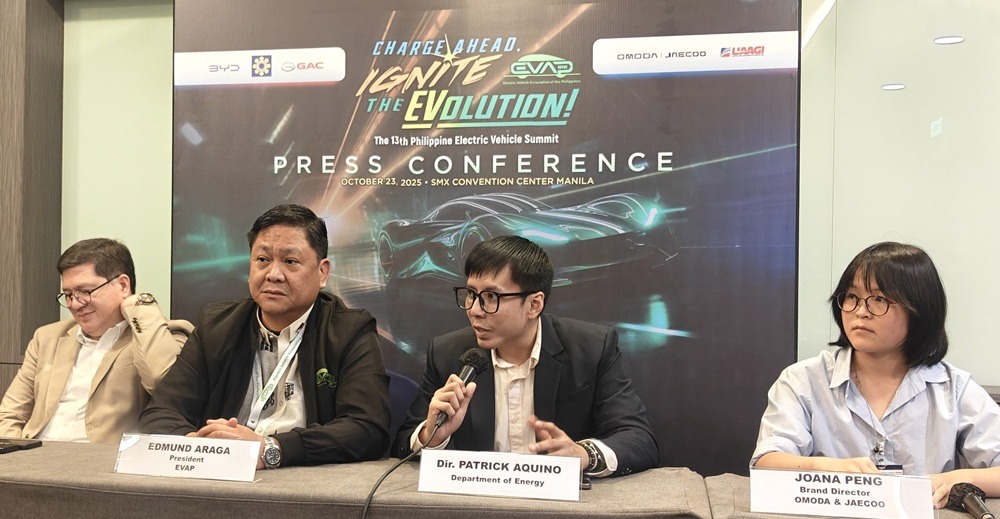
The Philippines is accelerating toward a more sustainable transport future as electric vehicle (EV) registrations continue to surge, according to the latest data from the Department of Energy (DOE).
From January to July 2025, the country recorded 28,353 new EV registrations and 1,362 renewals, already surpassing last year’s total of around 24,000. The figures reflect a growing appetite for eco-friendly mobility options among Filipino motorists.
Electric Vehicle Association of the Philippines (EVAP) president Edmund Araga said during the recently concluded 13th Philippine Electric Vehicle Summit (PEVS) the momentum underscores strong public interest and policy support.
EVAP is targeting 30,000 registrations by end-2025 and an ambitious 2.5 million total registrations by 2040.
DOE Energy Utilization Management Bureau director Patrick Aquino shared the optimism, adding that reaching 35,000 EVs on Philippine roads by next year would mark a “historic milestone” for the local EV industry.
Officials attribute the steady rise in adoption partly to the DOE’s issuance of six official EV classifications — Battery EVs (BEVs), Hybrid EVs (HEVs), Light EVs (LEVs), Plug-in Hybrid EVs (PHEVs), Range Extender EVs (REEVs), and Fuel Cell EVs (FCEVs).
“This structured classification allows for a more organized, transparent, and future-ready EV market in the Philippines,” Aquino said.
He added that the recently enacted Electric Vehicle Industry Development Act (EVIDA) is expected to further boost EV ownership through new incentives and infrastructure support.
The DOE aims to install 7,300 charging stations by 2028, up from the current 1,159 operational stations, through partnerships with developers and mandated installations in malls, expressways, fuel stations, and public buildings.
A recent Mapua University study, titled “Marketing Strategy and Preference Analysis of Electric Cars in a Developing Country: A Perspective from the Philippines,” found that Filipino buyers prioritize battery type, charging method, vehicle category, driving range, and charging speed when choosing EVs.
Aquino noted that most registered EVs are two-wheelers and three-wheelers, reflecting affordability concerns and practical use cases.
“Manufacturers can help accelerate adoption by addressing cost barriers and enhancing technology to meet local needs,” he said.
Despite the upward trend, local EV manufacturers face hurdles in importing essential materials due to Bureau of Customs (BoC) regulations.
Araga confirmed that negotiations with the BoC’s Imports and Assessment Service are ongoing to streamline import procedures and sustain the industry’s momentum.
“As we transition toward cleaner and smarter transport, industry cooperation and government policy must go hand in hand,” Araga said. “The Philippines is on the road to a greener, more electrified future.”


