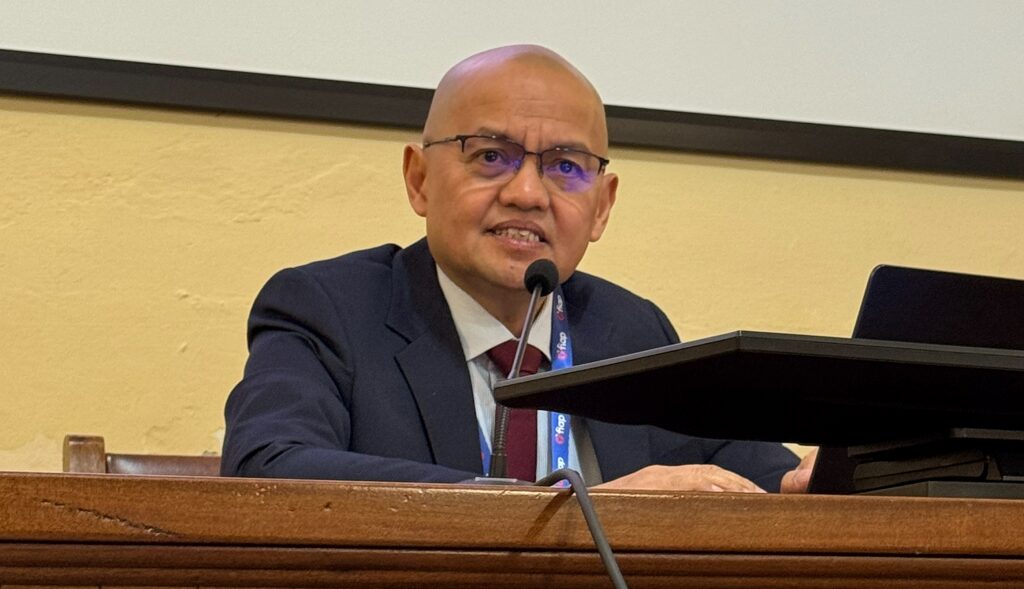
The Supreme Court (SC) highlighted its sweeping digital justice initiatives and artificial intelligence (AI) governance efforts at the Convention for the Creation of a Digital Framework for the Social Progress of the Philippines held at the Universidad de Granada in Spain.
The event, part of the CALESA Digital Project — short for Digital Capacity Building for Legal and Social Advancement in the Philippines — brought together global experts in law and technology to strengthen digital transformation in governance and the justice system.
The initiative is backed by the Spanish Agency for International Development Cooperation (AECID) and led in partnership with the SC, Department of Justice (DOJ), University of the Philippines (UP) Law Center, and Spanish academic institutions.
Delivering opening remarks on behalf of SC chief justice Alexander Gesmundo, senior associate justice Marvic Leonen underscored that discussions on AI must prioritize human dignity and social justice.
“AI and digital must be deployed so as not to degrade human dignity and human rights,” Leonen said. “Digital technology with AI is a powerful tool — but without human consciousness.”
He emphasized that while digitalization can enhance court efficiency and access, it must rest on ethical governance, cybersecurity, and transparency frameworks.
Leonen also warned against overreliance on automation, noting that “technology cannot replace wisdom, integrity, or courage, but it can amplify all three.”
Leonen’s keynote on the judiciary’s modernization centered on the Strategic Plan for Judicial Innovations (SPJI) 2022–2027, a comprehensive blueprint for the Philippine Judiciary’s digital transition.
The plan seeks to digitize court processes, leverage AI for legal research, and enhance data-driven policy formulation.
Among its flagship programs:
- eCourtPH – A full digital case management platform replacing paper-based workflows, offering real-time case updates and online document submissions.
- REAL Justice (Remote Hearing and Equal Access to Law and Justice) – Uses video conferencing to connect courts with remote communities like Tawi-Tawi, enabling access to hearings without physical presence.
- Scriptix – A voice-to-text AI transcription tool that accelerates courtroom documentation.
- Judiciary e-Payment Solution (JePS) – An online platform for secure and transparent payment of legal fees.
The SC also announced work on an AI Governance Framework to regulate the responsible use of emerging technologies within judicial processes, ensuring decisions remain transparent and human-centered.
The CALESA Digital Convention gathered digital governance leaders from the Philippines, Spain, Portugal, and the UK. Participants explored topics such as AI ethics in judicial administration, digital identity, and data economy development.
Other key Philippine delegates included associate justice Amy C. Lazaro-Javier, DOJ undersecretary Nicholas Felix Ty, and UP Law dean Gwen Grecia de Vera, joined by University of Granada officials and Spanish cooperation agencies.
Experts from the Philippines also shared local innovations in justice digitalization, including PHILJA vice chancellor Justice Edgardo Delos Santos, Prof. Jesus Disini Jr., and Atty. Annette Guevara Lagman, among others.
Leonen concluded by reaffirming that technology should serve — not supplant — human values: “Digital transformation is not an end in itself. It is a means towards a higher purpose: a judiciary that is efficient, transparent, inclusive, and above all, humane and just.”