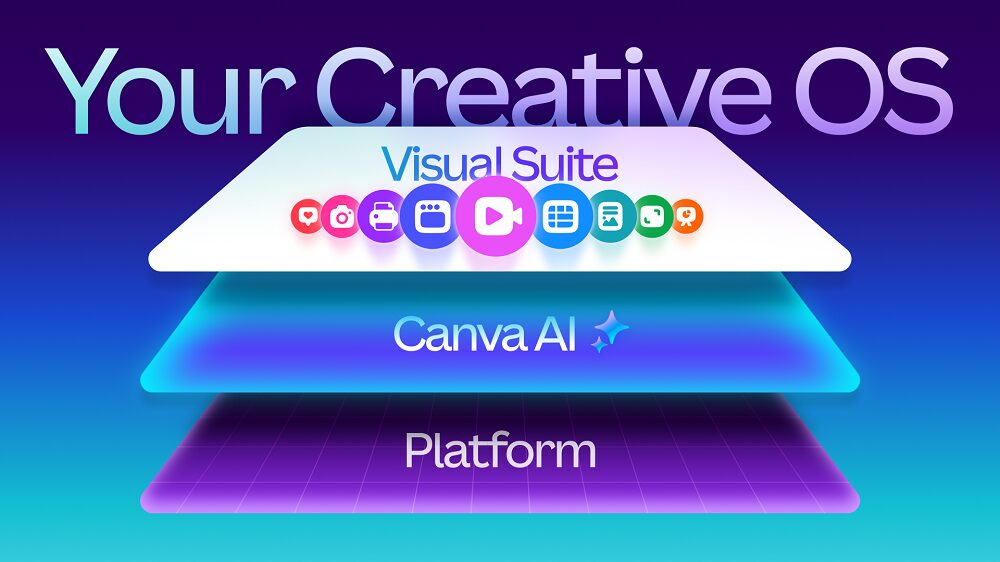
Online design platform Canva has announced what it calls its most ambitious product expansion to date, introducing new AI-driven tools, upgrades, and integrations that mark its transformation into the world’s first Creative Operating System.
The announcement, made on October 30, featured a sweeping set of updates across Canva’s entire ecosystem — from its core Visual Suite and newly consolidated Canva AI tools, to enhancements in its Platform Layer that power collaboration, branding, and third-party app integration.
Canva co-founder and CEO Melanie Perkins said the milestone reflects “over a decade of deep investment” aimed at empowering users to handle any creative need within a single, unified platform.
“These launches bring together over a decade of investment that we’ve been making deeply inside the Canva platform,” Perkins said. “All of these components — Canva’s Visual Suite, Canva AI, and the Platform Layer — come together in the world’s first Creative Operating System.”
Canva introduced several upgrades under its Visual Suite, starting with Video 2.0, a revamped video editing tool with a redesigned timeline, updated templates, and a new Magic Video feature that automatically assembles videos using AI from raw clips and short text prompts.
Another highly anticipated addition is Email Design, which allows users to create visually rich emails without coding. Designs can be exported directly as HTML for use in email marketing platforms.
Canva also launched Forms, an interactive feature that lets users embed surveys, sign-up sheets, and quizzes directly into presentations, documents, and websites. Responses are automatically stored in Canva Sheets, the platform’s spreadsheet tool.
The Data meets Canva Code feature links Sheets to Canva’s website builder, enabling users to create dynamic, data-powered web pages with live dashboards and interactive widgets.
Under the new Canva AI collection, the company unveiled the Canva Design Model — a foundational AI model that produces editable, layered designs instead of static images. This allows users to customize text, colors, and layouts instantly after generation.
Canva also introduced Ask Canva, a built-in AI assistant that provides design feedback and advice directly within projects through @mentions, and AI Where You Work, which integrates generative capabilities throughout the platform’s search and design tools.
For marketing teams, Canva launched Canva Grow, a new workspace that centralizes ad creation, publication, and performance tracking.
It also expanded its Brand System, bringing real-time brand guidelines and automatic styling into the design editor to ensure consistency across teams.
Meanwhile, for professional designers, Canva unveiled The All-New Affinity — a unified version of the award-winning design software suite it acquired in 2024.
The platform now combines Affinity’s photo editing, vector design, and layout tools into one product and file type. In a surprise announcement, Canva made the entire Affinity suite free for all users, forever.
Perkins closed the presentation by positioning Canva’s new direction as part of a broader creative movement.
“As knowledge becomes more accessible, we believe we’re moving from the Information Era to the Imagination Era — a time when creativity has never been more critical,” she said.
“From major upgrades to our Visual Suite to our new AI layer and brand tools, we can’t wait to see how people use all of these new products to bring their ideas to life.”