Political content is increasingly spreading through digital spaces that Filipinos primarily use for entertainment, humor, and lifestyle updates — not traditional news outlets — according to a new study mapping the country’s online political ecosystem.
The findings were presented during a Philippine Institute for Development Studies (PIDS) webinar co-hosted with the Philippine Communication Society (PCS) on November 13.
The study, Digital Public Pulse: Mapping the Digital Landscape of Philippine Politics, published in the PCS Review, shows how social platforms’ algorithms and creator-driven media have reshaped how political information flows across the internet.
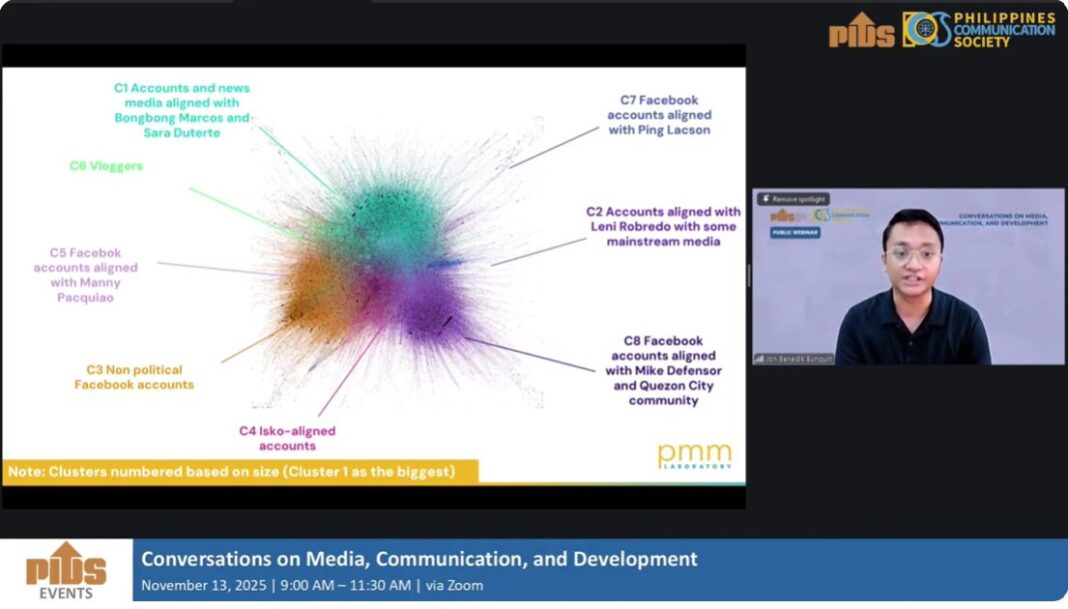
Researchers Dr. Jon Benedik Bunquin and Fatima Gaw of the University of the Philippines Diliman found that memes, vloggers, lifestyle creators, and platform-native commentators now play a larger role in shaping online political discourse than traditional newsrooms.
Many Filipinos encounter political posts not through news sources but through meme pages, humor accounts, gaming channels, and quote-card creators with massive followings.
“Legacy media channels remain dominant, but their audiences have become more limited and constrained,” Bunquin said, noting that mainstream media’s influence is shrinking in social spaces where non-news content dominates attention.
As a result, Filipinos who rarely seek out political news still receive political messaging through algorithm-driven feeds designed for entertainment.
The study highlights how political actors have adapted to this environment by communicating directly with supporters through Facebook, YouTube, TikTok, and other platforms.
Candidates now publish their own videos, statements, and commentary — often outperforming news organizations during high-stakes periods.
“Political actors no longer need the editorial gatekeeping of the press,” Bunquin said. “They can directly communicate with their audiences and produce their own content.”
During the 2022 national elections, politicians’ posts overtook those from news outlets in reach and engagement, especially in the latter part of the campaign.
One of the study’s most striking insights is the role of pages that appear unrelated to politics. Researchers identified networks of “synchronized posting,” where multiple entertainment pages shared the same political content within minutes of each other — boosting visibility and creating the impression of widespread support.
Many pages present themselves as apolitical, yet their massive audiences and viral formats make them influential distribution channels for political material, often without the fact-checking standards of journalism.
The study also points to the growing power of YouTube commentators who produce news-like content without newsroom oversight or editorial vetting, yet attract millions of views and shape perceptions on major political issues.
Discussant Dr. Orville Tatcho of UP Baguio agreed that digital platforms have transformed political communication but cautioned that offline relationships still carry significant weight.
Citing survey findings, he noted that family and friends remain key conduits of political information, blending personal networks with algorithmic exposure.
He emphasized the need for mixed methods research and stronger media literacy initiatives, especially because political messaging increasingly circulates in informal, entertainment-driven spaces where audiences may not expect or critically evaluate political content.
Bunquin encouraged Filipinos to use digital tools more purposefully.
“Citizens should leverage the affordances of digital media to demand accountability and build communities that translate social media discourse into meaningful action,” he said.