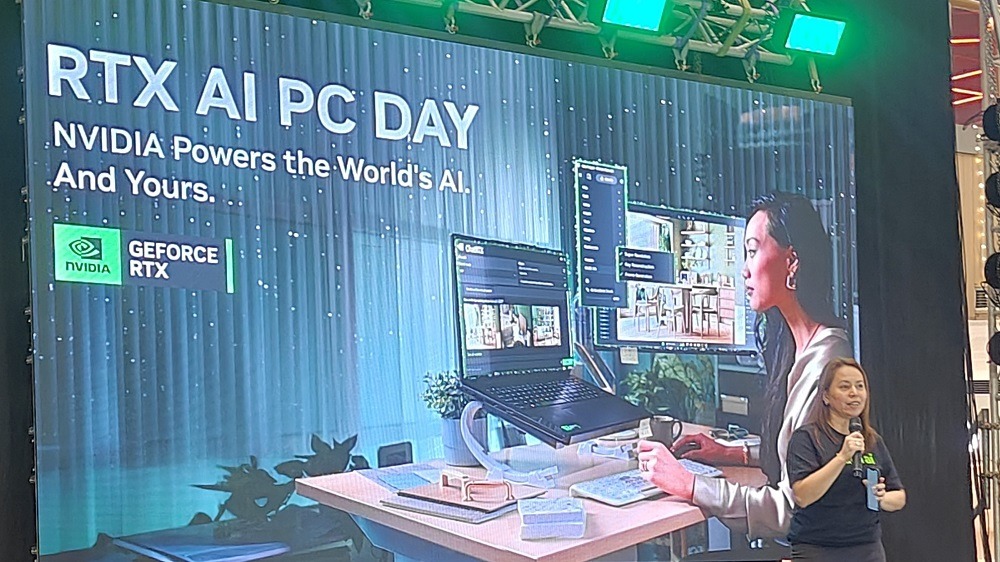
Chipmaker Nvidia staged its annual RTX AI PC Day on Jan. 10 and 11 at The Block in SM City North EDSA, bringing its latest artificial intelligence and graphics technologies directly to local gamers, creators, and PC enthusiasts.
The two-day public event featured hands-on demos and interactive booths focused on AI-driven tools for gaming, content creation, and productivity, highlighting how RTX-powered PCs are increasingly being positioned as consumer AI platforms.
Presentations were led by Frances Fernandez, marketing manager, and Jerome Matti, country sales lead for Nvidia Philippines, who outlined recent developments across the company’s RTX ecosystem.
Among the technologies showcased were Deep Learning Super Sampling (DLSS), Nvidia Studio for creative professionals, and Nvidia Broadcast for AI-enhanced livestreaming and video conferencing.
A key draw was the introduction of the GeForce RTX 50 Series GPUs, which incorporate fifth-generation Tensor Cores and support the newly announced DLSS 4.5.
Nvidia said the updates are aimed at improving both raw performance and AI-assisted graphics rendering, particularly for next-generation games and creative workloads.

The company also demonstrated Nvidia Reflex, a latency-reduction technology designed for competitive gaming. According to Nvidia, Reflex can cut system latency by as much as 75% in supported titles, improving responsiveness in fast-paced esports scenarios.
Beyond gaming, attendees were given a look at Nvidia’s generative AI microservices (NIM) and AI blueprints, which are designed to simplify the deployment of AI models and speed up creative workflows.
Demonstrations included the use of basic 3D objects to guide AI image generation, allowing creators to exert more control over composition and output.
For content creators, Nvidia highlighted RTX 50 Series features such as smoother 10-bit color editing, accelerated AI effects, and faster rendering and export times.
The company also pointed to the scale of its platform, citing more than 600 RTX AI-enabled games and applications and an installed base of over 100 million RTX AI PCs worldwide.