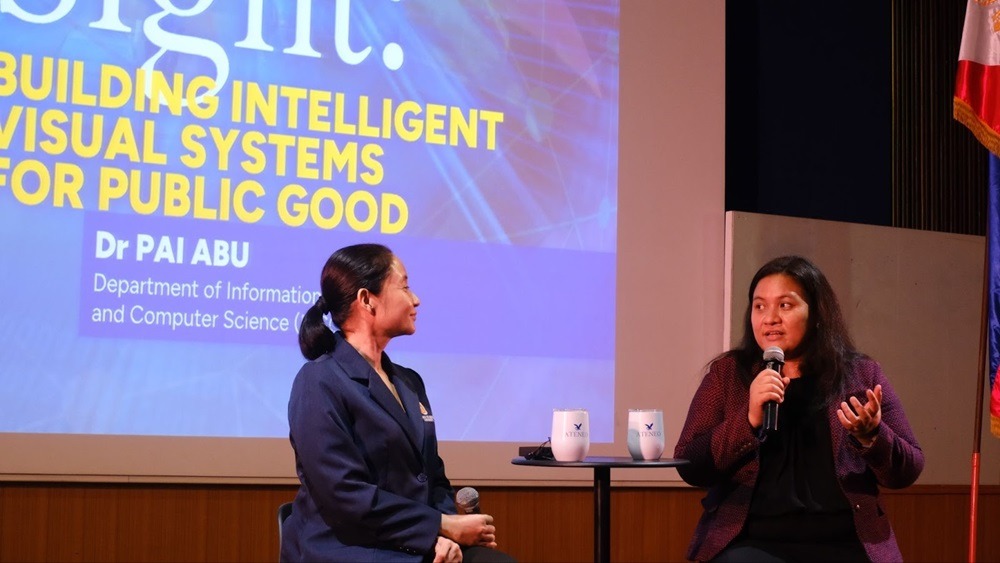
Despite the growing power of computers, machines still struggle to learn visual tasks as easily as humans do, according to a computer scientist who spoke at a recent lecture at Ateneo de Manila University.
During the Second Ateneo Breakthroughs lecture held on Feb. 26 at Escaler Hall, Dr. Patricia “Pai” Angela R. Abu discussed how machine-learning systems require far more structured training than people to interpret images and visual environments.
“One of the most surprising things about machine learning is that, despite how powerful computers are, they do not learn the way humans do: a toddler can easily recognize a familiar face, tell when something looks unusual, or make sense of a busy play area with very little instruction — but for a computer, those same tasks can be difficult and painstaking,” Abu said.
She noted that computer-vision systems typically need large datasets, extensive labeling, repeated training, and continuous testing to function reliably under varying conditions such as changes in lighting, camera angles, weather, and other real-world variables.
Abu delivered the lecture titled “Smarter Sight: Building Intelligent Visual Systems for Public Good.” The talk explored the gap between human and machine perception — where machines can sometimes outperform humans in analyzing large volumes of images but require far more preparation and training to do so.
Abu, an associate professor and chair of the Department of Information Systems and Computer Science (DISCS) at Ateneo de Manila University, leads the university’s ALIVE research group, which focuses on machine learning, computer vision, and image-processing systems.
Her team’s projects include applications in healthcare and transportation. In the medical field, ALIVE has developed tools such as a dental imaging support system and deep-learning models designed to detect bone metastasis from medical scans.
The group has also developed V-PROBE (Vehicle and Pedestrian Real-Time Observation and Behavioral Evaluation), a system designed to monitor traffic flow, predict parking availability, and identify potential congestion before it worsens.
According to Abu, such projects require close coordination with organizations that manage complex real-world environments, since machine-learning models must perform not only in controlled demonstrations but also under the unpredictable conditions of daily operations.
She said the research team is now seeking deeper collaboration with industry partners to help test and deploy these technologies outside the laboratory. Such partnerships can provide real operational settings, data pipelines, and deployment pathways needed to evaluate systems for speed, privacy and security safeguards, hardware limitations, and reliability in diverse conditions.
The lecture is part of Ateneo’s Breakthroughs series, which highlights research developments and emerging technologies with potential applications for public benefit.