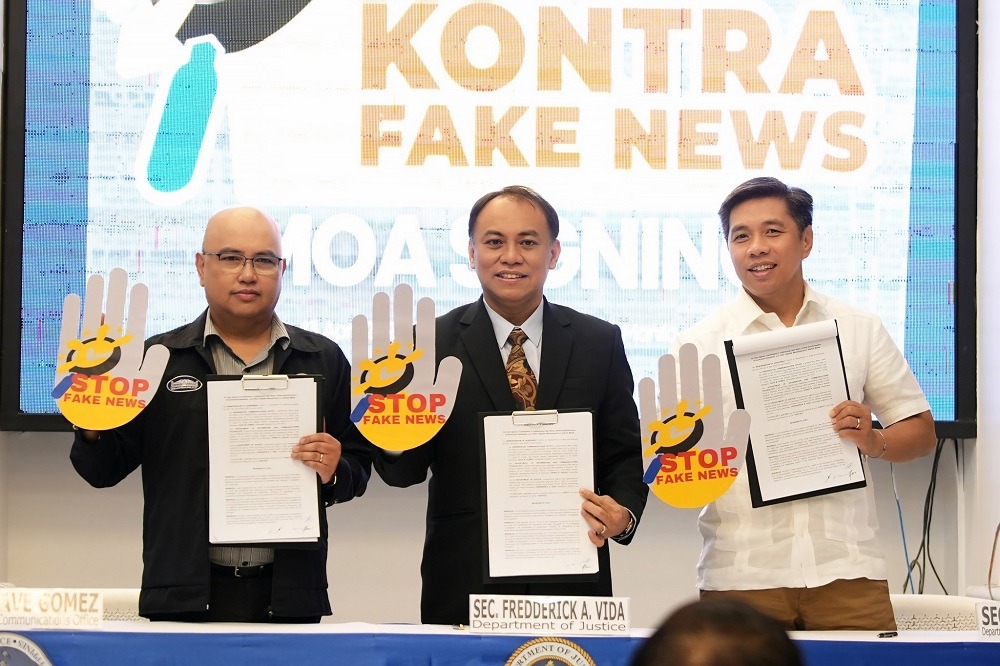
The Philippine government has formalized a multi-agency campaign against online disinformation and AI-generated deepfakes, raising fresh questions about how authorities will balance enforcement with constitutional protections on free speech.
The Department of Information and Communications Technology (DICT), Presidential Communications Office (PCO), and Department of Justice (DOJ) signed a memorandum of agreement creating a unified framework under “Oplan Kontra Fake News,” an initiative positioned as a coordinated response to the spread of false and misleading content online.
The move comes as officials warn that disinformation — amplified by artificial intelligence tools — has begun to affect public perception, emergency response, and trust in institutions, particularly during crises such as disasters and public health events.
Under the agreement, the DICT will handle technical aspects, including digital reporting systems and cybersecurity support; the PCO will oversee public communications and counter-disinformation messaging; and the DOJ will evaluate cases and pursue prosecution under existing laws.
The agencies will also form an inter-agency steering committee tasked with coordinating responses, including evidence handling and action against viral content deemed a threat to public safety or national security.
DICT secretary Henry Aguda framed the initiative as a necessary response to the speed and scale of online manipulation.
“In the age of artificial intelligence and hyper-speed information, truth must move faster than deception. This partnership ensures that government, technology, and law enforcement work as one to protect every Filipino from digital manipulation,” he said.
While officials stressed that the program is not intended to curtail legitimate expression, the broad scope of the initiative — including government-led identification and response to “viral disinformation” — could draw scrutiny from media groups, civil society, and legal experts concerned about potential overreach.
The agreement cites safeguards to protect journalism, dissent, and academic discourse, but details on how these protections will be operationalized remain unclear, particularly in determining what constitutes disinformation versus protected speech.