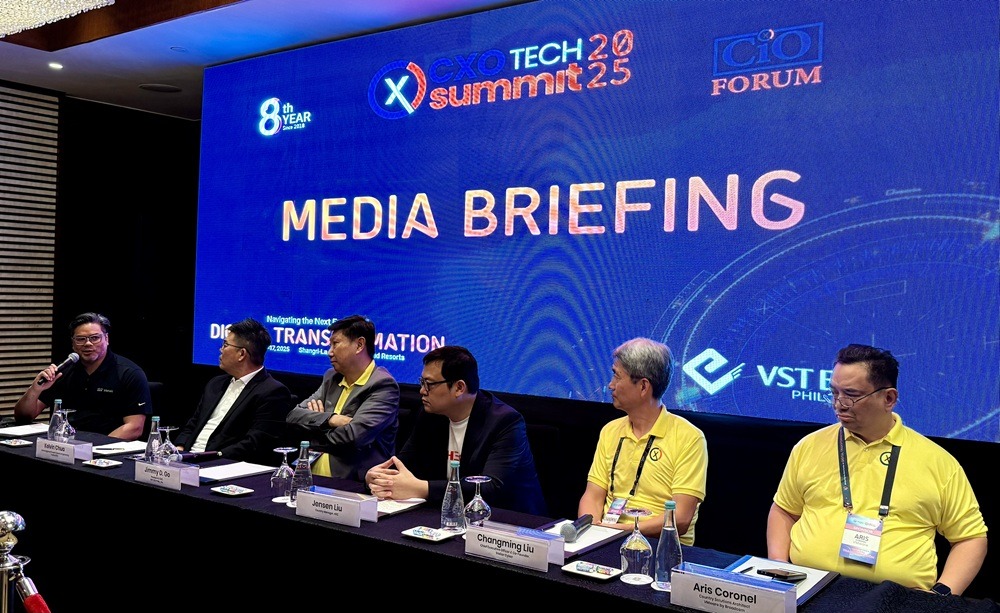
Jimmy Go, president and CEO of tech distributor VST ECS, is urging the passage of a data sovereignty law in the Philippines, saying it could unlock major investments from global technology firms and create thousands of local jobs through the establishment of new data centers.
Go said countries like Indonesia, Vietnam, and China have already benefited from such laws, which require data generated within their borders to be stored locally.
“When you look at Indonesia, Vietnam, and of course China — they have this data sovereignty law. What does it bring to the country? Companies like Google, Microsoft, and AWS are investing in their respective countries,” he said during a media briefing at the 8th CXO Tech Summit in Shangri-la Boracay.
Currently, Go noted, global tech giants can serve the Philippine market from abroad, limiting local infrastructure growth.
“Even our government is using AWS or Azure, but their data are not here in the Philippines,” he explained.
“If the data sovereignty law is approved, there will be more foreign direct investment, more jobs for Filipino people, and greater opportunities for the local tech ecosystem.”
Go added that localized data storage would not only improve latency and speed, but also drive new investments in power, cooling, and green energy to support the data infrastructure.
“The overall change is going to be very positive for the country,” he said, while acknowledging some resistance to the proposal. “I think it’s all positive. I hope it gets approved.”
Data sovereignty refers to the principle that digital information is subject to the laws and governance structures of the country in which it is collected or stored.
Herns Hermida, solutions architect at Cisco Philippines said enacting a data sovereignty law would also depend on whether the country can meet the technical and infrastructure requirements of hyperscalers
Hermida noted that the conversation revolves around the technical requirements for hyperscalers, specifically data centers, and how they vary depending on each hyperscaler’s needs.
He highlighted the need for tiered data centers with advanced power and cooling systems that meet global standards.
Hermida noted that while current data centers in the Philippines are still insufficient, this gap represents a huge opportunity for investment and collaboration, a potential for new projects and partnerships with vendors like Cisco, who can provide the necessary equipment, network security, and infrastructure support.
He also emphasized that developing a robust data center ecosystem would create widespread employment opportunities across sectors — from electricians and civil engineers to designers and ICT professionals.