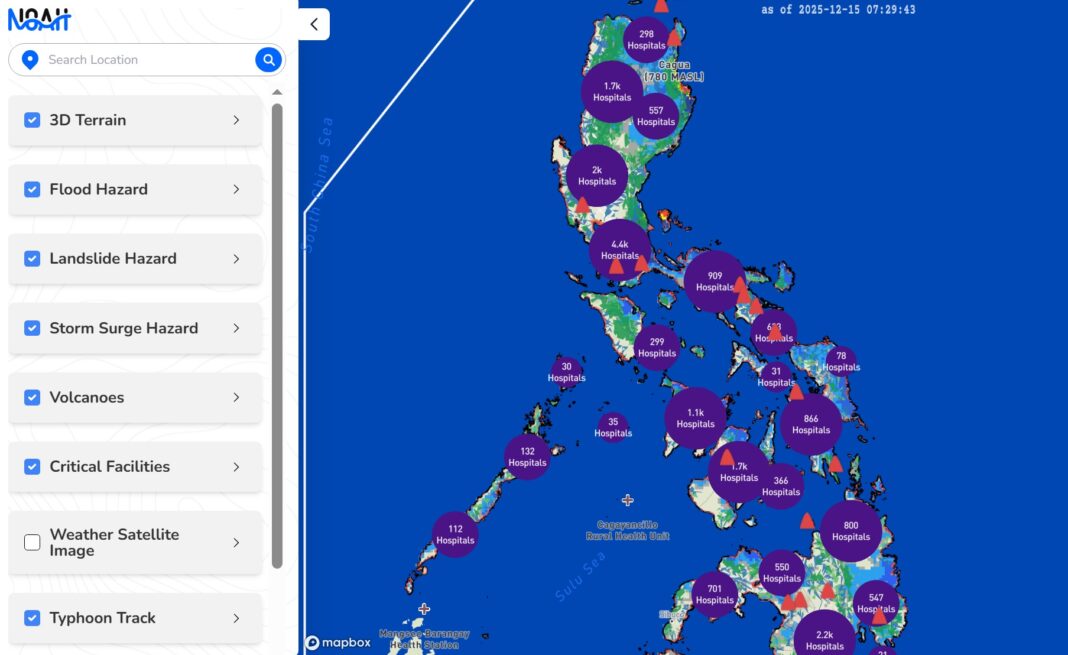
The House of Representatives has urged the Senate to approve a ₱1-billion allocation for the Nationwide Operational Assessment of Hazards (Project Noah) as part of the ongoing bicameral conference committee discussions on the proposed 2026 national budget.
During Saturday’s budget deliberations, Negros Occidental representative Javier Miguel Lopez Benitez underscored Project Noah’s continued value in delivering real-time hazard maps used by local government units, especially during climate disasters.
He cited about 35 million searches on the project’s website, with up to 2.5 million daily searches during peak typhoon periods, as evidence of its importance to Filipino communities.
Benitez noted that hazard maps have not been comprehensively updated since 2012, underscoring the need for fresh funding to modernize and expand data critical to disaster preparedness.
He is among the authors of House Bill 2577, which seeks to establish a National Climate Resilience Institute under the University of the Philippines (UP) system.
Nueva Ecija representative Mikaela Suansing, member of the House Appropriations Committee, also backed the funding bid, saying the proposed allocation would enable Project Noah to work closely with the Department of Public Works and Highways (DPWH) to better design and monitor flood control infrastructure.
Suansing highlighted that Project Noah’s simulation tools help identify where flood control structures are actually needed, minimizing the risk of misplaced spending on unnecessary projects.
She also pointed out the program’s diminishing budget in recent years — from about ₱500 million to just ₱36 million — even as it continues to produce maps relied upon by many Filipinos.
Project Noah was launched in 2012 as a government disaster risk reduction and mitigation initiative that combined advanced technologies with scientific research to provide hazard maps and early warnings.
It was initially administered by the Department of Science and Technology (DOST) and widely regarded as a flagship program for hazard assessment and public safety.
In January 2017, the national government announced it would end funding for Project Noah when its DOST-administered term concluded on February 28, 2017, citing a lack of funds for continued implementation.
The DOST stated that the project had met its deliverables and that its technologies would be adopted by other government agencies.
At the time, Project Noah’s then-executive director Mahar Lagmay warned that the defunding would result in the loss of trained disaster scientists and researchers, undermining continuity in hazard research and monitoring just as the country faced intensifying climate impacts.
To preserve the program, the University of the Philippines adopted Project Noah later in 2017, integrating it into the newly established UP Resilience Institute and continuing its operations as the Noah Center focused on research, development, and extension services in disaster risk reduction and climate change action.
Proponents of the proposed ₱1-billion funding argue that boosting Project Noah’s capacity is critical to enhancing the country’s climate resilience and flood mitigation strategies as typhoon seasons grow more intense and frequent.