
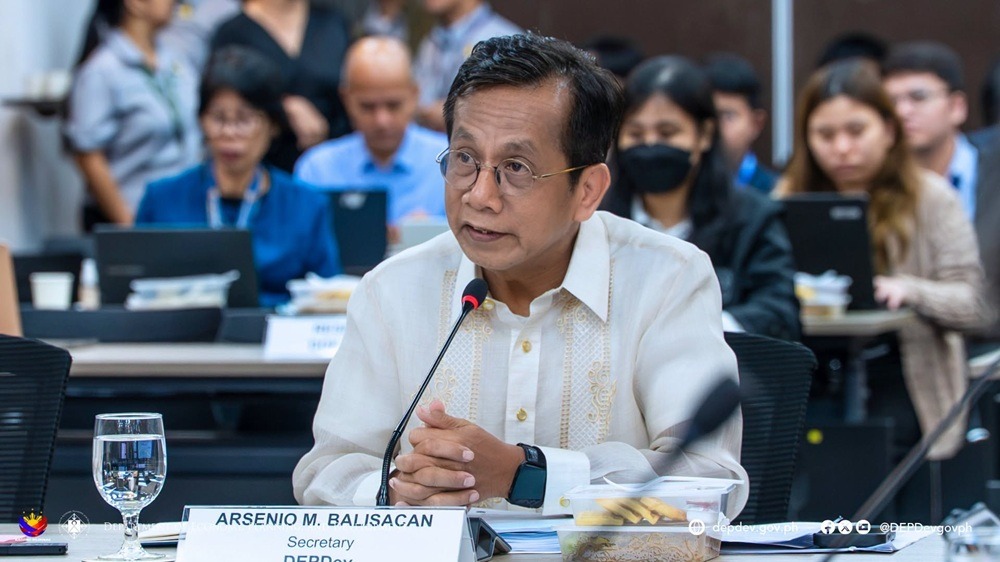
The Department of Economy, Planning, and Development (DEPDev) has urged government agencies to maintain human oversight and accountability when using artificial intelligence (AI) to monitor public programs and support decision-making.
Speaking at the 13th Monitoring and Evaluation Network Forum, DEPDev secretary Arsenio Balisacan said AI could help agencies process information, identify implementation problems, and address delays in reporting. He cautioned, however, that automated systems should not replace professional judgment.
“Our task, therefore, is not to surrender judgment to automation. It is to determine where AI can support our work, where it may mislead us, and what safeguards should govern its use,” Balisacan stated.
Balisacan said credible evidence still depends on rigorous methods, careful interpretation, and the transparent disclosure of limitations. AI systems may reproduce or amplify biases and errors found in their training data or introduced through their design, he added.
Government personnel must therefore understand how automated processes operate, examine the basis of their outputs, and retain responsibility for decisions affecting the public, according to Balisacan.
AI could help address persistent bottlenecks in government monitoring and evaluation, including fragmented reporting systems, manual data processing, and delayed delivery of information.
Its use is aligned with the Philippine Development Plan 2023–2028, which identifies digitalization, innovation, and good governance as development priorities.
During the forum, the Philippine Space Agency presented government applications of AI and satellite data through its Data Analytics Technologies and Operations Services for Space Data program and the Disaster, Hazard, and Risk Mapping initiative.
The technologies can be used to assess and monitor landslides, oil spills, forest fires, burned areas, ashfall dispersion, and the extent of flooding.
Balisacan said AI systems used by the government must themselves undergo regular evaluation to determine whether they produce the intended outcomes and treat people fairly.
“AI can support monitoring and evaluation. But it must also become a subject of monitoring and evaluation,” Balisacan said. “We must assess if AI-supported systems achieve their intended results, if their benefits justify their costs and risks, and if they serve people fairly.”
Organized with the United Nations Development Program, the hybrid forum brought together representatives from government, development organizations, universities, civil society, and the private sector.
Discussions covered regional case studies, spatial analysis, impact evaluation, data privacy, transparency, and institutional capacity for using AI in public governance.


