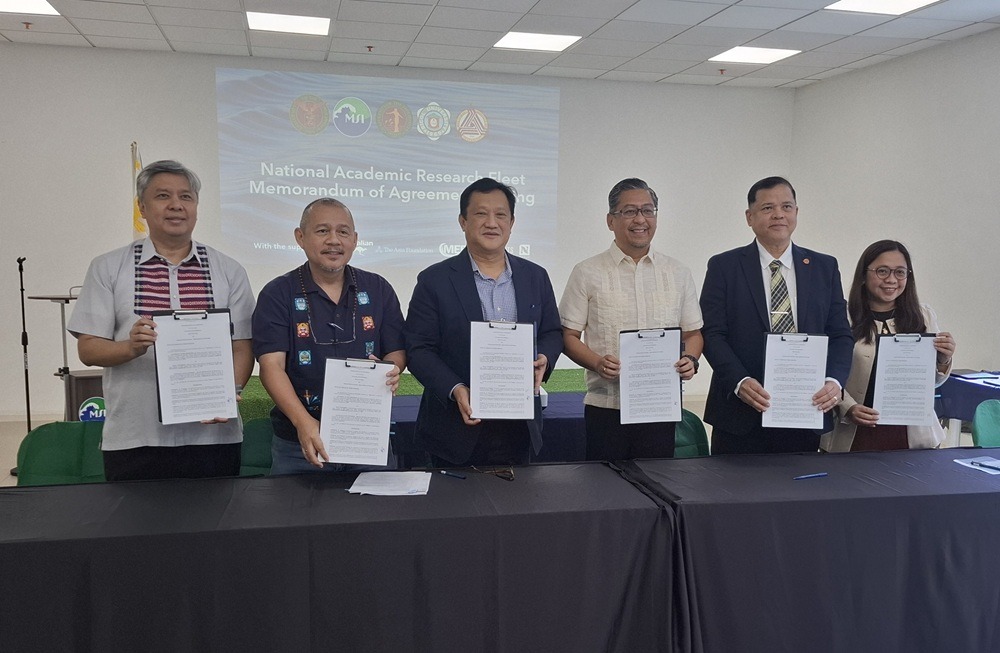
Four Philippine universities will share six research vessels under a University of the Philippines (UP)-led agreement that expands scientists’ access to offshore sampling and long-term monitoring of marine ecosystems.
UP Diliman, UP Visayas, Bicol University, and Mindanao State University–Iligan Institute of Technology signed the agreement on Nov. 23 at the UP Marine Science Institute in Quezon City.
The agreement covers the joint management and use of the vessels through the National Academic Research Fleet (NARFleet), an initiative led by the institute.
The vessels will allow researchers to collect biological and oceanographic samples farther offshore, establish baseline conditions, and return to the same areas to track changes over time. The universities can also conduct joint expeditions and train researchers in fieldwork at sea.
A shortage of suitably equipped research vessels has long limited offshore data collection in the Philippines, whose exclusive economic zone spans about 2.2 million square kilometers.
Gaps persist even in the study of coral reefs. A 2025 policy brief from the UP Center for Integrative and Development Studies found that no Philippine coral reef site had more than 15 years of continuous monitoring data.
Researchers can use the fleet to study marine biodiversity, ocean processes, fisheries, and the effects of climate change. Data from repeated expeditions could help identify changes in marine habitats and inform decisions on fisheries management, conservation, and climate adaptation.
At the signing, UP president Angelo Jimenez highlighted the role of artificial intelligence (AI) and digital tools in accelerating scientific research.
He also called for clearer communication of research findings to the public and policymakers to build support for sustained government funding.