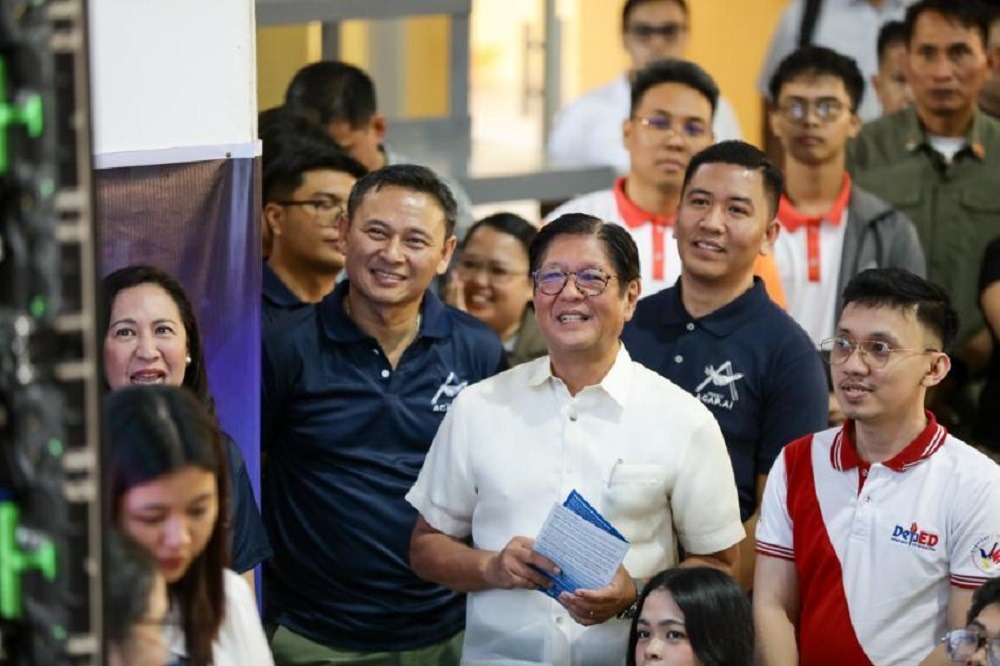
The Department of Education (DepEd) on Friday, Jan. 9, launched a national program to introduce artificial intelligence (AI) into basic education, focusing on training, safeguards, and curriculum changes rather than rapid classroom deployment.
Pres. Ferdinand R. Marcos Jr. and DepEd secretary Sonny Angara led the rollout of the Accelerating Governance and Adaptive Pedagogy through Artificial Intelligence (AGAP.AI), which DepEd said will be implemented in phases starting in 2026.
Under the program, DepEd plans to issue its Foundational Guidelines on the Integration of Artificial Intelligence in Basic Education, setting standards on responsible use, learner protection, inclusivity, ethics, and data privacy.
The guidelines are intended to define how AI tools may be used in schools amid concerns over misinformation, data security, and uneven access.
DepEd will also conduct a nationwide AI literacy and training initiative throughout 2026, targeting up to 1.5 million participants, including learners, teachers, and parents.
The training — branded as AI Ready Asean Philippines — will cover AI fundamentals, practical classroom applications, ethics, and risk mitigation.
Funding for the training comes from the Asean Foundation, with support from Google.org. DepEd signed a memorandum of agreement with the Asean Foundation during the launch to formalize the partnership.
The department said curriculum updates are underway to integrate AI concepts into basic education, with an emphasis on AI literacy and computational thinking.
In-service training modules for teachers focused on AI are scheduled for rollout by the second quarter of 2026.
DepEd is also working with international partners, including the Massachusetts Institute of Technology through its Responsible AI for Social Empowerment & Education (MIT RAISE) and the Day of AI Initiative, to support curriculum design and teacher training.
At the system level, DepEd said it will pilot AI-powered tools in 2026 to assist with teaching, assessment, and school management. These tools will be developed through the Education Center for AI Research and evaluated under national standards on reliability, fairness, and data privacy.
Existing AI platforms already used by the department may be expanded, subject to the same safeguards.
Officials said the initiative aligns with the government’s broader digital transformation agenda and regional goals under Asean Vision 2045, positioning education as a key entry point for preparing students and teachers for an AI-driven economy.