Ride-hailing and delivery platform Grab has entered into a strategic partnership with Chinese sensor maker Hesai Technology to distribute lidar products across Southeast Asia, signaling a push to expand the region’s adoption of autonomous and robotics technologies.
Under the agreement, Grab will act as the exclusive distributor of Hesai’s lidar sensors in the region, handling sales, customer support, and marketing.
The companies said the arrangement will make the sensing technology more accessible to businesses deploying automation in sectors such as mobility, logistics, and manufacturing.
Lidar, short for Light Detection and Ranging, uses laser-based measurements to create precise three-dimensional maps of surroundings, allowing machines and vehicles to detect obstacles and navigate environments.
The technology is widely used in advanced driver-assistance systems, autonomous vehicles, and industrial robotics.
Anthony Tan, Grab group chief executive officer and co-founder, said the collaboration is intended to broaden access to the technology beyond the company’s own transport initiatives.
“By expanding access to world-class lidar technology in Southeast Asia, Grab is doing more than improving our own autonomous mobility and mapping capabilities; we are providing the essential ‘eyes’ that allow robotics to ‘see’ and navigate safely, thus ensuring that 3D intelligence can be made accessible and scaled to every industry across our region,” Tan said.
Hesai CEO and co-founder David Li said demand for automation hardware is increasing across Southeast Asia as companies adopt AI-driven systems.
“Lidar is a core technology that enables robots to achieve autonomous perception and safer operations. The Southeast Asian market has shown strong demand across manufacturing, logistics, and service robots. Through our partnership with Grab, we will leverage our mature and reliable lidar technology with the needs of local markets, accelerating the deployment and large-scale lidar adoption for robotics applications.”
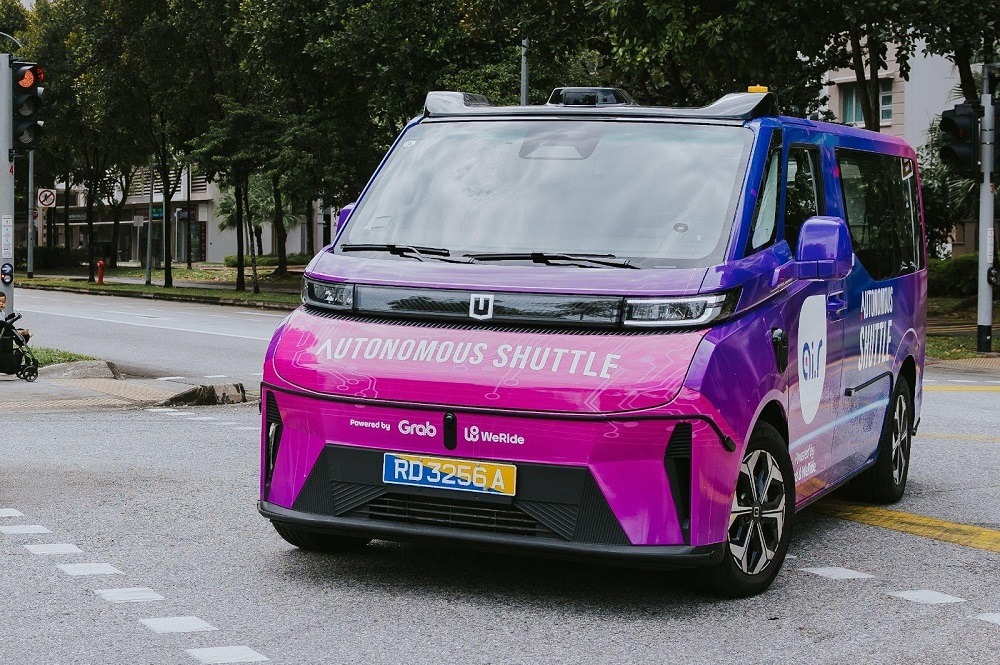
Hesai sensors are already being used in autonomous vehicle trials, including installations on self-driving fleets operating in Singapore’s Punggol district.
The companies expect demand for lidar to grow as industries in Southeast Asia invest in AI-enabled automation and so-called “embodied AI,” where software intelligence is paired with physical machines capable of operating in real-world environments.
The partnership aims to position both firms to supply the hardware layer needed for such deployments across the region.