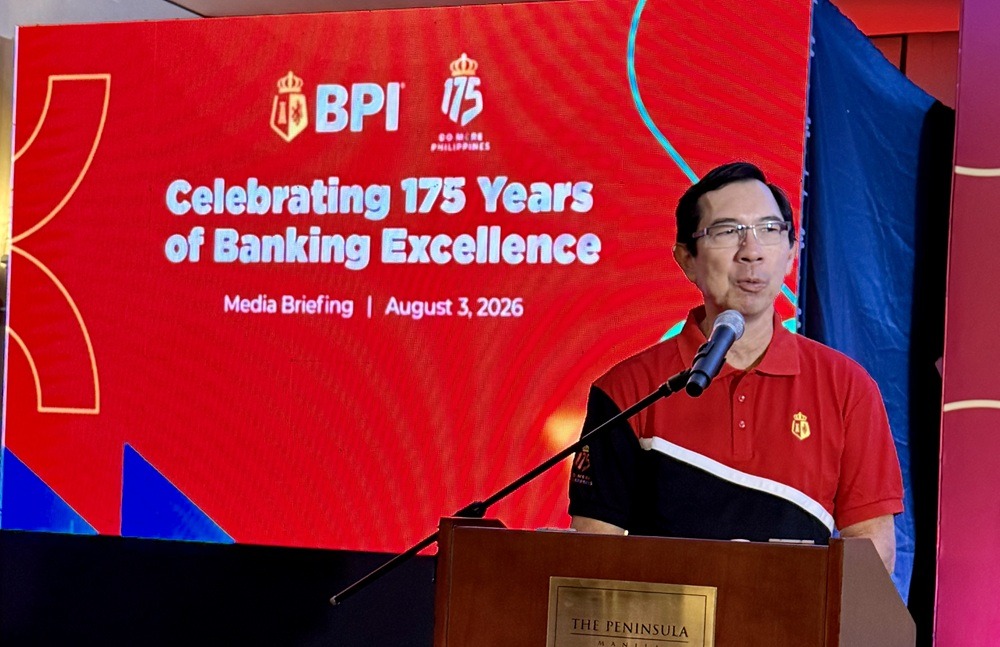
The Bank of the Philippine Islands (BPI) is developing an agentic artificial intelligence (AI) system for auto loan processing as part of a broader plan to deploy the technology across customer service, credit evaluation, and other banking operations.
During a media briefing in Makati City to mark its 175th anniversary, BPI president and CEO TG Limcaoco said the bank intends to extend the system to credit cards, personal loans, housing loans, and business loans if the auto loan project proves successful.
“We have a project going on today of agentic AI for our auto loan process. And once we get that on board and going and successful, it’s very easy to move that to credit cards, to personal loans, and then you’ll go to housing loans, and then business loans,” Limcaoco said.
Agentic AI systems are designed to perform multistep tasks and make limited decisions with less human intervention than conventional chatbots.
BPI is also preparing to integrate AI into its call center to help agents provide more accurate and consistent responses. The bank is separately experimenting with what Limcaoco described as a “BPI brain,” an AI-based system that would learn from the bank’s processes and assist employees in making decisions.
“Myself and a small group of people, we’re working on a credit brain. It’s still an experiment we’re doing. It’s not replacing us yet, but certainly we can see the potential of helping people do their jobs better,” he said.
The bank has already deployed BEAi, a generative AI application that allows frontline employees to retrieve information about BPI’s products, services, and policies. Limcaoco said the tool was introduced nearly two years ago to help standardize information given to customers.
BPI has used other forms of AI, including machine learning, pattern recognition, and chatbots, for years. Limcaoco said recent interest has shifted toward generative AI following the emergence of ChatGPT.
“For us, we look at AI as a tool that will increase productivity, that will allow us to serve our customers better,” he said.
Despite the planned expansion, Limcaoco said AI would remain a support tool and would not replace human service or customer-focused decision-making.
“I don’t think it ever replaces true service and true customer obsession,” he said.
Limcaoco also warned that the increasing use of complex technology could make it more difficult for banks to maintain customer confidence.
“We like to call ourselves as a very technology-driven bank today, but we have to realize that technology can never replace trust,” he said. “In fact, technology makes trust harder, because a lot of people don’t understand technology.”


Established on Aug. 1, 1851, BPI is the Philippines’ first bank and the oldest in Southeast Asia. Its earlier technology deployments included the country’s first 24-hour automated teller machine in 1982 and online banking at the start of the millennium.
BPI now operates digital platforms including the BPI app, VYBE by BPI, BPI Trade, BPI Wealth, BizLink, BizKo, and the BanKo mobile app. It also runs an agency banking network covering more than 7,000 retail partner stores nationwide.