The expansion of artificial intelligence infrastructure is creating new revenue opportunities for telecommunications companies as data centers and enterprises demand faster, more reliable connectivity, according to networking equipment provider Ciena.
During a virtual media briefing on July 30, Ciena said revenue from high-capacity connectivity services worldwide is forecast to grow at a compound annual rate of 18% from 2025 to 2030. Southeast Asia is expected to outpace the global market with annual growth of 22% over the same period.
“We believe that service providers who are well-prepared to take advantage of these opportunities will unlock this new revenue growth curve…by enabling this AI ecosystem,” said Francisco Sant’Anna, senior adviser for market intelligence at Ciena.
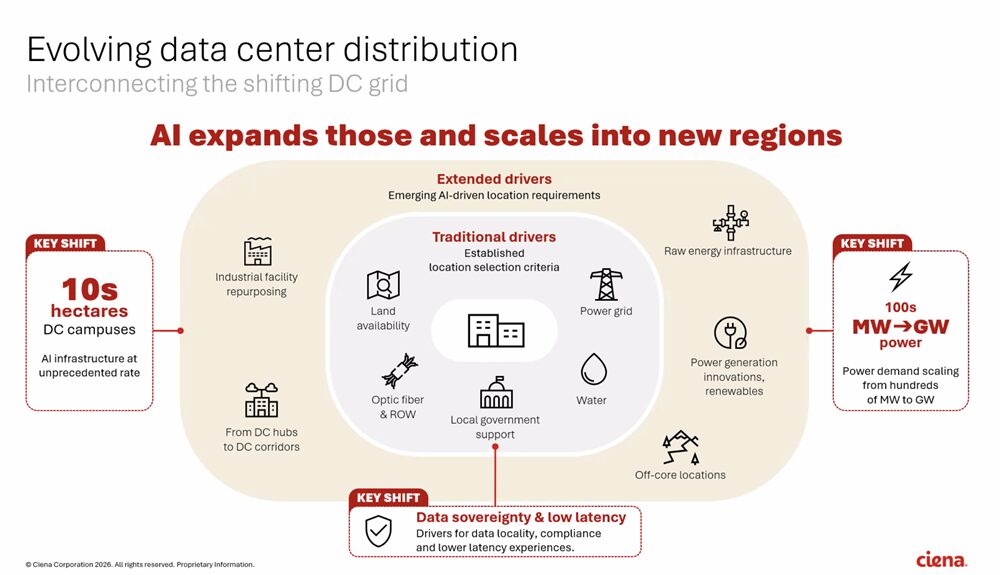
The company identified three main sources of demand: investments by hyperscale and AI-focused cloud providers, the increasing geographic distribution of data centers, and the adoption of AI by enterprises.
Ciena said AWS, Alphabet, Meta, and Microsoft are expected to invest a combined $600 billion in new data centers in 2026. When spending by “neoscalers,” or smaller cloud providers specializing in AI computing, is included, total AI infrastructure investment could exceed $1 trillion.
These investments will require network providers to connect large data centers used for training and running AI models, as well as link more distributed computing facilities. Smaller AI cloud providers may also need flexible bandwidth and managed connectivity services as their operations expand.
The physical requirements of AI data centers, including access to land, power, and water, are also pushing facilities farther from major urban centers. Data sovereignty rules and the need to reduce latency are meanwhile encouraging companies to establish more facilities closer to their users.
Ciena said this trend is already visible in Southeast Asia, particularly in Indonesia, Malaysia, and the Philippines.
Enterprise AI adoption is adding another layer of demand. As companies deploy more inference workloads, existing networks can become bottlenecks in moving data between users, cloud platforms, and computing facilities.
Alex Wong, Ciena regional managing director for Asean, Hong Kong, and Taiwan, said Southeast Asia has the land, power, water, fiber infrastructure, and cross-border links needed to support AI. He also cited continuing investments and a developing regulatory environment.
The Philippines could benefit from several submarine cable systems expected to land in the country, strengthening its links to regional and global data centers.
Ciena said it is working with local telecommunications companies PLDT, Globe, and Converge to develop networks capable of supporting hyperscale investments. Additional data centers are also being constructed in the country to meet anticipated AI demand.
However, Wong said telecommunications companies must recognize that AI applications impose different requirements from conventional internet traffic.
“AI workloads are much more dynamic, much more sensitive to latency, and the infrastructure is becoming more distributed, so operators have to think beyond simply adding more bandwidth,” Wong said.
“An AI operator is one that can deliver more than basic connectivity. They can provide high-performance networks that can move huge volumes of data quickly, reliably, and predictably between the distributor and compute locations. That is what separates an AI-ready network from a traditional one,” he added.