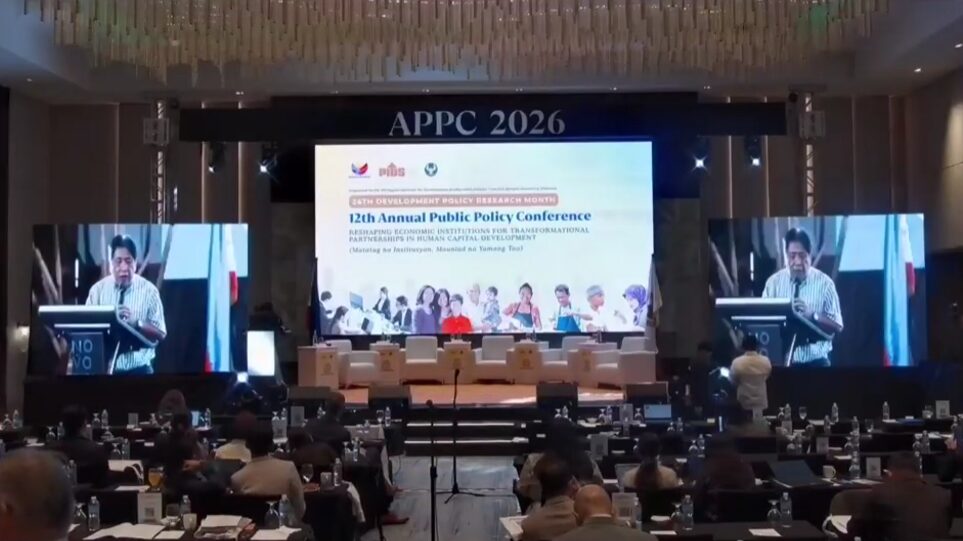
The Philippines needs to rethink its workforce strategy as artificial intelligence (AI) threatens occupations that the country has traditionally invested in while skilled Filipino workers continue to seek better opportunities abroad, economists and education experts said.
Brookings Institution non-resident senior fellow Elizabeth King said the country faces a potential mismatch between the jobs it has been developing and occupations increasingly exposed to AI and automation.
“The jobs that are most vulnerable to artificial intelligence are exactly the jobs we have been investing in, which [are] clerical support jobs,” King said during the 12th Annual Public Policy Conference (APPC) on Sept. 17.
The 12th APPC was the culminating activity of Development Policy Research Month led by the Philippine Institute for Development Studies.
The issue is particularly significant for the Philippines, where clerical and administrative work forms part of the employment base supporting the country’s services and business process outsourcing sectors.
King said technological disruption is compounded by unequal access to digital infrastructure. Nearly 19 million Filipinos, or about 17% of the population, cannot afford a minimum internet package, while adoption of AI and other technologies varies substantially across regions.
She said the country also faces a capacity problem in producing workers equipped with the basic cognitive abilities needed to work alongside AI rather than be displaced by it.
“It may be the capacity to generate enough workers with foundational cognitive skills required to complement AI,” King said.
Preparing workers for an AI-driven economy, however, cannot begin only when they enter school or the labor market, she said.
King pointed to nutrition and cognitive development during the first 1,000 days of life as critical to the capabilities of children who will eventually enter the workforce.
“Stunting delays entry to school. It hurts achievement in school, completion [of] basic education, and so forth and so on,” she said.
Investments in nutrition, healthcare, and early cognitive development could therefore affect the quality of the Philippine workforce entering the labor market around 2040.
University of the Philippines School of Economics associate professor Renato Reside Jr. said the workforce problem is also tied to the Philippines’ longstanding difficulty in retaining skilled workers and creating enough well-paying domestic opportunities for them.
“I think it is time for the Philippines to take a hard look at, as Dr. King would say, implementation,” Reside said.
He said better implementation of economic policies could have helped the country retain more workers, accelerate growth, and address persistent problems such as labor migration and low real wages.
The Philippines will likely continue relying on remittances in the near term, Reside said, but reducing that dependence will require structural changes that create more productive and higher-paying jobs domestically.
“Fix the budget process, realign away from wasteful spending to productive spending,” he said.
Reside cited manufacturing, the electric vehicle industry, and increased domestic processing of mineral resources as areas that could generate productive employment and improve competitiveness.
Philippine Business for Education executive director Hanibal Camua said reforms should also examine how the education system is governed and whether schools have sufficient authority to respond to local requirements.
“We need to discuss and further flesh out that issue on the decentralization of education,” Camua said, noting that the country’s basic education system covers roughly 47,000 public schools.
“The main question is, why aren’t we decentralizing?” he said.
Greater local capacity could allow schools and education authorities to respond more closely to differences in economic conditions, community requirements, and local labor markets.
Asian Development Bank director Eisuke Tajima, meanwhile, said spending on education, healthcare, and other social sectors should not be viewed separately from economic policy.
“One of the things I would like to really highlight at this conference is that the social sector policy and operation must be viewed as an economic growth strategy, part of it,” Tajima said.
He said policymakers need to break down institutional silos and connect education more closely with demand from employers.
“The Philippines needs good healthcare for healthy workers… and the education sector really needs to respond to the private sector demands,” Tajima said.
SHIFT Consulting president and Asian Institute of Management adjunct faculty Richard Anthony Cruz said the underlying issue is whether investments in human capital are actually producing the intended results.
“You invest the capital, but did it really result in the outcome that we’re looking for?” Cruz said.
He described this as a “conversion problem,” arguing that the Philippines needs to identify areas where it has a competitive advantage and coordinate government, industry associations, and businesses around specific opportunities.
“Hopefully it’s a whole-of-country approach, meaning that we have private sector, we have industry associations, we have government focused on very specific opportunities,” he said.
Cruz said the same approach is needed to improve Philippine performance in international education assessments such as the Program for International Student Assessment (PISA).
“If we’re really serious about moving the needle on PISA outcomes, we need to have a whole conference just on that 10-year plan, because it should be a whole-of-country approach, not just a DepEd approach,” Cruz said.