Digital banking and mobile wallets are becoming common channels for international money transfers among Filipinos, but high fees and security concerns continue to affect adoption, according to Visa’s Money Travels 2026 report.
The study found that 45% of Filipino respondents received money from overseas in the past 12 months, the highest proportion among six Asia-Pacific markets surveyed.
About 72% of respondents said they send or receive money internationally several times a year, while 35% do so at least monthly.
Remittances primarily support household expenses, with 34% citing daily necessities as a reason for international transfers. Other reasons included family obligations (33%), holiday gifts (30%), and emergency expenses (25%).
The United States accounted for 36% of inbound remittance activity reported by respondents, followed by Canada at 13%, Australia at 9%, Saudi Arabia at 8%, and Japan at 7%.
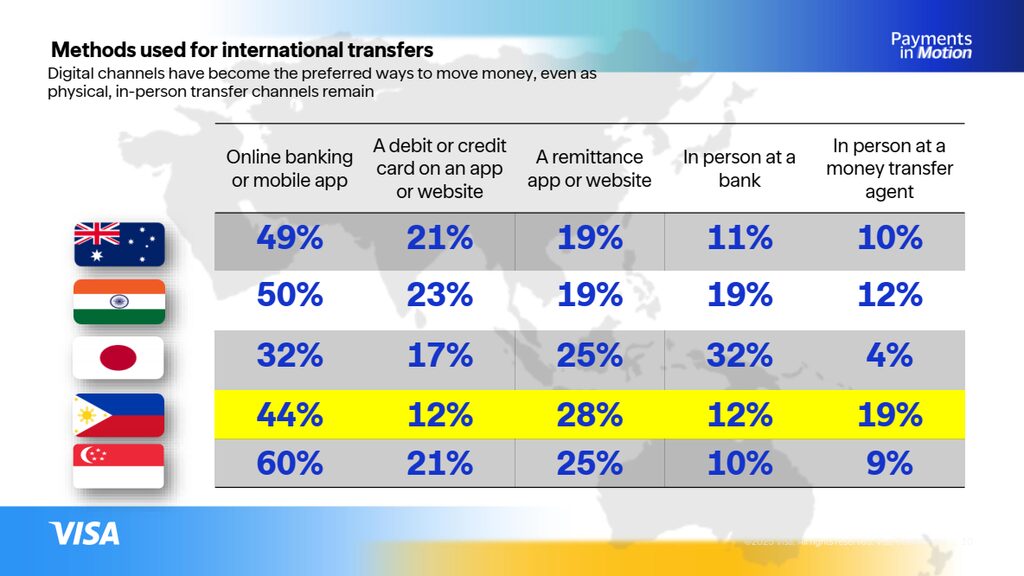
Online banking and bank mobile apps were the most commonly used channels, accounting for 44% of reported transfers.
Mobile wallets and remittance apps each accounted for 28%, while 19% of respondents used physical money transfer agents or stores.
Speed was a key factor in choosing digital services. Among mobile wallet users, 44% reported near-instant access to transferred funds, compared with 31% of those using direct bank transfers and 18% of those making in-person transactions.
However, 37% cited high fees as a problem with digital transfers. Technical difficulties and exchange rate issues were each reported by 15% of respondents.
The report also found that awareness of stablecoins is growing in the Philippines, although actual use remains limited.
Stablecoins are cryptocurrencies designed to maintain a relatively stable value against an asset such as the US dollar.
About 42% of Filipino respondents said they had heard of stablecoins, but only 2% of remittance users had used them.
Trust levels remained significantly lower for stablecoin transfers than for conventional methods. Only 38% expressed trust in stablecoin transfers, compared with 81% for cash remittances and 79% for digital remittances.
Another 79% said they wanted more education on how stablecoins work.
Visa is expanding its money movement services through Visa Direct and developing stablecoin-based payment capabilities to address delays in conventional cross-border transfers.
Visa Direct allows banks, fintech firms, and businesses to send funds to cards, bank accounts, and digital wallets across more than 195 countries and territories. The service supports over 150 currencies and 18 billion endpoints worldwide, according to the company.
Visa is also developing a system that would allow businesses to use stablecoins instead of traditional currencies to pre-fund Visa Direct payouts. The company said the approach could make funds available within minutes rather than days.
Other initiatives include near-instant stablecoin payouts for consumers, freelancers, and content creators, as well as seven-day settlement capabilities for banks and fintech firms.
Visa launched stablecoin settlement in the United States in 2025 after earlier pilot programs. The company has not specified a rollout schedule for the Philippines.
Visa Philippines country manager Jeffrey Navarro said the company would continue working with regulators, banks, and fintech partners to improve the speed, security, and accessibility of money transfers.
The study, conducted by Morning Consult, surveyed more than 45,000 respondents across 20 markets, including 3,101 adults in the Philippines.