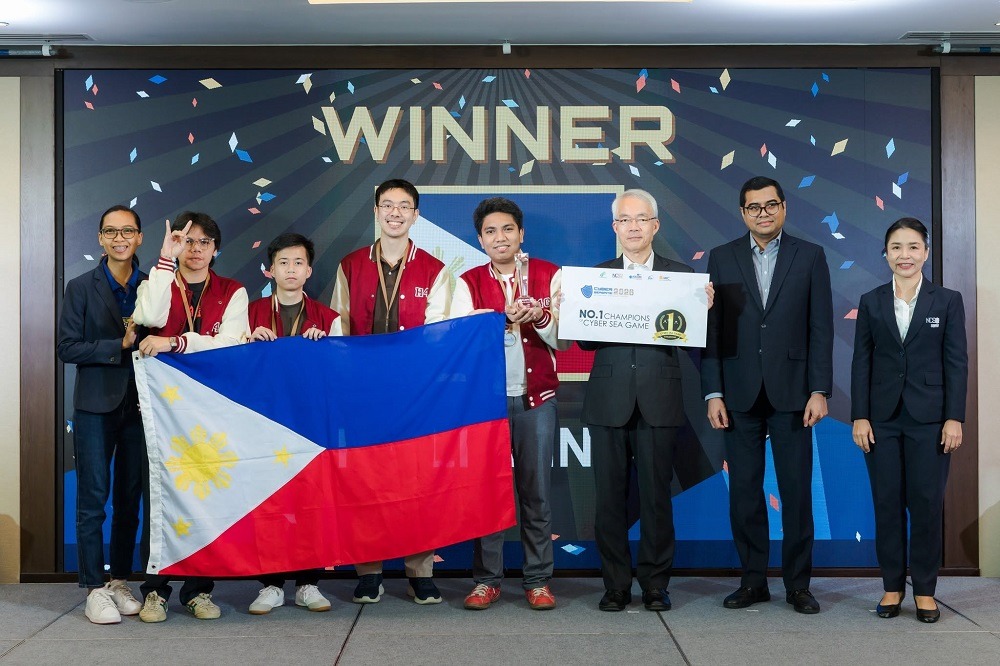
A four-member Philippine team won the 2026 Cyber SEA Game, a regional cybersecurity competition for students and young engineers from Asean member states, beating eight other national teams in the two-day event held on Oct. 26–27 in Bangkok, Thailand.
The results were announced on Oct. 27 during the reception of the Asean-Japan Cybersecurity Policy Meeting at Crowne Plaza Bangkok Lumpini Park.
Singapore finished as first runner-up, while Malaysia placed second runner-up. The competition brought together 36 participants from nine national teams.
The Philippine team comprised Audre D. Montero of the University of the Cordilleras in Baguio City; Justin Clark H. Ong of Asia Pacific College in Makati City; Jiandale Ambal of Mindanao State University–Iligan Institute of Technology; and Glenn Gabriel C. Castillejo of the University of Perpetual Help System Laguna–Cauayan Campus in Isabela.
They were accompanied by Rhean Joy B. Acupido, assistant school director of the University of Perpetual Help System in Cauayan.
The Department of Information and Communications Technology (DICT) identified the team members through its annual HackForGov Capture-the-Flag competition, drawing from participants who excelled in national and regional contests.
Ong, the team leader, was selected after his performance in HackForGov 2025, where his team won the national championship and he received the Top Performing Individual award for achieving the highest individual score.
Ambal was part of the Region X champion team in the HackForGov 2026 regional competitions and was named its Top Performing Individual.
Montero received the same individual recognition in the Cordillera Administrative Region, while Castillejo was part of the Region II champion team and also earned the individual award.
The Cyber SEA Game uses a “Capture the Flag” format, in which participants solve technical challenges in cybersecurity disciplines such as reverse engineering, binary exploitation, web security, cryptography, and digital forensics.
The competition was organized by the Asean-Japan Cybersecurity Capacity Building Centre with support from the Japanese government.
Angel S. Averia Jr, president of the Philippine Computer Emergency Response Team (PhCERT) and national chairperson of the National Citizens’ Movement for Free Elections (Namfrel), welcomed the Philippine team’s victory, saying it demonstrated that cybersecurity talent exists beyond Metro Manila.
“I am delighted that Team Philippines captured first place in this year’s Cyber SEA Game,” Averia said.
“This victory proves that our country has young, rising talent in cybersecurity, and not only in Metro Manila but in Baguio, Isabela, and Mindanao,” he said.
Averia said cybersecurity depends not only on laws and technology but also on people capable of protecting critical systems and personal data.
“Laws can require us to protect our critical systems and personal data, and technology can give us the tools, but public trust ultimately rests on people with the skill and integrity to defend them.
“That is why PhCERT, the National Association of Data Protection Officers of the Philippines (Nadpop), and Namfrel partner with schools. Giving students real problems to solve is one of the ways we can help nurture that talent.”
Ong, a recent Asia Pacific College graduate, previously helped develop data analytics tools and dashboards for Namfrel during the 2025 national and local elections. The tools supported the group’s election-monitoring activities.
Averia urged government agencies to provide more support for cybersecurity education and training.
“We call on the relevant government agencies to support our state universities and colleges and our private academic institutions in developing the cybersecurity capabilities the country very much needs as we face growing challenges in the cyber domain.”
The DICT, through its National Computer Emergency Response Team under the Cybersecurity Bureau, uses HackForGov to identify and develop cybersecurity talent from academic institutions nationwide.
Launched in 2019, the initiative provides students with hands-on technical challenges and opportunities to compete at different levels.