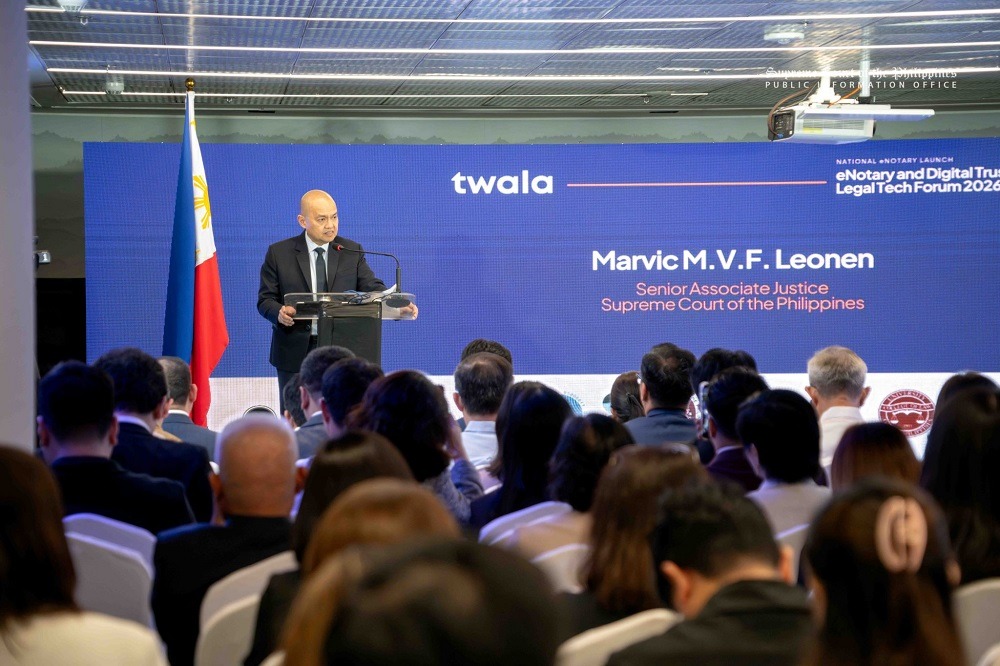
Supreme Court (SC) senior associate justice Marvic Leonen has warned that digitalization alone cannot make justice accessible, saying legal aid and efforts to help marginalized communities assert their rights must accompany technology-driven reforms.
“Faster and more convenient services do not by themselves make justice accessible…[l]egal aid is essential. Alone, however, it cannot correct the inequalities that keep marginalized communities from asserting their rights,” Leonen said during the “eNotary and Digital Trust: Twala Legal Tech Forum 2026” on Oct. 19 in Taguig City.
Leonen, who chairs the SC committees on Access to Justice and Underserved Areas and Human-Centered Augmented Intelligence in the Judiciary, said technology can reduce barriers caused by geography and poverty by allowing litigants to attend hearings remotely, file pleadings electronically, and have documents notarized without missing work.
He cited the Remote Hearing and Equal Access to Law and Justice (REAL Justice) Program launched in Tawi-Tawi in 2024.
Satellite Internet connectivity enabled videoconferencing for court proceedings, allowing litigants and witnesses in remote communities to avoid costly and time-consuming travel.
Leonen said the judiciary’s Strategic Plan for Judicial Innovations 2022-2027 identifies access to justice as a key outcome, but the obligation to improve access will continue after the plan ends.
“Access to justice is an outcome of [the SPJI]. We are almost done, alongside efficiency and innovation. The plan ends in 2027. The obligation it names does not,” he said.
He also cited two reforms aimed at expanding legal assistance and supporting community-level efforts to address inequality.
The Unified Legal Assistance Service (ULAS) Rules, which took effect in 2025, require covered lawyers to provide legal aid.
The Rules on Institutionalizing Support for Developmental and Social Change Lawyering, meanwhile, recognize the work of lawyers and organizations serving marginalized communities, advancing human rights, and pursuing reforms addressing the roots of inequality.
Leonen said legal aid helps people obtain representation, while developmental and social change lawyering supports longer-term efforts to help communities understand and defend their rights.
He also discussed the nationwide rollout of electronic notarization, which began on Oct. 19.
The SC signed joint memorandum circulars with the Land Registration Authority and the Securities and Exchange Commission establishing guidelines for accepting and processing electronically notarized documents before the two agencies.
The measures are intended to make notarization more accessible while maintaining the integrity of electronic transactions.
The forum, organized by Filipino legal technology company Twala, brought together representatives from the judiciary, government, the legal profession, academe, and the technology sector to discuss electronic notarization and digital trust.
Leonen said the judiciary would adopt technology subject to governance rules and constitutional safeguards, particularly as artificial intelligence becomes more widely used in legal work.
“The judiciary will not merely adopt technology. Within our sphere of influence, we will govern it,” he said.
He stressed that AI should assist judges and court personnel rather than replace human decision-making.
“No machine will sit on our Bench because no machine can give those reasons and answer for them. No machine can take the same oath that we took under our Constitution,” Leonen said.
He said judicial decisions require reasoned explanations grounded in facts and law, with judges remaining accountable for their rulings.
Leonen also pointed to the need for cooperation among institutions to build public trust in digital systems, citing partnerships between Twala and the University of the Philippines College of Law and the Integrated Bar of the Philippines.
Looking ahead, he said the judiciary aims to expand remote filing, identify court congestion more proactively, and make judicial decisions available in Philippine languages.
“Digital transformation is measured in people… For them, digital justice means a case filed promptly, heard without needless delay, and decided fairly,” Leonen said.