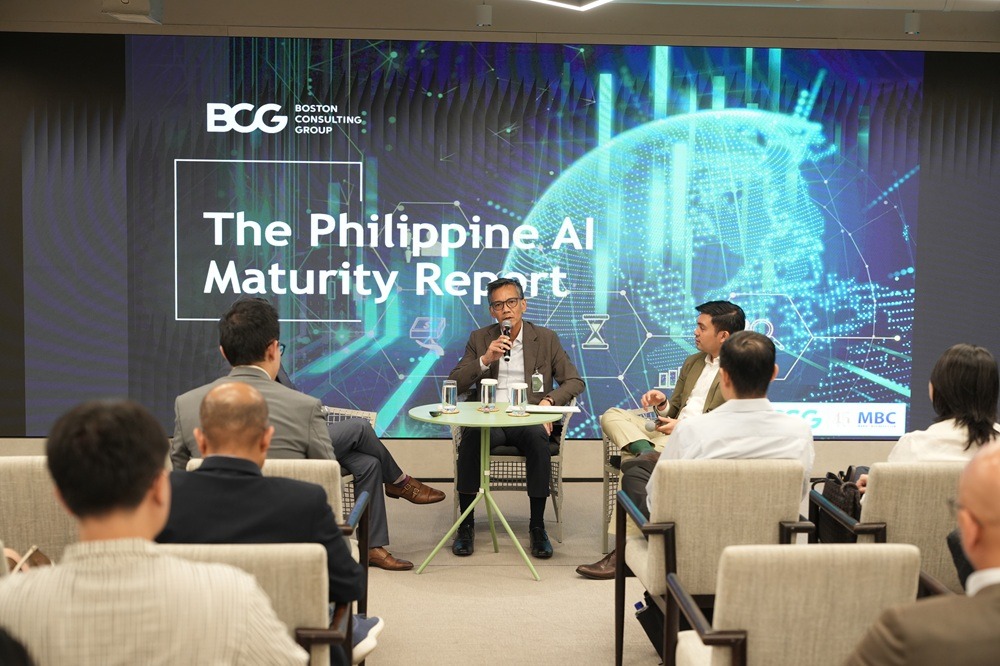
Philippine companies are approximately two years behind the global average in artificial intelligence (AI) maturity, with most businesses struggling to translate their investments in the technology into measurable business results, according to a new study by Boston Consulting Group (BCG) and Makati Business Club (MBC).
The Philippine AI Maturity Report, released on Nov. 11, found that 60% of surveyed companies remain in the “Stagnating” or “Emerging” stages of AI maturity, while none have reached the highest classification, known as “Future-built.”
Despite the current gap, 54% of the companies expect to achieve Future-built status by 2029, a target that would require them to improve their AI maturity at 2.5 times the recent pace of improvement in the global average.
The study covered 35 large Philippine companies across 12 industries and used the framework of BCG’s 2026 global Applied AI Index, which assessed more than 1,330 organizations across over 60 countries.
It found that the Philippines’ average AI maturity in 2026 was closer to the global average recorded in 2024 than to current international levels.
“Philippine business leaders are recognizing the potential of AI, as seen through their ambitious AI targets. The gap is in turning this ambition into real business value,” said Julian Cua, managing director and partner at BCG Manila and one of the report’s co-authors.
“The critical question is no longer whether AI is coming, but what companies choose to do with it now that it is here.”
The report found that Philippine companies have made more progress in establishing the technological and organizational foundations for AI than in generating actual business outcomes.
The four AI-enabling capabilities — technology, data, people, and operating model — registered an average score of 46, compared with 37 for business outcomes covering innovation, customer experience, and operations.
Customer-facing applications were among the least mature areas, particularly agentic AI, AI-powered pricing, marketing personalization, and customer journey management.
The study also identified a significant gap between companies leading in AI adoption and those falling behind.
The 10 highest-performing companies outscored the bottom 10 across all capability areas, with the largest differences recorded in operating models at 46 points, people capabilities at 40 points, and technology at 38 points.
Among the leading companies, 80% reported having live AI deployments in IT and data workflows, compared with only 20% among the lowest-performing firms.
Companies with higher AI maturity also allocated an average of 13.4% of their IT budgets to AI, compared with 7.7% among less mature organizations.
However, the report suggested that overall technology spending was not the primary obstacle.
Philippine companies spend an average of 3.1% of their revenue on foundational IT, compared with 2.6% globally and 3.7% among Southeast Asian peers.
The findings suggest that differences in AI maturity are linked more closely to how companies organize their operations and direct their technology investments than to overall IT spending.
The report identified three major obstacles to wider AI adoption: outdated technology systems, shortages of skilled workers, and the relatively high cost of AI compared with local labor expenses.
Although 74% of Philippine enterprises have migrated all or most of their IT infrastructure to the cloud, 49% continue to identify legacy systems as a major barrier to digital transformation.
Demand for AI skills has also increased sharply, with Philippine job postings requiring such capabilities rising more than sixfold between 2021 and 2025.
Despite this growth, only 17% of organizations said they could recruit and retain enough workers with AI expertise.
The report also noted that Philippine businesses generally pay prices for AI technology comparable to those in global markets, despite operating in an economy with substantially lower labor costs.
BCG and MBC warned that the country’s slow progress in AI maturity could have implications for industries that depend heavily on labor-cost competitiveness, particularly information technology and business process management (IT-BPM).
The report noted that overseas Filipino worker remittances and IT-BPM export revenues together account for roughly 17% of Philippine gross domestic product.
It outlined two possible scenarios: AI could automate tasks currently performed by Filipino workers, potentially weakening the country’s cost advantage, or it could improve workers’ capabilities and allow Philippine businesses to compete on higher-value services.
Based on the survey findings, the report assessed Philippine companies as being closer to the first scenario.
“Factors such as a young, digitally engaged population, a world-class service workforce, and a business sector eager to innovate provide our country with the potential to create an AI-enabled economy,” said MBC executive director Julia Abad.
“However, we face the challenge of transforming this potential into sustained business outcomes. We must take our ambition to establish an AI-ready country.”
To narrow the gap, the report recommended that companies establish multiyear AI strategies tied to specific business outcomes, prioritize workforce training, strengthen their technology and data infrastructure, and monitor the returns generated by AI investments.
It also called for closer coordination between government and businesses to address fragmented data systems, develop and retain advanced AI talent, and manage the cost of deploying AI at scale.
BCG said that, based on its experience, 70% of the value generated by AI comes from changes involving people, organizational structures, and business processes rather than technology alone.