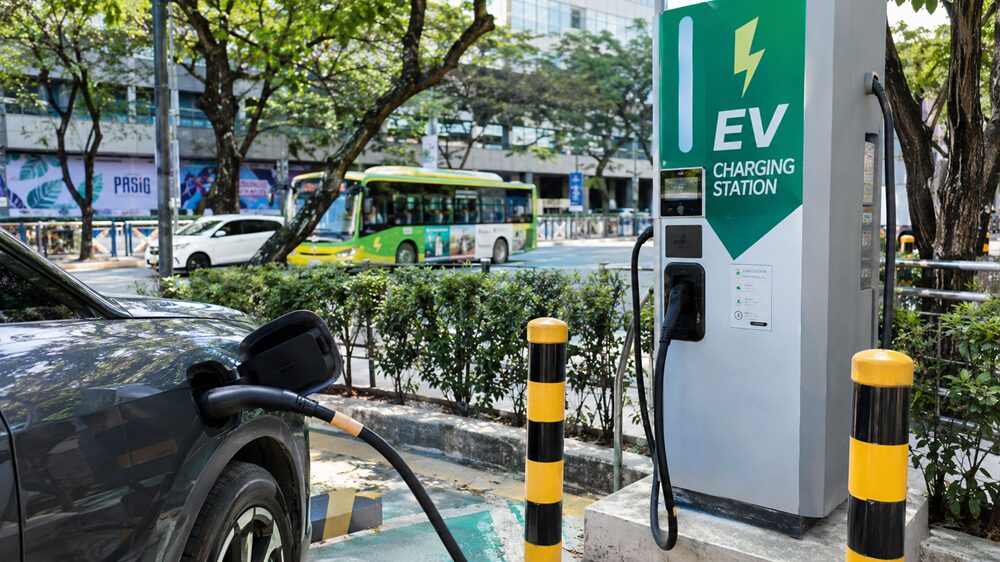
Local government officials from Pasig, Mandaluyong, and Bacolod have called for faster permitting procedures and clearer national guidelines for electric vehicle (EV) charging stations, citing regulatory bottlenecks and land constraints that could slow down the adoption of electric mobility.
Speaking at the Asean EV Conference 2026 held on Nov. 11-12 in Makati City, representatives of the three cities discussed their respective EV initiatives, including electric public transport procurement, route planning, and the integration of charging infrastructure into local development regulations.
The Department of Energy (DOE), meanwhile, said it is coordinating with the Department of the Interior and Local Government (DILG), Department of Public Works and Highways (DPWH), and Anti-Red Tape Authority (ARTA) on a joint memorandum circular intended to simplify the permitting process for EV charging stations.
DOE EV Industry Management Division chief Andresito Ulgado said the proposed circular “aims to simplify the permitting requirements through a harmonized whole government approach, reduce administrative bottlenecks, and accelerate the deployment of EV charging infrastructure.”
The initiative seeks to address overlapping requirements and administrative procedures that local governments and private developers encounter when installing and operating charging facilities.
In Pasig City, transportation officials said the shift to electric mobility is being guided by the city’s local public transport plan rather than vehicle procurement targets alone.
“In Pasig City, we didn’t start with counting how many electric vehicles we should procure. We start with planning,” said Jhon Rhandy Cabanes, officer-in-charge of the Pasig City Transportation Development and Management Office.
With the city’s local public transport plan already approved and adopted by the city council, Cabanes said officials have identified the number of conventional public transport vehicles that would eventually need to be replaced with electric units.
“We already have numbers in our head: how many public transportation fleets do we need to convert from traditional to electric vehicles,” he said.
Pasig has acquired five electric buses as part of its efforts to encourage commuters to shift from private vehicles to public transportation.
“A percentage of those [electric bus] ridership is shifting from at least one trip of their life from using private vehicles to public transportation, and for us that’s a very big win,” Cabanes said.
He identified land availability, right-of-way restrictions, and permitting requirements as continuing challenges to expanding the city’s charging infrastructure.
Although Pasig has established a one-stop shop to accelerate permit processing, Cabanes said closer coordination with national agencies is needed to eliminate duplicative requirements.
The city is also drafting a policy that would encourage private developers to install EV charging facilities.
“We’re trying to incentivize putting up charging stations in our city, because we want to find a way to circumvent the right-of-way issues,” he said.
Charging infrastructure provisions are also being considered for new government buildings and township developments.
In Bacolod City, local officials are taking a route-based approach to electric public transportation.
“We are gradually integrating electric mobility into our transport systems,” said Mariam Ruth Arcolas of the Bacolod City Planning and Development Office.
The city has identified two proposed green transport routes and conducted trial operations using electric jeepneys.
“We have identified two developmental green routes,” Arcolas said. “We used three to four electric jeepneys for four to five days, and that’s how we gradually integrate electric mobility.”
She said incorporating EV initiatives into existing local development plans has been relatively manageable with assistance from nongovernment organizations and national government agencies.
However, she emphasized the need to involve commuters, transport operators, and other stakeholders in the transition.
“Public awareness is very important. For example, our constituents, commuters, traffic and transport operators, we need to involve them,” Arcolas said.
Mandaluyong City, meanwhile, has incorporated EV-related provisions into its land use and green building regulations.
Abraham Raposon Jr., chief of the Green Building Division of the Mandaluyong City Planning and Development Department, said the city’s regulations require new developments to integrate charging facilities into their buildings.
“We have already integrated it into the comprehensive land use plan of 2017 to 2032, as well as the city development plan that integrates this provision of electric vehicles,” Raposon said.
Mandaluyong has also procured 30 electric tricycles for barangay use, while additional EV units donated by the DOE are being used to transport schoolchildren and senior citizens.
The discussions highlighted the role of local governments in implementing the country’s EV policies, particularly in identifying suitable transport routes, allocating space for charging facilities, and establishing local regulations.
The session on policy, governance, and social readiness was organized by Clean Air Asia through the e-mobility ASAP Project.
The two-day Asean EV Conference, themed “Driving Asean Forward,” was organized by the Electric Vehicle Association of the Philippines, DOE, Meralco, Meralco Power Academy, and Clean Air Asia’s e-mobility ASAP Project.
The event took place during the Philippines’ 2026 Asean chairship, following the Philippine EV Summit held on Oct. 22-24.