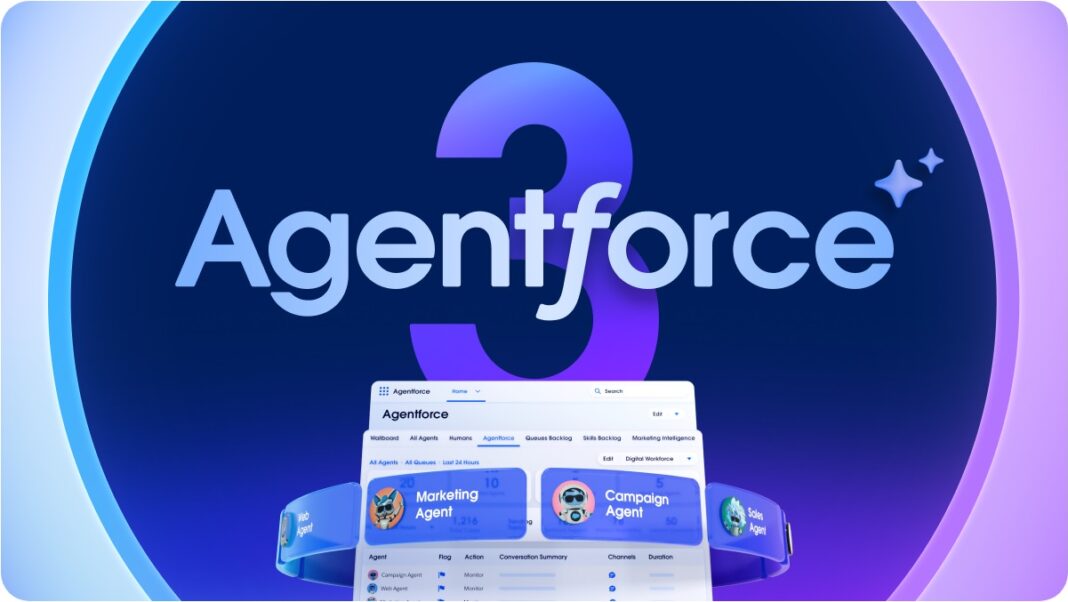
Cloud computing firm Salesforce has announced Agentforce 3, a major upgrade to its digital labor platform that gives companies the visibility and control to scale AI agents without compromise.
As enterprise adoption accelerates, the real blocker has become clear: teams can’t see what agents are doing — or evolve them fast enough. Agentforce 3 changes that.
Built on learnings from thousands of Agentforce deployments since its initial launch in October 2024, Agentforce has helped customers deliver undeniable value.
With a new Command Center for complete observability, built-in support for Model Context Protocol (MCP) for plug-and-play interoperability, and over 100 new prebuilt industry actions to speed time to value, Agentforce 3 helps companies scale what works, fix what doesn’t, and unlock the full potential of agentic AI.
According to a soon to be released Slack Workflow Index, AI agent usage is up 233% in six months, and over that same period, 8,000 customers have signed up to deploy Agentforce.
But until now, agent platforms have lacked the tooling, governance, and observability needed to scale enterprise-wide. Agentforce 3 closes this gap — delivering the complete visibility, secure tool integration, and enterprise-grade controls organizations need to make agent velocity their competitive advantage.
“With Agentforce, we’ve unified agents, data, apps, and metadata to create a digital labor platform, helping thousands of companies realize the promise of agentic AI today,” said Adam Evans, EVP & GM of Salesforce AI.
“Over the past several months we’ve listened deeply to our customers and continued our rapid pace of technology innovation. The result is Agentforce 3, a major leap forward for our platform that brings greater intelligence, higher performance, and more trust and accountability to every Agentforce deployment.”
As AI agents take on routine tasks and begin collaborating more closely with human teammates, teams need a new observability layer built for the era of digital labor.
Agentforce Command Center is that layer: a complete observability solution that gives leaders a unified pane of glass to monitor agent health, measure performance, and optimize outcomes.
Built into Agentforce Studio, it completes the agent lifecycle with powerful tools to understand and refine agents at scale.
- Uncover patterns across interactions to optimize your agents: Command Center empowers teams to analyze every AI agent interaction, drill into specific moments, understand trends in usage, and see AI-powered recommendations for tagged conversation types to continuously improve your Agentforce.
- Track agent health and intervene in real time: Get live, detailed analytics for latency, escalation frequency, and error rates, plus real-time alerts when the unexpected happens, so teams can act fast and keep agents running smoothly.
- Understand what’s working, and where to improve: Command Center offers detailed dashboards that track agent adoption, feedback, success rates, cost, and topic performance — so teams can see what’s gaining traction and where to improve.
- See what your agents are doing — in the tools your teams already use: Agentforce captures all agent activity in a native, extensible session-tracing data model in Data Cloud — powering analytics, monitoring, and real-time alerting. Built on the OpenTelemetry standard, these agent signals integrate seamlessly with tools your teams already use, including Datadog, Splunk, Wayfound, and other monitoring partners for end-to-end visibility across your existing stack.
- Deliver a configurable Command Center for every team: Monitor AI agents alongside human teammates — right in the flow of work. Starting with Service Cloud, agent activity will surface in real-time wallboards so contact center supervisors can track performance and escalate fast. And over time, every department will have a Command Center purpose-built for optimizing their agents.
- Build and test agents fast with AI-assisted development tools: In Agentforce Studio, use natural language to generate topics, instructions, and test cases. Testing Center simulates behavior at scale with state injection and AI-driven evals — so you can pressure-test your agents before going live.