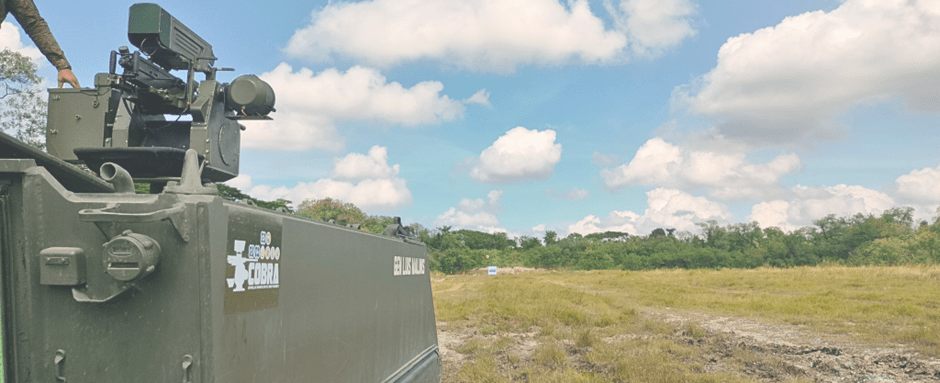
The Department of Science and Technology (DOST) has formally turned over the locally developed Controller Operated Battle Ready Armament (Cobra) system to the Department of National Defense (DND) and the Philippine Army.
This development, the government said, marks a milestone in the country’s push for self-reliant defense and opening new opportunities for domestic manufacturing and technology firms.
The turnover ceremony was held at Camp O’Donnell in Capas, Tarlac, following a two-year research and development partnership jointly funded by DOST and DND.
The project received ₱24 million in funding from DOST and an additional ₱5 million counterpart support from the Philippine Army.
DOST secretary Renato U. Solidum Jr. said the Cobra project demonstrates the country’s growing capacity to design and engineer mission-critical defense technologies using local expertise.
“A secure and sovereign Philippines requires a strong foundation in science, technology, and innovation,” Solidum said, adding that the system reflects the government’s long-term vision for strengthening national defense capabilities.
Developed with an emphasis on local sourcing, the Cobra system is expected to create opportunities for Philippine firms involved in fabrication, machining, electronics, optics, software integration, and maintenance.
DOST officials said the design allows for easier upkeep and faster repairs, positioning local manufacturers to play a key role should the system move to mass production.
DOST–Metal Industry Research and Development Center (MIRDC) prototyping division chief and project leader Rodnel Tamayo said the system was intentionally built around materials and components available in the local market.
“Most of the materials are locally available. Soldiers can also maintain it, and repairs can be done faster because the parts are accessible,” he said.
Philippine Army commanding general Lt. Gen. Antonio G. Nafarrete said the Cobra system supports the Army’s land-centric defense thrust under the Comprehensive Archipelagic Defense Concept (CADC), which focuses on strengthening territorial defense.
Beyond military capability, Nafarrete emphasized the broader economic impact of local defense manufacturing.
“This is a big help to our economy. It creates jobs for skilled workers and supports local industries — one clear advantage of having a locally manufactured system,” he said.
DND undersecretary for defense technology research and industry development Rene Diaz said the project highlights the country’s progress toward a Self-Reliant Defense Posture (SRDP).
“This achievement shows that we have the skill, capacity, and drive to advance our SRDP journey. Science is a key driver of defense capability,” he said.

With the Philippine Army considering reproduction of the Cobra system, local companies may soon participate in full-scale manufacturing, subject to licensing and certification requirements.
Officials said the successful turnover signals the readiness of Philippine industry to take on more advanced defense projects and meet international standards.