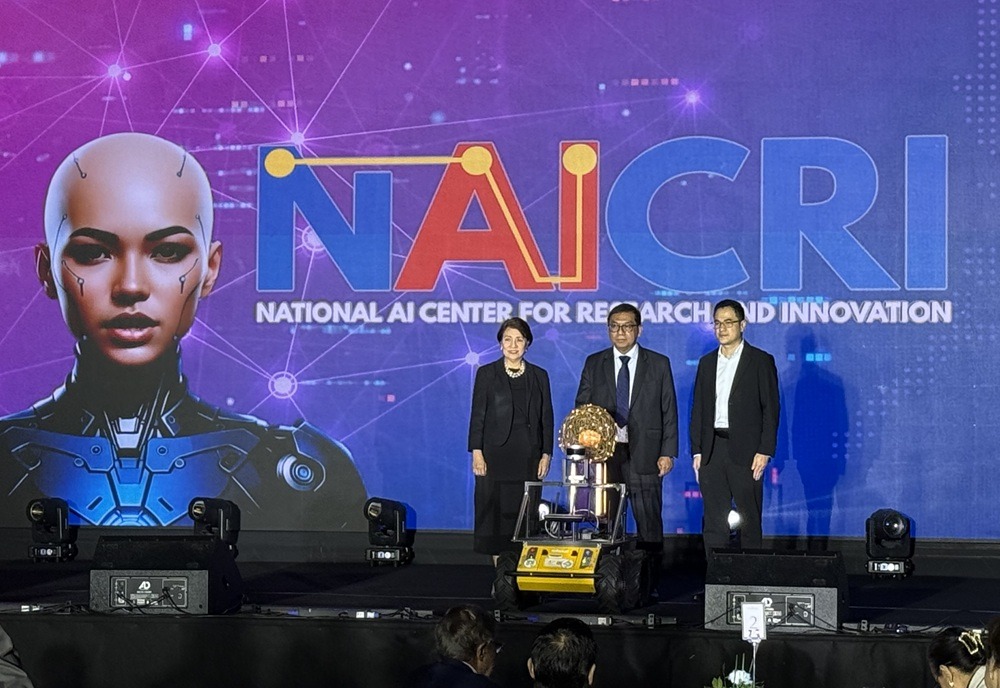
The Department of Science and Technology (DOST) has formally launched the National Artificial Intelligence Center for Research and Innovation (NAICRI), positioning it as the institutional backbone of the National AI Strategy for the Philippines (NAIS-PH) and consolidating years of government-led AI projects into a permanent national capability.
The launch, held at The Manila Hotel on Thursday, February 26, gathered senior officials, lawmakers, academe, industry leaders, and international partners for the ceremonial activation and live demonstrations of operational AI systems.
In his keynote address, DOST secretary Renato U. Solidum Jr. framed artificial intelligence as a defining development issue.
“AI is comparable with electricity and the Internet. It is reshaping how industries operate, how governments deliver services, and how nations compete. The question before every country is no longer whether AI will shape development. The question is, who will shape AI for development, and for whose benefit?” he said.
He added that the rise of generative AI has intensified the urgency of that question.
“What has changed in recent years is the scale and visibility of AI’s impact, driven largely by the emergence of generative AI. It has accelerated innovation and made it clear that the strategic question before every nation is no longer whether AI will shape development, but who will shape AI for development,” he said
Solidum said the Philippines enters the AI race with structural advantages, including “a young and digitally connected population, a growing innovation ecosystem, a dynamic services sector, and a clear commitment to digital transformation.”
However, he acknowledged uneven adoption.
“More than 80% of our establishments have basic digital infrastructure, but only 15% have adopted advanced AI technologies, and that adoption is concentrated in urban areas and larger firms,” he said. “We can’t discount awareness. It is institutional capacity, and it is unevenly distributed.”
He noted that past AI efforts were often project-based.
“Until now, AI efforts in the Philippines have been opportunistic, rather than orchestrated. We have had promising projects, capable researchers and reliable partners, but not the institution to align them.”
The country also faces structural constraints: limited advanced computing power, shortages of specialized AI talent, uneven regional adoption, and governance frameworks still catching up with technology.
“If these gaps are not addressed, they will constrain our ability to compete in an increasingly AI-driven global economy. But if they are addressed strategically, they become the very foundations of our next phase of national development. That is what NAICRI is for.”
Solidum described NAIS-PH as a “collaborative AI ecosystem” built on four interconnected layers.
“First, the AI factory — the physical infrastructure, the human capital, and the legal framework needed to power AI at national scale. Second, the AI refinery, where research, development, and innovation happen,” he said.
The refinery includes AI hubs, universities, startups, SMEs, and the private sector to ensure commercialization.
The third layer consists of cross-sector partnerships across government, industry, and international collaborators, while the fourth centers on the public and communities that AI must ultimately serve.
NAIS-PH assigns clear agency roles: DOST leads research and development; the Department of Information and Communications Technology (DICT) leads infrastructure; the Commission on Higher Education (CHED) and the Department of Education (DepEd) handle talent development; and the Department of Trade and Industry (DTI) drives commercialization.
“All of this is anchored in five desired outcomes. We call them the five S’s — sovereignty, security, safety, sustainability, and skills. These are not slogans. They are the standards against which every initiative under NAIS Philippines will be measured.”
Officials stressed that NAICRI builds on operational platforms rather than starting from scratch.
Among the systems showcased:
- COARE is DOST-ASTI’s high-performance computing facility, which powered COVID-19 response tools such as FASSSTER and other national dashboards. GPU utilization has increased 54% since 2020, with more than 100% growth in the past year alone.
- AI4RP (Project Gabay) is the country’s first live AI-based weather forecasting system in Southeast Asia, reducing forecast computation time from three hours to 15 minutes and extending lead times from two days to 14 days.
- Geospatial Analytics and Technology Solutions (GATES), which harmonizes datasets across disaster risk reduction, health, environmental monitoring, natural resources, infrastructure planning, and knowledge management to enable AI-driven analytics.
- NAIRA, the Nexus for AI Research and Applications, which includes DIMER (Democratized Intelligent Model Exchange Repository) for sharing AI models across agencies and an AI-powered natural language interface that allows users to query government data in Filipino, English, or Taglish.
Solidum emphasized that infrastructure and governance must go together.
“To scale AI responsibly, we need more than compute. We need data governance — policies and common standards for how data is accessed, used, and shared consistent with international standards.”
He added that governance is being embedded “by design, with access controls, traceability, and ethical standards built into our platforms from the start, not added as an afterthought. Governance is not an afterthought. It is an enabler.”
Regional and inclusive focus
Under NAICRI’s roadmap, DOST will conduct national surveys within 30 days to develop an AI compute country profile and roll out a training catalogue to help regions access shared computing facilities.
“National AI compute is not a luxury. It is infrastructure as essential as roads, ports, and power,” Solidum said, warning of a potential “computing divide” for countries with AI strategies but insufficient infrastructure.
He stressed that AI must drive inclusive growth.
“For AI to contribute meaningfully to national development, its benefits must extend beyond a few sectors and a few cities. AI must become a tool for regional development and inclusive growth, not a source of new regional divides.”
He underscored that development remains people-centered.
“Development is about people. The programs I have just described exist to serve Filipino communities, Filipino workers, and Filipino aspirations. That is the standard.”
Solidum closed by signaling the Philippines’ ambition to shape, not merely consume, advanced technologies.
“The Philippines will not be a passive consumer of advanced technologies. We intend to be a contributor to their development and a partner in shaping their global production.”
With NAICRI activated, he said, AI will be embedded in the country’s long-term development strategy.
“Artificial intelligence, guided by our values and aligned with our priorities, will be one of the key instruments through which we secure prosperity, resilience, and opportunity for present and future generations of Filipinos. Today is not the finish line. It is the starting line.”