E-commerce adoption in the Philippines has grown rapidly over the past decades, reshaping consumer expectations for digital services.
Twilio, a customer engagement platform, on Jan. 13 released a report examining digital patience among consumers in Asia Pacific and Japan (APJ), defining it as the time, goodwill, and attention users extend to a brand online before complaining or disengaging.
The study found Filipino consumers to be among the most digitally patient in the region, subject to specific service conditions.
Titled “Decoding Digital Patience: Are Asia Pacific’s Digital Users Losing Their Cool?”, the study surveyed more than 7,000 respondents across seven markets: the Philippines, Indonesia, Singapore, Japan, Hong Kong, India, and Australia.
Seventy-six percent of Filipino respondents described themselves as patient when dealing with digital or automated customer service, second only to Indonesia at 86% and above the APJ average of 68%.
Filipinos also reported the longest “willing-to-wait” period, expecting issue resolution within 27.3 minutes on average, compared with the APJ average of 24.4 minutes.
However, the report noted that Filipino patience depends on service quality and interaction design.
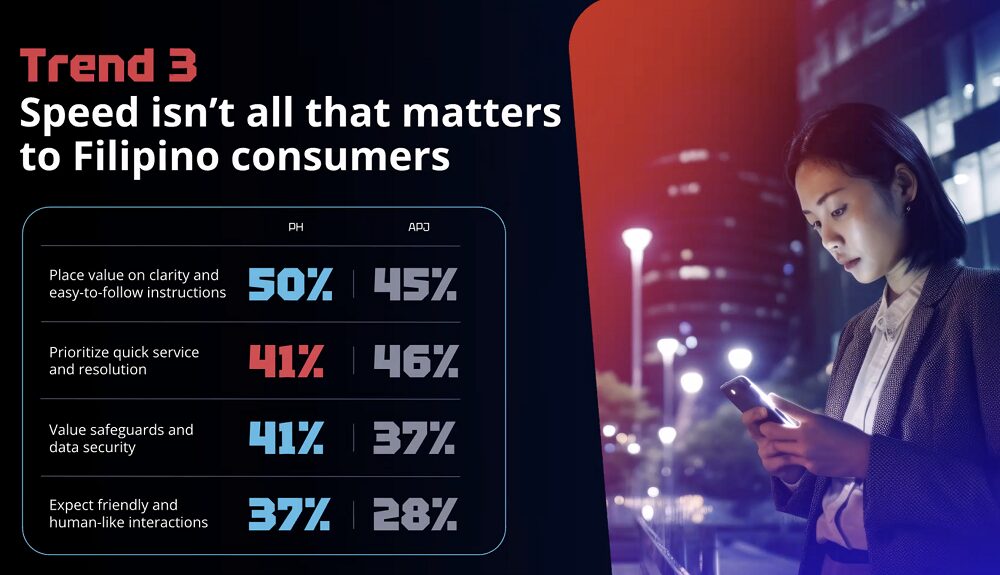
While 41% of Filipino respondents prioritized fast resolution, 50% said clear and easy-to-follow instructions were more important in sustaining patience. Security was cited by 41% of respondents, while 37% emphasized warm and friendly interactions.
Speaking during the report’s pre-launch virtual briefing, Twilio vice president for marketing in APJ Nicholas Kontopoulos said Filipino patience is shaped by both culture and system design.
“The Filipino consumer extends goodwill and patience, but this is not a free pass,” Kontopoulos said. “Their patience is rooted in culture and design and is sustained by interactions that are clear, transparent, and human.”
The report found that Filipinos not only reported the longest willingness to wait, but also experienced the longest actual resolution time, averaging 31.9 minutes, compared with the APJ average of 24.4 minutes.
Kontopoulos said service efficiency in the Philippines may have conditioned consumers to tolerate longer wait times. Markets known for higher service efficiency, such as Singapore and Hong Kong, recorded lower patience levels.
Industry type also influenced tolerance. Filipino consumers were more patient when dealing with sectors perceived as complex or high-stakes.
Eighty-one percent said they were patient during health-related interactions, such as follow-up questions after consultations.
Patience levels were lower in retail and financial services, with 73% reporting patience when requesting refunds, 72% when dealing with telco hardware issues, and 68% when disputing charges or unauthorized transactions with finance and insurance firms.
The report found that 81% of Filipino respondents had already interacted with AI-powered customer service systems.
However, patience levels declined when AI agents were involved. While 87% said they remained patient when chatting with a human agent and 85% when speaking with a human on the phone, only 72% said the same when interacting with AI chatbots.
During the briefing, Philippine Airlines vice president for customer experience Mark Anthony Munsayac said past experiences with poorly designed AI systems contributed to consumer frustration.
The report cited scripted responses (46%), generic answers (44%), and unresolved issues (41%) as the most common causes of dissatisfaction with AI-powered systems.
The findings showed a continued preference for human interaction. Forty-three percent of Filipino respondents preferred starting customer support with a human agent, compared with 23% who preferred automated systems.
Twilio said Filipino consumers view longer waits for capable human agents as preferable to faster but rigid AI interactions that may fail to resolve issues.
At the same time, respondents expressed openness to AI for low-risk tasks such as product recommendations, appointment bookings, and delivery updates. Seventy-five percent, however, said they expected a seamless transition to a human agent when needed.
“Don’t shun AI — use it wisely,” Kontopoulos said. “Start with low-stakes tasks.”
He added that emotionally charged situations, such as missed flights, still require human intervention supported by AI tools.
“If your AI lacks warmth and transparency, it’s just getting in the way,” he said.
Twilio commissioned YouGov to conduct the survey among 7,331 adults, including 1,007 respondents from the Philippines. Data collection ran from August to September 2025.