Despite high failure rates in scaling artificial intelligence (AI) initiatives, companies in Asia-Pacific (APAC) continue to ramp up investments, according to a new study by Accenture.
In its 2026 Pulse of Change survey, Accenture said 86% of executives plan to increase AI spending this year, even as many deployments struggle to move beyond pilot stages.
“Not even a third of the C-suite surveyed globally (32%) report having achieved sustained, enterprise-wide AI impact,” the firm said.
Accenture said AI projects often perform well in proof-of-concept tests but fail when integrated into core business processes, highlighting the gap between experimentation and full-scale adoption.
During a media briefing on April 22, Accenture executives said APAC firms remain optimistic about AI as a tool for navigating economic uncertainty, including volatile energy markets, workforce shortages, and talent gaps.
“Resilience is rising to the top of CEOs’ agendas right now. That is the single biggest reason why AI investment is accelerating in this region,” said Ryoji Sekido, Accenture’s co-CEO for APAC.
The study found that 71% of business leaders now prioritize investment in digital tools to manage change, up from 53% in mid-2025.
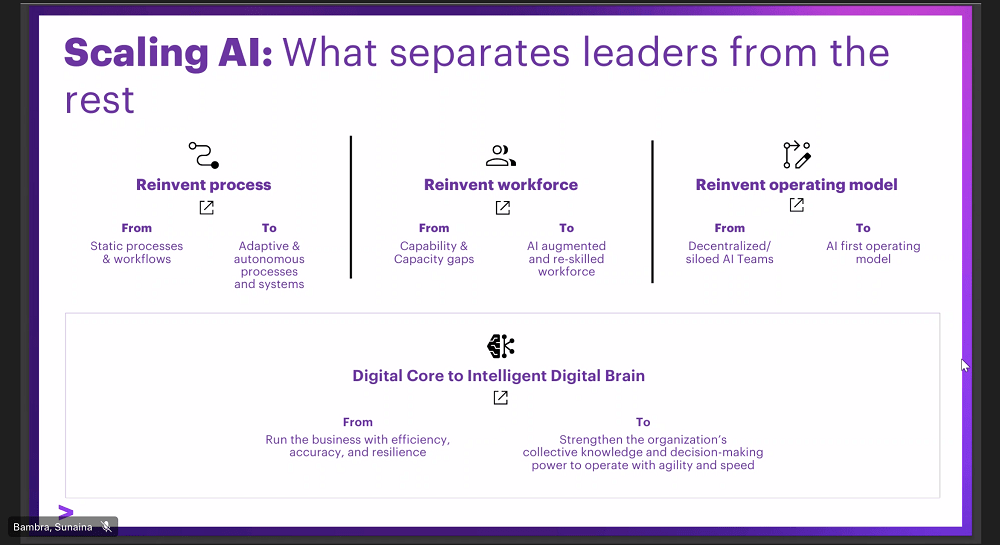
However, Accenture said scaling AI requires more than funding, pointing to four critical areas: talent, processes, operating models, and data.
Training workers remains a key hurdle. Only 20% of employees globally feel involved in shaping how AI affects their work, while just 17% actively seek ways to use the technology.
Companies that have successfully scaled AI tend to invest heavily in workforce upskilling. Telecom firm One New Zealand, for instance, rolled out internal programs such as “AI School” and “AI Studio” to train employees and crowdsource AI use cases.
Beyond talent, Accenture said firms must redesign workflows and adopt adaptive, AI-driven processes, supported by strong governance frameworks.
Singapore-based United Overseas Bank (UOB) was cited as an example, with AI deployed in areas such as portfolio optimization, credit risk analysis, and customer service.
“To deploy AI at scale, governance becomes even more critical,” said Alvin Eng, head of enterprise AI at UOB.
Accenture also emphasized the need for an “intelligent digital core” — integrating data, systems, and decision-making — to support large-scale AI deployments.
Indian consumer goods firm Dabur India said maintaining reliable data pipelines remains one of the biggest technical challenges.
“In this era you cannot sustain without having a data foundation,” said Dabur global CIO Manas Mehra.
Despite the difficulties, Accenture said companies that invest in talent, governance, and data infrastructure are emerging as early leaders in the region’s ongoing AI race.