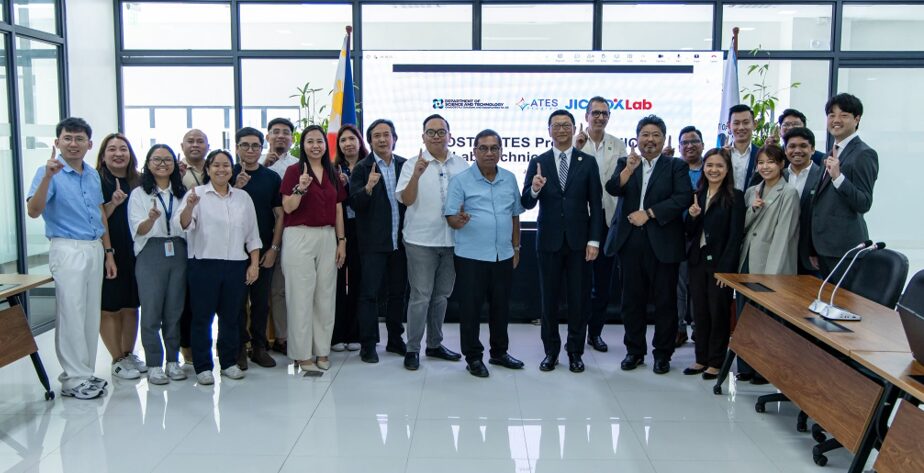
The Department of Science and Technology (DOST) and the Japan International Cooperation Agency (JICA) have launched a technical collaboration aimed at strengthening the government’s Geospatial Analytics & Technology Solutions (GATES) program, a flagship initiative designed to integrate geospatial, climate, and hazard data into a unified platform for disaster risk reduction and evidence-based policymaking.
Under the partnership, JICA’s Digital Transformation Lab (DXLab) will provide technical expertise over a four-month period beginning in June 2026 to help DOST improve data interoperability, governance, and digital transformation capabilities for the platform.
The collaboration will also explore how the system can contribute to broader digital public infrastructure for climate and disaster-risk data.
The GATES program, launched in 2025 under DOST’s ELEV8PH initiative, seeks to consolidate fragmented datasets from agencies such as the Philippine Atmospheric, Geophysical and Astronomical Services Administration (PAGASA) and the Philippine Institute of Volcanology and Seismology (PHIVOLCS) into a single AI-ready national data platform.
The system is intended to support disaster preparedness, climate resilience, and government decision-making.
“The DOST is grateful for this partnership with JICA through its Digital Transformation Lab,” DOST secretary Renato Solidum Jr. said. “As we continue to build the GATES Program, this collaboration provides an important opportunity to draw from international expertise and best practices in data governance, digital transformation, and the responsible use of AI.”
Solidum said the initiative aims to establish an integrated and interoperable AI-enabled data ecosystem that can support evidence-based governance and help improve disaster risk reduction, climate resilience, and public service delivery.
According to DOST, the GATES program has already deployed the HANDA integrated preparedness platform, developed an initial data architecture blueprint, and begun training and capacity-building activities.
The program is also exploring geospatial artificial intelligence (GeoAI), predictive analytics, and Earth observation applications to support planning and sustainable development.
The collaboration will focus on two areas: strengthening the platform’s data infrastructure and identifying practical applications that can help government agencies respond more effectively to disasters and climate-related risks. Potential use cases include typhoon impact modeling, climate-risk monitoring dashboards, and evacuation planning tools.
JICA Philippines chief representative Baba Takashi said the partnership builds on decades of cooperation between Japan and the Philippines in meteorology, disaster preparedness, and seismic monitoring.
“This is not about Japan bringing solutions to the Philippines. This is about two nations, united by shared vulnerability and shared resolution, building a platform for evidence-based policies together,” Takashi said.
“The expertise lies here — in the DOST scientists, the PAGASA forecasters, the PHIVOLCS researchers. JICA DXLab’s role is to walk alongside you and help accelerate what DOST has already set in motion.”
DOST said the GATES program is intended to operationalize the Philippines’ National AI Strategy through geospatial intelligence and serve as a model for data-driven governance across government agencies.