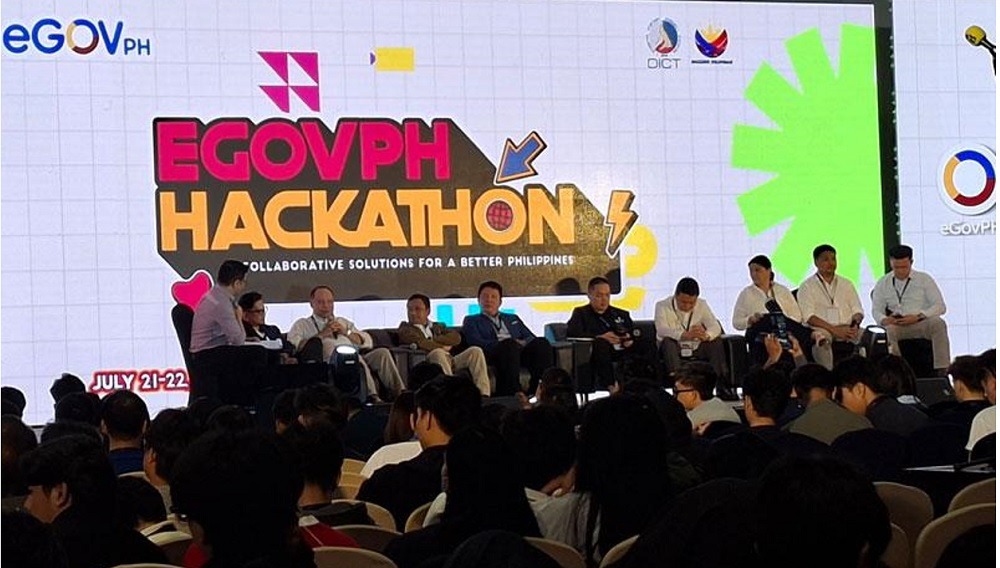
The Department of Information and Communications Technology’s (DICT) eGovPH Hackathon 2026 showcased nine government application programming interfaces (APIs) for developers, but complaints from participants over registration problems, delays, and the judging process have overshadowed the two-day event.
Held from July 21 to 22 at the SMX Convention Center Aura in Bonifacio Global City, the hackathon drew about 1,500 participants tasked with building digital services using the government’s technology platforms.
The DICT opened nine APIs for the competition: eGovPH Single Sign-On, National ID eVerify, eMessage, eGov AI, eGovPay, eGovChain, eReport, Face Liveness, and Compass.
The tools covered identity verification against PhilSys records, government-account authentication through OAuth 2.0, SMS and email notifications, artificial intelligence services, digital payments, blockchain-based document verification, emergency and complaint reporting, and defenses against deepfakes.
Compass, or the Centralized Open Monitoring Platform for Appropriations and Spending Statistics, was co-developed with BetterGov.PH to track public funds from approval to payment by department, agency, and individual release.
The release of the APIs drew praise from some attendees, who said the government was taking the correct infrastructure-first approach by allowing developers to build services on top of shared platforms.
IT professional Seve Barnett said the API catalog was “substantive, not just a slide deck of buzzwords.”
“Single sign-on, PhilSys identity verification, a citizen complaints API, AI services, a payments gateway, even a blockchain layer for tamper-evident records — these are real building blocks, opened up for developers to actually build on,” Barnett said.
“That is the right instinct and if sustained it is exactly the kind of infrastructure-first approach digital governance advocates have been asking for.”
However, Barnett and other participants said the execution of the hackathon did not reflect the digital-government principles promoted during the event.
Barnett said his registration was initially confirmed, later questioned because individual slots supposedly did not qualify, and eventually confirmed again. When he arrived, however, his name was missing from a printed sign-in sheet.
“A digital government event running on paper lists is the irony that sets the tone for everything else,” he said.
He also claimed participants were asked to sign a nondisclosure agreement without being given sufficient time to read it or a copy to retain.
“Basic transparency 101, skipped at an event about transparency,” Barnett said.
Another participant, Bryl Lim, described the event as “one of the most disappointing hackathons” he had joined, although he stressed that his criticism was directed at the organization of the competition and not the eGovPH platform.
“Kudos to the eGov team for building a great platform, opening their APIs to developers, and continuing to push digitalization forward. I genuinely appreciate that effort,” Lim said.
“My disappointment is with how the hackathon was organized.”
Lim said the registration process was disorganized and the announced schedule was not followed. Teams spent hours waiting without clear instructions, he said, with the hackathon proper starting only at about 5 p.m.
A participant using the name “anth.dev” raised a similar complaint, saying his team completed all registration documents in advance but was required to fill out the same form again upon arrival.
“The opening program also ran much longer than expected. Instead of using that time to brainstorm and start building our solution, participants spent hours simply sitting and waiting,” he said.
He added that organizers could have provided work tables so participants could conduct research or work on their laptops while the program was underway.
First Lady Liza Araneta Marcos attended the event and joined DICT secretary Henry Aguda and undersecretary David Almirol Jr. in formally starting the competition through virtual buttons displayed on the event’s LED wall.

The program also included a panel discussion titled “Digital Government for Everyone: Strengthening Innovation and Inclusive Public Services.”
The panel included Almirol, William Emmanuel Yu, Jojo Flores, Ferdie Perez, Jason Torres, Mel Megrino, Mark Bundalian, Kristoffer Rada, and Raymond Anthony Alimurung.
Organizers said entries were evaluated based on social impact, which accounted for 35% of the score; integration with the eGovPH project, 30%; presentation, 15%; user interface and user experience, 10%; and reels or slides, 10%.
Despite the published criteria, participants said they were not given their individual scores, a scoring breakdown, or feedback from the judges.
They also questioned the decision to announce the Top 10 teams while the assessment of the other entries was reportedly still underway.
“What confused me the most was that the organizers announced the Top 10 winners while also saying that the evaluation of the remaining teams was still ongoing, and that the rest of the Top 30 would be announced at a later date,” Lim said.
“As a participant, it is difficult to understand how the Top 10 could already be final if not everyone had been fully evaluated yet. I hope they can provide more clarity on how this process worked.”
The DICT identified the Top 10 teams as DeCSiphers, eGovibes, CS, QTR.ZIP, GG ANO TARA?, CORDON BLEU, BISAYA HACKERS, DATAMARAWS, AGeek, and Monorepo.
The remaining teams completing the Top 30 were expected to be announced the following week.
“It was also unfortunate that teams were not given their scores or any feedback,” anth.dev said.
“Even for those who didn’t make it to Top 10, understanding where they performed well and where they could improve is one of the most valuable takeaways from participating in a hackathon.”
According to participants, the competition had a P2-million prize pool. The Top 10 teams would receive P100,000 each, while the other 20 teams completing the Top 30 would receive P50,000 each.
Lim said the amount involved made transparency in the evaluation process more important.
“With that level of support and investment, I believe the judging process should be fully transparent,” he said.
Barnett also questioned whether projects developed during government hackathons would eventually become public services. He cited the lack of an update on Project Tunai, the previous year’s winning entry, including whether it had been piloted, adopted, or shelved.
“Which raises the real question: do these hackathons produce real public services, or just trophies?” he said.
Barnett also urged the government to ensure that the newly opened APIs remain available beyond the current administration.
“The real test of these APIs is not whether they impress a room of developers in 2026. It is whether they still exist, still work, and are still open in 2028, under a different administration with different priorities and, quite possibly, a different logo,” he said.
“If the eGov APIs catalog is genuinely durable public infrastructure, it should be treated as such — owned by the institution, not the administration.”
The participants nevertheless expressed support for the government’s broader digitalization efforts and said their complaints focused on how the hackathon was conducted.
“My feedback is directed solely at the event’s execution,” anth.dev said. “I hope future editions will improve the participant experience because initiatives like this have potential to bring together talented individuals who genuinely want to contribute to building better digital government services.”
For his part, Almirol admitted that the event was not perfect and said that there are many things that needed to be fixed with government systems and processes themselves, which is the primary reason the DICT initiated the eGovHackathon.
One of the themes of the event was building trust between government systems and citizens.
“Trust is the new oil,” Almirol said. — with reports from Carlos Nazareno