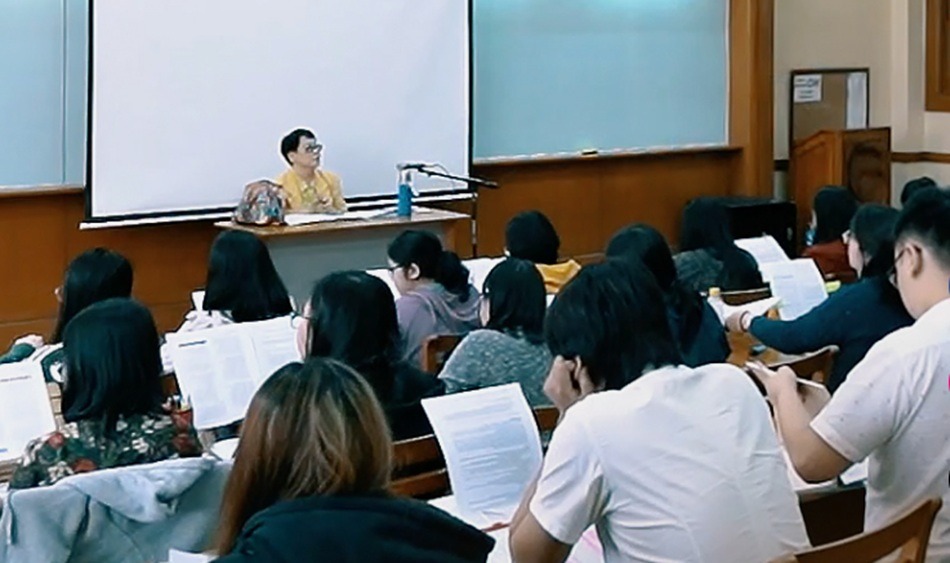
The University of the Philippines College of Law will restrict the use of artificial intelligence and electronic devices in first-year Juris Doctor courses beginning academic year 2026–2027, citing concerns that regular reliance on AI is weakening students’ legal reasoning and research skills.
Under a policy adopted by its regular faculty on Aug. 4, first-year core subjects traditionally covered by the Philippine Bar examinations will, as much as possible, be taught fully onsite.
Students attending these classes will generally be prohibited from using phones, laptops, tablets, smart watches, smart glasses, recorders, and other electronic devices, including for taking notes. Instructors may allow their use for specific class activities, emergencies, or other circumstances requiring prior permission.
Faculty members may impose academic penalties for unauthorized device use, apart from initiating disciplinary proceedings.
Major assessments, including midterm and final examinations, must also be conducted individually, onsite, and offline. Faculty members will retain discretion over whether to allow open-book examinations or require students to undergo recitations without notes.
The college said it observed “a considerable decline in the quality of reasoning and argumentation coinciding with the regular use of AI by students.”
It said similar concerns had been raised by employers regarding recent graduates, suggesting that some students had become dependent on the technology.
For writing assignments such as academic papers and legal memoranda, students will be barred from relying on generative AI at any stage of the research and writing process. The restriction covers conceptualization, drafting, revision, editing, and grammar checking.
The policy also prohibits the use of legal research platforms and databases that principally rely on AI. UP Law’s Legal Research Cluster, in consultation with its Faculty Colloquium on Technology, Legal Education and Law Practice, will prepare a list of databases that may be introduced in first-year courses.
Faculty members may introduce AI-based legal research tools only after students have learned and been assessed on conventional research fundamentals. Such use must be consistent with the policy and endorsed by the Legal Research Cluster.
Professors who allow limited AI use will be required to supervise students and require detailed disclosures explaining how the technology was used. The disclosures must appear in the students’ output and in relevant drafts.
The mere possession of an electronic device during an onsite assessment in a core subject will be treated as an academic integrity offense and may result in formal disciplinary action.
UP Law said it was not seeking either the complete exclusion or unrestricted acceptance of AI. It acknowledged that future lawyers must learn to use the technology ethically but maintained that AI should supplement, rather than replace, legal analysis.
The college warned that lawyers who use AI without a firm grounding in legal principles could expose themselves to malpractice and risk applying the law without sufficient regard for social context.
The faculty colloquium will monitor implementation of the policy and its immediate effects. UP Law said a corresponding policy for students in higher-year subjects would be issued later.