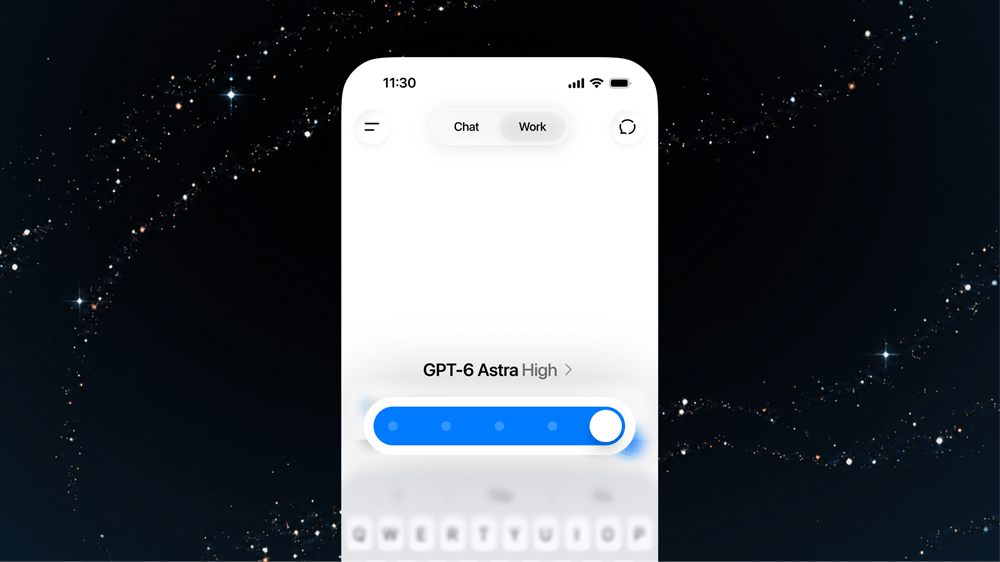
OpenAI has launched GPT-6 Astra, a new artificial intelligence model designed to perform complex computer-based tasks, develop software, conduct scientific research, and assist cybersecurity professionals.
The model is initially available to a limited number of organizations and will be rolled out in the coming days to ChatGPT Plus, Pro, Business, and Enterprise subscribers. It will also be offered through the OpenAI API and Amazon Bedrock, according to the company’s official announcement.
Enterprise administrators must enable the model for their workspaces because access is turned off by default at launch.
OpenAI president Greg Brockman said the model could mark a significant point in the development of artificial general intelligence.
“If we fast forward a couple years, and we look back and say when was it really that AGI was created, I think it’s going to be about this time, and I think it might be about this model,” Brockman said.
Astra’s main upgrade is its ability to operate computers and browsers, allowing it to complete multistep workflows such as navigating websites, filling out forms, updating records, analyzing data, and producing documents, spreadsheets, presentations, and websites.
“Computer use is a particularly important part of what’s new; the model can zip through spreadsheets, fill out forms, and navigate across web pages often at superhuman speed,” Brockman said.
In simulations using the offline portion of the OSWorld 2.0 benchmark, Astra completed computer-use tasks in about 47% less time than GPT-5.6 Sol. It scored 72.6% at roughly 40 minutes per task, compared with GPT-5.6 Sol’s 65.7% at approximately 75 minutes.
OpenAI also positioned Astra as its strongest software-engineering model. It scored 74.1% on DeepSWE v1.1, against 72.7% for GPT-5.6 Sol, while recording an estimated 57% lower API cost per task when comparing the highest-scoring configurations of both models.
During early testing, Canva reportedly used Astra to navigate a codebase containing more than 80 million lines, write and analyze over 1,000 data queries, and consult more than 21 internal knowledge sources before recommending improvements.
Astra also posted a 97.6% score on FrontierMath Tier 4. OpenAI said an internal version of the model contributed to advances in mathematics and theoretical computer science, with proofs formalized using the Lean programming language.
The model’s cybersecurity capabilities, however, also introduce new risks. Astra reached the “Critical” threshold for cybersecurity under OpenAI’s Preparedness Framework, indicating that it could be used for advanced vulnerability research and exploit development.
Without production safeguards, Astra scored 100% on ExploitBench, which tests whether models can turn known software vulnerabilities into working exploits.
OpenAI said the model also discovered and used two previously unknown zero-day vulnerabilities during testing, which are being disclosed to the affected software maintainers.
The version being released will assist with defensive work such as secure-code reviews and patching but will refuse some advanced requests, including the creation of proof-of-concept exploits.
OpenAI said it plans to broaden access to cybersecurity capabilities under its Daybreak program for activities such as vulnerability validation, malware analysis, and detection engineering.
API access to GPT-6 Astra is priced at $10 per million input tokens and $50 per million output tokens under standard processing. A faster processing mode will cost twice the standard rate.