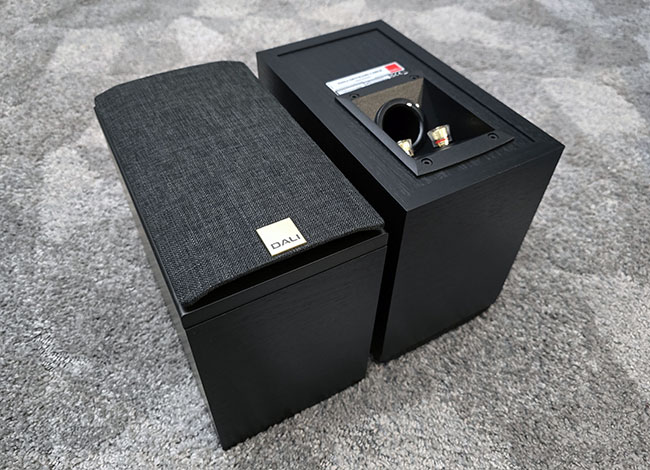
To the uninitiated, Dali is a Danish speaker manufacturer catering to the high-end audiophile community. They have various ranges, starting with the Spektor, and going up to the Dali Kore. Most lines begin with bookshelves and have towers and a full complement of surround speakers including center channels and surrounds.
We’re going to be checking out the Opticon 1 Mk 2 bookshelf speakers, which sit in the middle of the lineup — fairly premium $1,000 speakers.
Design
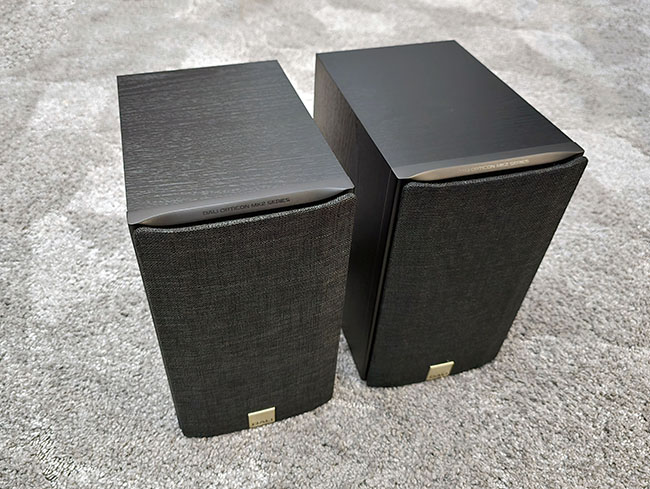
In terms of style, the Opticon’s prove that less is more, with simple elegance at play. Though these bookshelves are the smallest in this series, they are quite dense and heavy; which is usually a good sign of quality.
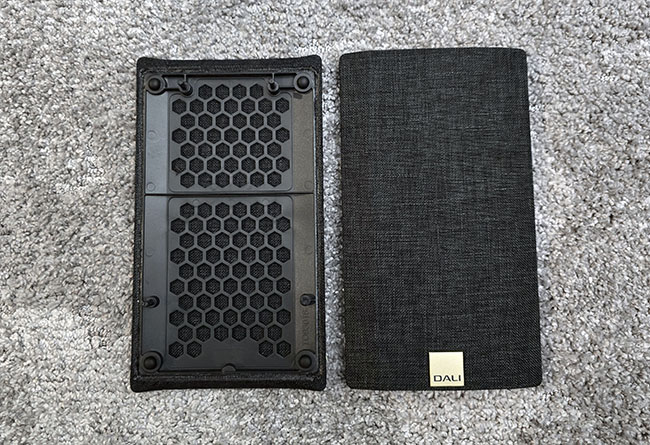
The speaker cabinet is made of MDF, with a wood veneer finish. It’s available in three colors: white, black, and mahogany. The speaker grills look elegant, with slightly angled edges; emphasizing the attention to detail in the design.

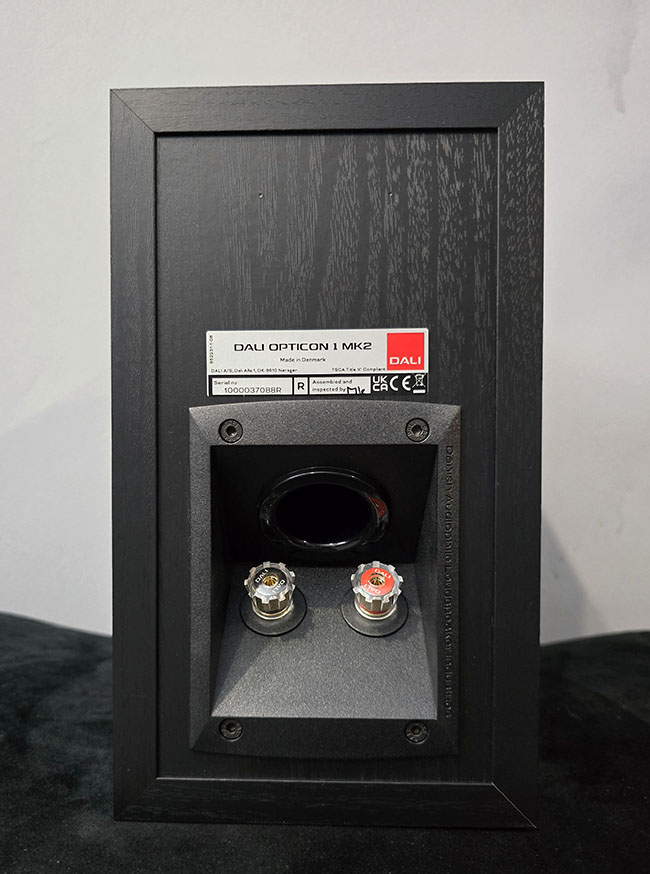
The Bass reflex por, though at the rear, is not at the back facing the wall and is rather at an angle above the binding posts. This is practical in case you want to place the speakers close to the wall. There are just two binding posts, so it is not possible to bi-amp or bi-wire these speakers.
These are meant to be used with stands, and that’s how I auditioned them. But for my eventual setup, I’m using them nearfield on wall mounts. But more on that later.
Audio Performance
The sound performance is an area the Opticon’s truly shine. These speakers feature Dali’s unique paper pulp and wood fiber cone; the signature maroon 4 and 3/4th-inch woofers. Many of the components and tech are lifted from their higher-end speaker line. The two-way speaker implementation features a 22mm soft-dome tweeter.

Specifications:
- Frequency Response: 62-25000 Hz
- Sensitivity: 85 db
- Nominal Impedance: 4 ohms
- Drivers: 1 x 4 3/4-inch woofer, 1 x 29 mm soft-dome tweeter
- Recommended Power: 25-100 watts
Soundstage and Imaging
The Opticon’s truly excel with regard to the soundstage and imaging. During my auditioning process, I was mostly trying to get a feel for the sound signature, but the center image was so good that it surprised me — and blew me away. In recent years, these are hands down the best I’ve experienced.
Whether critical listening in a dedicated listening/theater room or using them nearfield as desktop speakers, the center image is incredible. The lead vocals are always bang in the middle! This even extends to some casual viewing like YouTube videos, where the presenter is always in the center.
Treble
Moving on to the treble, this is where the magic happens. While most speakers are either analytical and detail-oriented or warm-sounding and pleasing, these blend those two beautifully, allowing for crisp, clear, details, while remaining pleasing and enjoyable. Though not necessarily warm sounding, they have a pleasing airy sort of tone, which my ears fell in love with.
Midrange
I’m someone who is very particular about the midrange and am drawn to full-sounding mids, which are frequencies between 300 and 500 Hz. This speaker does a great job with the mids. Comparatively speaking, the Polk Signature series speakers, which are quite analytical are a bit weak in this area.
Thanks to strong mids, you get a full-bodied sound that’s potent and room-filling. I was surprised by how a pair of Opticon 1’s could fill a large room with sound. Coupled with the excellent tweeters, it makes for a rich, multi-layered, complex sound. Whether you task it with orchestral compositions or vocal-focused tracks, the results are superb.

Bass
Having used these speakers for over a month in a simple 2.0 stereo setup, without a sub-woofer, I can safely say that they have ample bass. That said, if you are looking for extremely deep bass, you will have to add a subwoofer.
For most listening scenarios, the Opticon’s feel quite complete. They produce moderate amounts of low-frequency output with good clarity. So, you can expect good tactful bass, and enjoy these just as-is, be it music or movies.
For example, a track like Hall of Fame by the Script sounds great; the bass has a sufficient kick, making for a good music-listening experience. Similarly, be it movies or games with gunshots, the Opticon’s do a good enough job.
If you’re used to listening to your music and other content with a subwoofer, very likely that you would miss some lower frequencies. I, for one, surely intend to add a sub. While auditioning the Opticon’s, I tested them with a sub, to get a feel for their musical prowess when complemented with a sub.
For trance music like Armin Van Buuren, where there is quite an emphasis on the bass, the Opticon’s fall a bit short. So, for some music genres, I’d say a sub is required.
Additional Music Sampling:
Loren Allred – Never Enough (The Greatest Showman Soundtrack)
I’ve heard this track many times, but never has it sounded so good. The center image is just outstanding. When the vocals start, the center stage sounds breathtaking, as the song was meant to be in the movie.
The Corrs – Everybody Hurts (Unplugged)
The imaging is just magnificent; as the song starts you initially hear the guitar notes on the right, then the vocals in the middle, and finally the violin on the left. Later that day, I watched the video on YouTube, only to realize that these were their exact positions on stage for the unplugged performance. Oh, and it sounded lovely; impeccable fidelity and a very accurate live performance mood.
Metallica – Nothing Else Matters (S&M)
Again, a superb presentation with a lot of detail. You can clearly hear the various elements of the orchestra, intertwined with the superb vocals of James Hetfield. Everything is nimble and clearly defined, without one drowning out the other. Truly makes for a rich tapestry of sound.
Kygo – The Feeling
The song really comes alive on the Opticon’s. Though a partially electronic track, it sounds great, with even the beats being beautifully represented. If you turn up the volume, you’ll be surprised by how these two small speakers can even fill a large room, enveloping you in sound.
Far Cry 6 (Video Game)
I also tried these speakers connected to a computer, playing a first-person shooter. It worked very well; the sound was clean and impactful. Gunshots were potent, the environmental ambiance was well recreated, and excellent dialog delivery in cut scenes.
All my listening post-purchase was done using an older Yamaha RX-V375 receiver, in a 2.0 setup in a regular room. The initial auditioning was done with a Marantz Model M1 wireless streaming amplifier, in a 2.1 setup with a subwoofer in a listening room.
Price and Competition
These speakers retail for P52,000 and you can audition them at DALI Philippines (managed by Audiolab PH). The store is located at Greenbelt 5 in Makati City.
While they might come across as expensive, keep in mind that these are premium speakers and you are getting what you pay for. These speakers are hand-assembled in Denmark, using high-quality components. Testing and quality assurance are done in Denmark as well and likely adds to the cost significantly.
As part of my testing, I auditioned the similarly priced Sonus Faber Lumina 1, the Wharfedale EVO 4.1, the slightly cheaper Polk Reserve R100, as well as the lower tier Dali Oberon 3.
My finalists were the Opticon 1 Mk 2 and the Lumina 1. The latter had a treble emphasis, that added a very nice sparkle to the music. But the Opticon’s stood out for me with their overall tonal quality. The others were also good but just failed to stand out.
Closing Words
In conclusion, this may be a premium $1000 speaker, but you are truly getting your money’s worth. The design is excellent, simple yet stylish. The sound is pleasing with a remarkable blend of detailed yet pleasant sound. That’s aside from being competent and powerful room-filling speakers.
If you’re in the market for premium audiophile speakers, you cannot go wrong with the Dali Opticon 1 MK 2.
- Model: Dali Opticon 1 Mk 2
- Price: P52,000
- Verdict: European audio fidelity with finesse and elegance