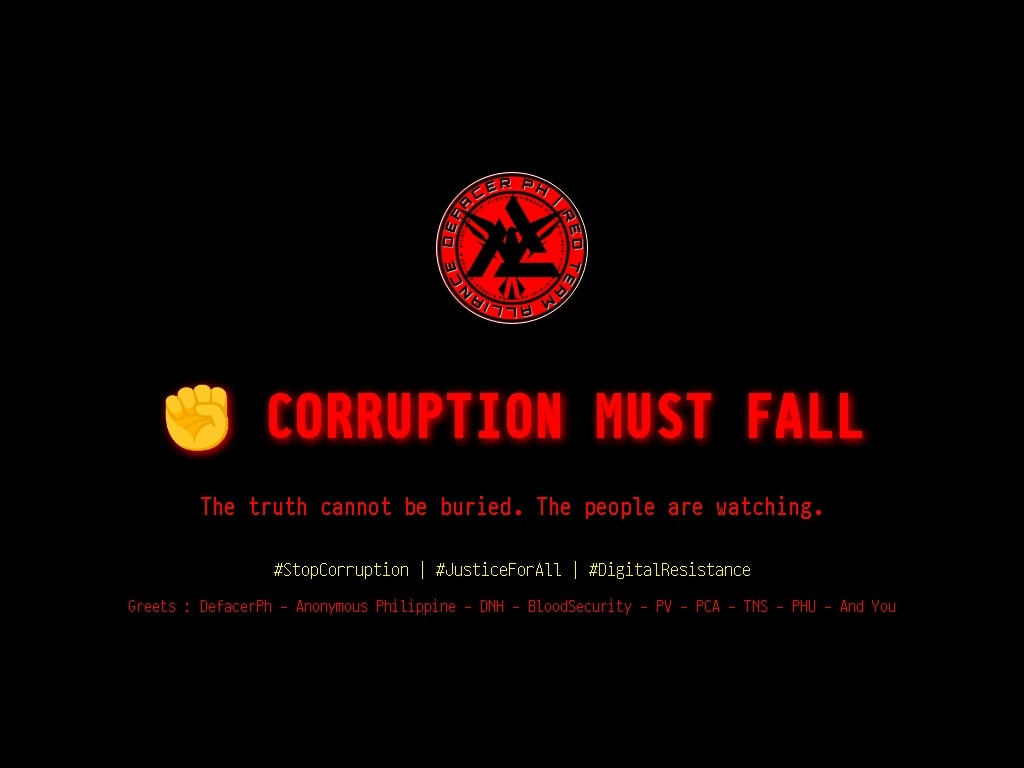
Thousands of Filipinos took to the streets over the weekend to demand accountability in government infrastructure spending, with their calls for transparency and reform echoed online by hacktivist groups that defaced nearly 20 government websites in a show of digital protest.
The demonstrations, held at Luneta Park in Manila and mirrored by smaller gatherings in provincial cities, targeted the Department of Public Works and Highways (DPWH) over what protesters described as “rotting corruption” in public works projects.
Organizers cited years of misuse of taxpayer money on incomplete roads, unsafe bridges, and delayed flood-control systems that they say have endangered communities across the country.
“Enough is enough,” read one placard, echoed by chants of “No to Corruption, DPWH Accountability, People Power.”
Civil society groups demanded independent audits, protection for whistleblowers, and criminal charges for officials accused of siphoning funds.
The anger in the streets found a parallel front online. A group calling itself the Darkframe Cyber Alliance defaced the DPWH’s official website, posting a manifesto that accused the agency of betraying public trust and endangering lives with substandard projects.
The timing of the attack — just as protesters massed at Luneta — gave the online action symbolic weight.
“Betrayal of public trust will not be tolerated any longer,” the hackers declared.
Another hacktivist collective, L00tz x Slashie, struck websites of several local government units (LGUs) in the Zamboanga Peninsula.
Their protest messages denounced large-scale flood-control projects, which they alleged were land grabs disguised as development, destroying mangroves and wetlands while benefiting only private contractors.
Screenshots of the defaced portals quickly spread on social media, amplifying the narrative of corruption and mismanagement that fueled the weekend’s rallies.
The Department of Information and Communications Technology (DICT) acknowledged the defacements, saying 19 government websites were affected on September 21. Four belonged to national agencies, while the rest were LGU-run portals.
DICT secretary Henry Aguda sought to reassure the public that critical systems remain safe, describing the incidents as “inconsequential” in scale.
“We recorded 19 government websites that experienced defacement. This means the website was taken over and altered, but the government agencies were quick to react,” Aguda said, stressing that no personal data was stolen and no major services were disrupted.
The DICT has activated Oplan Cyberdome, a whole-of-nation cybersecurity defense plan that mobilizes law enforcement, telecoms, social media platforms, and private sector partners to counter digital threats during sensitive events.
Independent monitoring group Deep Web Konek reported that other key websites — including those of the Office of the President, Commission on Higher Education, and DICT’s Free Public Wi-Fi program — also experienced intermittent outages from suspected distributed denial-of-service (DDoS) attacks.
While no breaches were detected, high-volume traffic floods temporarily limited access to several portals, further underscoring the vulnerability of government digital infrastructure.
The online disruptions coincided with mounting political pressure on government institutions accused of neglecting transparency and accountability.
Protest leaders argued that hacktivist actions, while illegal, reflected the growing frustration of citizens who feel their grievances are ignored.
“People have lost faith in the system,” one rally organizer said. “When roads crumble, bridges collapse, and flood projects displace families, citizens will look for any way to be heard — on the streets or online.”
The DICT continued to downplay the technical impact of the incidents, reiterating that citizen data and core government services remain secure.
But as both protests and cyberattacks converge on the same message — accountability — the challenge for the administration lies not only in defending digital systems, but in restoring public trust, netizens said.
“Cybersecurity is about more than firewalls,” watchdog group Deep Web Konek said in a statement. “True safety in cyberspace requires transparency, fairness, and accountability from institutions. Without these, systems may be protected, but citizens remain unprotected.”