Tetra Pak Philippines is ramping up its local sustainability drive through the use of advanced packaging and recycling technologies, positioning the Philippines as a key player in the company’s global push toward a low-carbon and circular economy.
The move follows parent company Tetra Pak’s €100-million global R&D investment in sustainable packaging innovations announced during its FY24 Sustainability Report presentation on October 17.
At the core of Tetra Pak’s efforts in the Philippines is the deployment of smart, paper-based carton packaging that extends the shelf life of food and beverages without refrigeration — a critical advantage in a country frequently hit by power outages and logistics disruptions due to natural disasters.
Through its aseptic packaging technology, Tetra Pak enables producers to safely distribute milk and other nutritious products across the archipelago, especially to rural and disaster-affected communities, while reducing food spoilage and energy consumption.
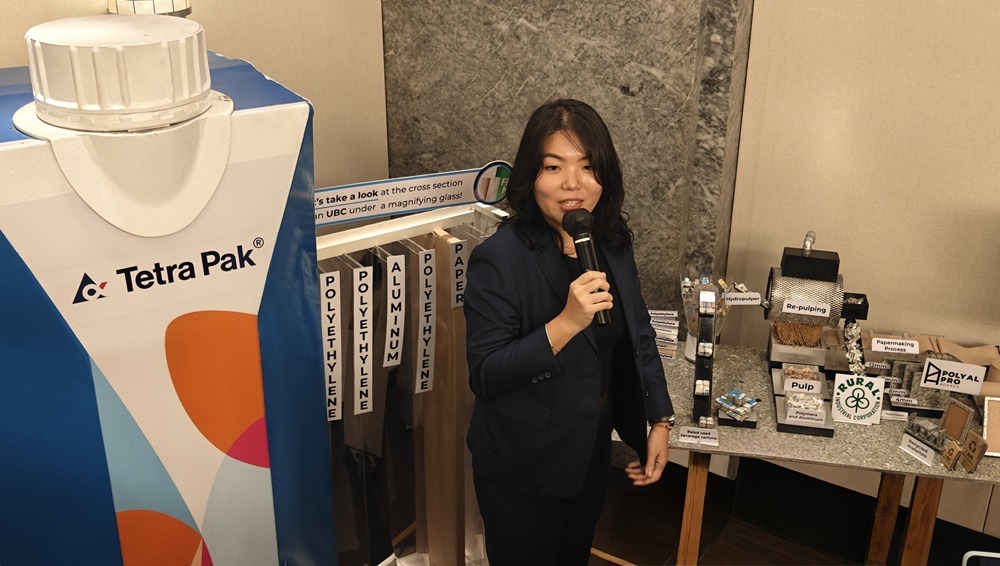
“Our packaging technology isn’t just about preserving food—it’s about building resilience,” said Catherine Chua, sustainability manager at Tetra Pak Philippines.
“By combining material science with circular design, we’re helping address food security and environmental sustainability at the same time.”
Digitalized Recycling Ecosystem
The company’s flagship program, “Cartons for Communities,” integrates technology-enabled collection and recycling systems to promote circular economy practices.
The program uses digital tracking and logistics coordination tools to efficiently collect, sort, and process post-consumer beverage cartons.
Tetra Pak partners with Rural Industrial Corporation and Axelum Resources Corporation to transform used cartons into Poly Al boards and recycled chipboards, which are repurposed for furniture, housing, and school facilities.
In 2024 alone, the initiative recovered over 700 tons of cartons, marking an 80% increase from the previous year. The company also expanded its partnerships with local government units (LGUs), enabling more communities to adopt data-driven recycling and materials recovery systems.
Tetra Pak’s Philippine operations are also exploring AI and IoT integration in food processing lines to monitor energy efficiency, automate quality control, and reduce waste in real time.
The company’s technological focus aligns with its broader goal of achieving net-zero emissions and full recyclability across all product lines by 2050.
“Technology is the enabler that connects sustainability with scale,” said Chua. “From the design of our packaging to the systems that recycle them, every innovation brings us closer to a circular, climate-smart food ecosystem.”