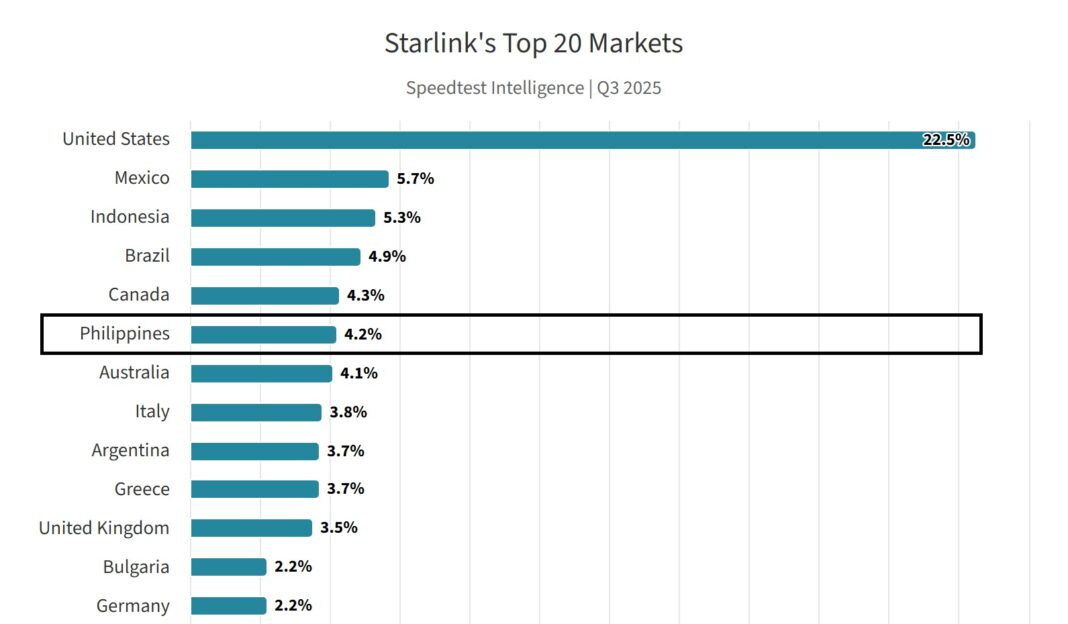
The Philippines has become one of the world’s largest markets for low Earth orbit (LEO) satellite internet, ranking sixth globally for Starlink usage, as the country prepares to pilot satellite-to-phone connectivity through a partnership with a local telecom operator.
Data from Ookla’s Speedtest Intelligence shows that Starlink now accounts for more than 97% of global satellite broadband usage, with the Philippines emerging as one of its top six markets worldwide in terms of user activity and testing volume.
The ranking places the country alongside major markets such as the United States, Brazil, Indonesia, Mexico, and Canada.
Industry analysts say the Philippines’ high ranking reflects strong demand for alternative connectivity in island provinces, mountainous regions, and disaster-prone areas where fiber and mobile networks remain limited.
Starlink, operated by SpaceX, uses thousands of LEO satellites orbiting much closer to Earth than traditional geostationary systems.
This enables lower latency and faster speeds, supporting video calls, online classes, cloud services, and digital payments even in remote communities.
Since 2019, SpaceX has launched more than 10,700 Starlink satellites and built a global customer base of around 9.2 million users.
In the Philippines, LEO satellite broadband has increasingly been used as a primary or backup connection in provinces with limited terrestrial infrastructure.
Ookla data shows that traditional geostationary providers such as Kacific continue to record much higher latency in the country, making real-time applications more difficult for users.
Starlink’s growing footprint in the Philippines is now expanding beyond home broadband. In January 2026, the government announced a pilot program for satellite-to-phone connectivity through a partnership between Globe Telecom and Starlink.
The initiative will allow standard LTE mobile phones to connect directly to satellites without relying on ground-based cell towers.
The Department of Information and Communications Technology (DICT) said the Philippines will be the first country in Southeast Asia to test Direct-to-Cell services, which link ordinary smartphones directly to LEO satellites.
Under the setup, users will not need new handsets or special equipment. Starlink’s satellite network will interface with Globe’s mobile system, enabling basic voice, messaging, and data services in locations where building cell sites is difficult, such as small islands, upland villages, and conflict-affected areas.
Testing and proof-of-concept activities are expected to begin in the first half of 2026, focusing on geographically isolated and disaster-prone areas.
Officials said satellite-to-phone connectivity could play a critical role during typhoons, earthquakes, and power outages, when terrestrial networks are often damaged.
By enabling basic communications even when cell towers and power lines are down, the system could support coordination among communities, local governments, and emergency responders.
Globe said the initiative will complement — not replace — its existing mobile and fiber networks, positioning satellite connectivity as a resilience and coverage layer.