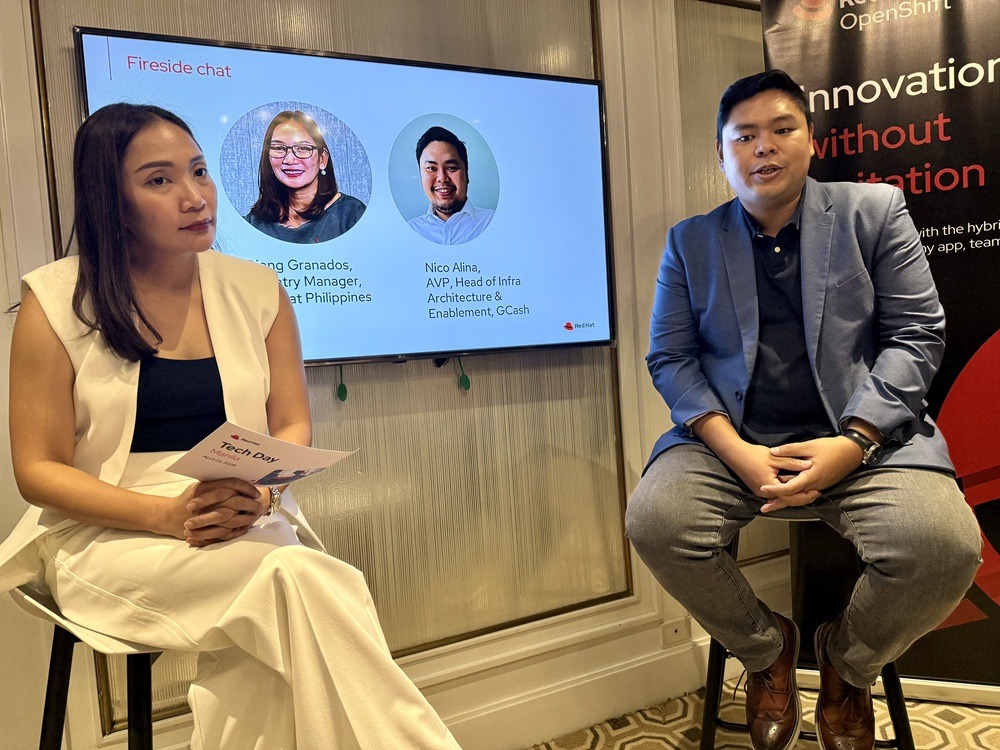
Tech firm Red Hat is positioning open-source technologies as a key driver of enterprise modernization in the Philippines, as it outlined its local strategy and showcased customer adoption during a media session at the Tech Day Manila conference at the Rockwell Powerplant Mall in Makati City last April 22.
Speaking at the event, Red Hat Philippines country manager Djang Granados said the company is seeking to expand its role beyond software provision, emphasizing support for enterprises adopting hybrid cloud, artificial intelligence (AI), automation, and virtualization.
Granados described open source as a shift from traditional proprietary licensing models to subscription-based platforms supported by vendors.
“Gone are the days that customers are still purchasing licenses or software that has a proprietary license. Open source, however, is a subscription-based model that customers usually are allowed or entitled to use because it’s open and it’s built by the community,” she said.
She added that Red Hat’s role is to provide enterprise-grade support for organizations deploying open-source systems.
“Red Hat is actually there to provide support to these enterprise organizations,” Granados said.
The company said it is focusing on industries such as telecommunications and financial services in the Philippines, where it already counts several major firms among its customers.
A highlight of the event was a fireside chat with GCash, which discussed its transition from monolithic systems to microservices-based architecture using open-source tools.
GCash assistant vice president Nico Alina said the shift was driven by the need for speed and cost efficiency.
“So, same idea with everyone. From monolithic to microservices architecture, we really had to re-architect a lot of the stuff that we had back in 2018,” he said.
He noted that the company’s infrastructure strategy evolved during the pandemic, when transaction volumes surged.
“Basically, we were growing two times, three times on a daily basis. The amount of compute power that we need to roll out on a daily basis was really, really difficult,” Alina said.
This led to the adoption of a hybrid cloud approach, with most workloads hosted overseas while gradually expanding local infrastructure.
“Hybrid cloud strategy came about with basically the idea of standardizing our architecture and basically workload portability,” he said.
Alina said the use of a unified platform helped improve operational efficiency and security across different cloud environments.
“It’s basically standardizing our architecture, which means it’s basically standardizing our operational efficiency,” he said.
He added that security remains a priority for the fintech firm.
“A big thing for us is really standardizing our security and compliance because trust and security is still our number one priority,” Alina said.
Red Hat said it sees growing opportunities in the Philippines as organizations pursue digital transformation, including AI adoption and infrastructure modernization, with government agencies and private firms increasingly turning to open-source platforms.