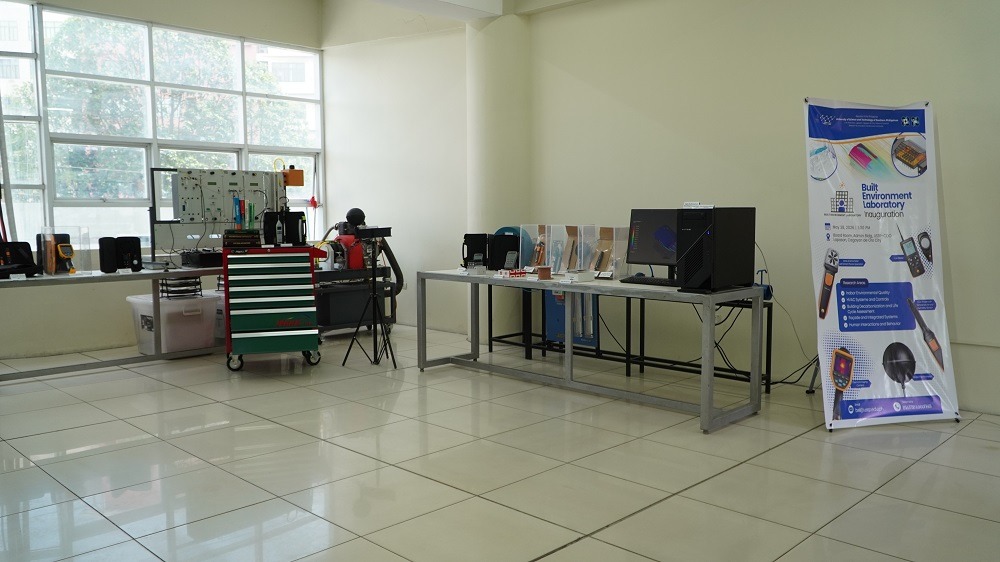
The Department of Science and Technology (DOST) and the University of Science and Technology of Southern Philippines (USTP) have opened a new research facility in Cagayan de Oro City aimed at developing technologies that could reduce electricity consumption in homes and commercial buildings.
The Built Environment Laboratory (BEL), inaugurated on May 28, was established through funding from the DOST–Philippine Council for Industry, Energy, and Emerging Technology Research and Development (PCIEERD) under its Institution Development Program.
The facility is equipped with laboratory tools and software designed to support research on heating, ventilation and air-conditioning (HVAC) systems, indoor comfort, productivity, and building efficiency.
According to USTP professor and project leader Richard Jayson Varela, the laboratory will support studies aimed at improving energy efficiency and indoor comfort in buildings, with the goal of helping modernize existing infrastructure in Cagayan de Oro City.
One of the projects conducted by researchers involved the Dr. Ricardo E. Rotoras Memorial Hall at USTP, where airflow and thermal comfort issues were analyzed using Computational Fluid Dynamics and Building Energy Modeling tools.
The study found that redesigning the building using passive ventilation strategies could reduce cooling energy demand by as much as 68%.
DOST-PCIEERD deputy executive director and officer-in-charge Niñaliza H. Escorial said the laboratory was established to ensure that energy-saving technologies are tested before wider deployment.
“Before we bring these energy-saving solutions to a wider scale, we take the time to carefully test and validate them, to make sure they truly work in real settings. That is why the Built Environment Laboratory was established. By investing in this facility, we are not only supporting our researchers and engineers, but we are also making sure that the solutions they develop genuinely improve the comfort and everyday experience of the people who use these spaces,” Escorial said.
Research activities at the facility also include the development of smart blinds that combine mechanical design, sensor-based automation, and adaptive shading systems to help regulate indoor temperatures and reduce reliance on energy-intensive cooling equipment.
DOST undersecretary for research and development Leah J. Buendia said the research addresses practical challenges faced by building occupants.
“What stands out in this initiative is the researchers’ attention to everyday realities, how heat, airflow, and comfort affect those who use these spaces daily. Their work brings us closer to solutions that truly respond to people’s needs,” Buendia said.
Data from the Department of Energy showed that commercial and residential buildings accounted for 54% of the country’s total energy consumption in 2024. The DOE has also warned of possible power supply pressures as higher temperatures and increased electricity demand strain the grid.
DOST secretary Renato U. Solidum Jr. said the laboratory could help generate solutions to rising energy costs and growing demand for electricity.
“The initiative comes at a critical time, as the Philippines continues to face increasing pressure on its power supply system driven by population growth, rapid urbanization, and heightened cooling demand during hotter seasons,” Solidum said.
“With BEL, we can strengthen our capacity to generate solutions to this problem not only within the university but also communities and industries facing rising energy costs,” he added.