
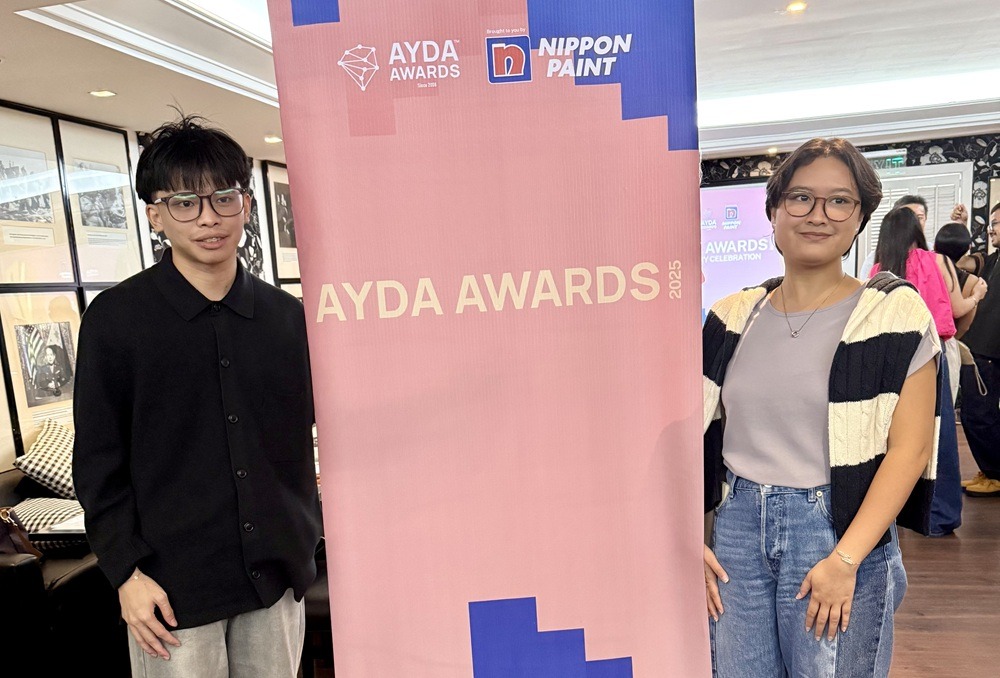
Two Filipino students won major honors at the AYDA International Awards 2025–2026 in Bangkok, Thailand, with projects addressing the displacement of the Sama-Bajau community in Mindanao and the decline of traditional Filipino children’s games.
Ejhey Durias of the University of Mindanao was named Designer of the Year in the architectural category for “Banuas Lawod,” becoming the first Filipino to win the competition’s top international award.
Patricia Danielle Malijan, an interior design student at the De La Salle-College of Saint Benilde, also received the Nippon Paint Color Award for “Kampihan.”
The international finals, held from June 11 to 12, drew more than 9,000 student submissions from 17 countries and regions under the theme “Converge: Crafting Cultural Legacies.”
Durias’ winning project proposes a community for displaced members of the Sama-Bajau, incorporating housing, livelihood opportunities, aquaculture, and spaces intended to preserve their cultural identity.
He said he conducted field research and spoke with Sama-Bajau communities in Davao, including people who had left their coastal settlements and turned to begging in urban areas.
He said the project was formed by his childhood visits to coastal communities near Panabo City, although he is not a member of the Sama-Bajau.
“I really admired their simple way of living but I never fully understood the challenges they were facing. So, that realization has kind of inspired me to design with greater empathy and purpose for them,” he said.
Durias will receive a grant worth $10,000 for a three-week program at the Harvard University Graduate School of Design. Under the award’s terms, he may instead receive 50% of the amount in cash if he decides not to attend the program.
“Honestly it feels surreal even though at this very moment. I didn’t expect to win the award. But I am really grateful that I was actually surprised that my name was flashed in the screen,” Durias said.
“I am very, very proud to represent not only my university but the whole country in the international stage. And for that I am very grateful for everyone, for their support,” he added.
Malijan, meanwhile, received the $1,000 Nippon Paint Colour Award for “Kampihan,” a proposed heritage and spatial play hub designed to encourage children to take part in traditional Filipino games.
The project was inspired by Malijan’s immersion in a disadvantaged community, where she observed that children spent much of their time on mobile phones because the local playground was inaccessible and unsafe.
“We noticed they’re only on their phones because the community playground wasn’t even a playground. It wasn’t accessible. It was a hazard,” she said.
Malijan’s design incorporates games such as patintero, piko, luksong baka, and luksong tinik, as well as spaces for bahay-bahayan or playing house.
“It’s a playground that fosters and nurtures Filipino traditional games. Because kids these days don’t even know what that is anymore. So, it’s a culture that’s dying,” she said.
Malijan said winning the color award was unexpected because she had previously been reluctant to use color extensively in her designs.
“To see that I’ve gone from not using color at all to winning this color award” allowed her to recognize how much she had grown as a designer, she said. She plans to use the $1,000 prize as possible seed capital for a business.
Chen Lee Siong, general manager of Nippon Paint (Coatings) Philippines, said the competition evaluates entries based on their relevance, originality, feasibility, and potential contribution to society.
“It’s not a design for the sake of design. It’s not just a castle in the air. It must be grounded. It must be also relevant,” Chen said.
He also said the use of artificial intelligence was not prohibited, but the central concept must still come from the student.
“AI makes your work faster and become more efficient. But the originality of the ideas, it still comes from them. This is more important,” he said.
Durias disclosed that he used AI to generate images of people for his architectural perspectives but later converted and modified them as vectors in Adobe Illustrator. He said the project’s concept and proposed solutions came from his field research and interactions with the Sama-Bajau.
The AYDA Awards, formerly known as the Asia Young Designer Awards, was established in 2008. Its entries are judged on design concept, innovation, functionality and relevance, sustainability, aesthetics, and use of color.


