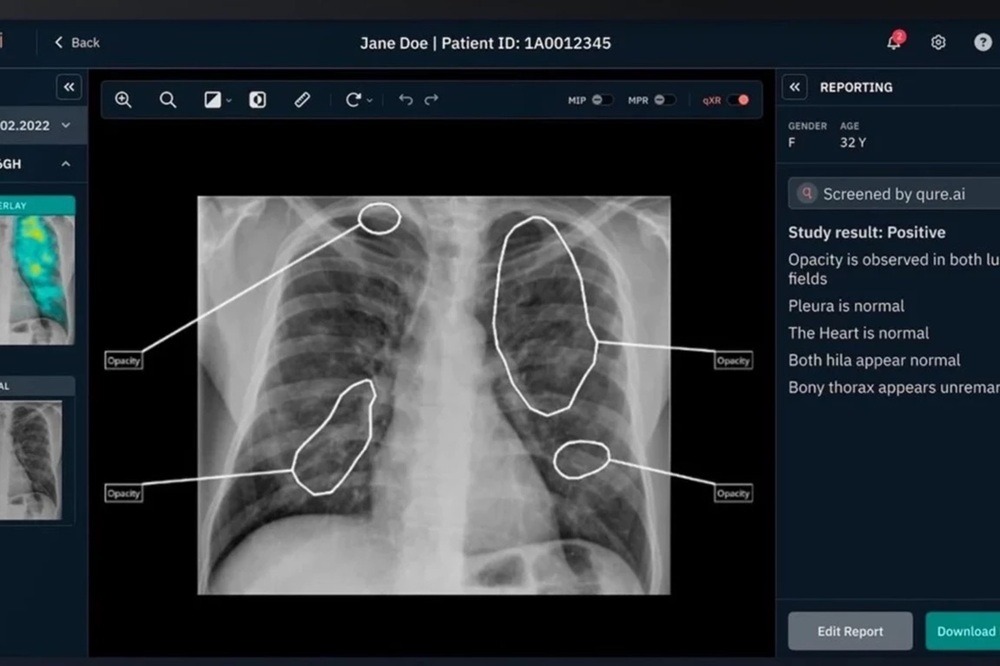
Artificial intelligence-assisted interpretation of chest X-rays could reduce the cost of tuberculosis screening in rural Philippine health units, although researchers cautioned that the projected savings depend heavily on local costs and diagnostic conditions.
A study by Ateneo de Manila University researchers Harold Henrison Chiu, Bryan Christopher Lao, and Gloanne C. Adolor modeled the use of AI to interpret chest radiographs of patients suspected of having TB in rural health facilities. The research was published in the August 2026 issue of BMC Health Services Research.
The researchers developed a decision-analytic model involving a theoretical annual cohort of 1,000 presumptive TB patients undergoing chest radiography.
The five-year analysis factored in AI software and operating costs, radiologist reading fees, and confirmatory GeneXpert testing.
Under the model, AI-assisted interpretation would cost an estimated P877,330 annually, compared with P1.14 million for manual interpretation.
That translates to roughly P877 per person screened using AI, against P1,142 for manual interpretation — a difference of about P265 per patient.
The technology could have particular relevance in geographically isolated and disadvantaged areas, where access to radiologists and teleradiology services can be limited.
Delays in interpreting an X-ray can require patients to make another trip to a health facility, incur additional expenses, or take more time away from work.
“For resource-constrained communities, the most important question is therefore not whether AI can outperform or assist an expert reader, but whether it can extend expert-level support to places where expertise is scarce in a way that is affordable, sustainable, and equitable,” the researchers said.
They said AI could potentially be integrated into existing TB programs using portable digital X-ray machines and systems capable of operating with limited connectivity, bringing screening closer to communities with poor access to medical specialists.
The researchers, however, stopped short of recommending nationwide deployment.
The economic advantage of AI changed under different assumptions. When lower manual or teleradiology reading fees were used, or diagnostic-performance estimates based on a Philippine scenario were applied, AI remained more effective but was not necessarily cheaper.
The findings are also based on a theoretical cohort and assumptions about costs and diagnostic accuracy. An AI-assisted X-ray interpretation would not itself confirm tuberculosis, with patients still requiring confirmatory testing.
Instead of immediate nationwide adoption, the researchers recommended targeted pilot deployments in underserved rural health units, coupled with local validation, quality assurance, monitoring, and an assessment of their budget impact.
The study comes as the Philippines continues to carry a heavy TB burden. Citing World Health Organization data, the researchers said an estimated 739,000 people in the country developed tuberculosis in 2024, equivalent to 6.8% of the estimated 10.8 million cases worldwide.