
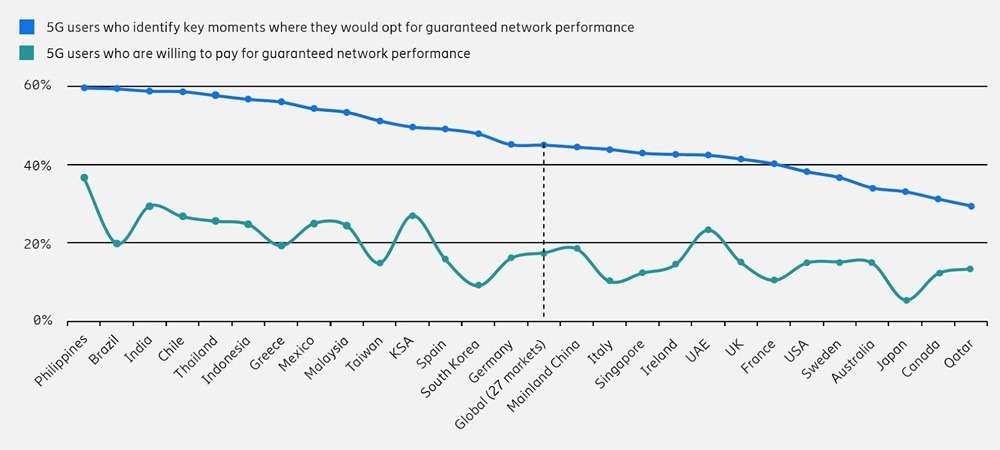
Six in 10 Filipino 5G smartphone users want guaranteed network performance during situations where connectivity is critical, while more than a third are willing to pay extra for such services, according to a global study by Ericsson ConsumerLab.
The study, “Winning in the Market with Differentiated Connectivity Offerings,” found that 60% of Filipino 5G users identified situations in which they would want guaranteed connectivity, compared with a global average of 40%.
Another 36% of Filipino respondents said they were willing to pay a premium for guaranteed quality of service, suggesting a potential market for 5G plans and add-ons that offer different levels of network performance rather than conventional best-effort mobile broadband.
Ericsson said the willingness to pay for performance assurance could generate the equivalent of up to two additional months of average revenue per user for telecommunications operators.
The global study surveyed 43,000 smartphone users across 27 markets, including about 34,000 active 5G users. In the Philippines, Ericsson interviewed 1,500 consumers, including 900 active 5G subscribers, with the results representing an estimated 46 million smartphone users.
Daniel Ode, head of Ericsson Singapore, Brunei and Philippines, said demand for more predictable network performance could increase as consumers use more artificial intelligence applications on their smartphones.
“Filipino consumers show a strong appetite for guaranteed 5G performance, with over a third ready to pay a premium for uninterrupted connectivity during critical moments,” Ode said.
“As on-the-go AI adoption and multimodal apps accelerate, expectations around responsiveness will only intensify. By introducing discoverable, performance-assured offerings, local service providers can address this growing demand, capture up to two months of additional ARPU, and build enduring subscriber loyalty.”
The study found that AI applications could place additional pressure on mobile networks as users increasingly shift from text prompts to more data-intensive interactions involving images and video.
Ericsson projects daily use of multimodal AI among smartphone users to increase from 16% currently to 32% by 2030. It also expects video-based AI interactions to rise from 22% to 51%, while 44% of AI activity is expected to take place while users are on the move.
Among existing smartphone AI users, response time was found to have twice the impact on overall network satisfaction compared with other 5G subscribers, according to Ericsson.
The findings point to possible changes in how telecommunications companies package mobile connectivity. Instead of offering only flat-rate data plans, operators could offer performance-based tiers or temporary add-ons that guarantee particular network characteristics for applications or situations where latency and reliability are important.
In the Philippines, 36% of 5G users surveyed said they would prefer to buy differentiated connectivity directly from their telecommunications provider, while 25% were open to alternatives such as enhanced connectivity bundled within third-party applications.
Ericsson said network application programming interfaces, including “Quality on Demand” APIs, could allow app developers and digital service providers to request specific network performance when needed. Such technology could support services in which enhanced connectivity is activated for particular applications or periods rather than applied continuously to a subscriber’s entire connection.
The survey was conducted from June to August 2025 among active smartphone users aged 15 to 69 across 27 markets.


