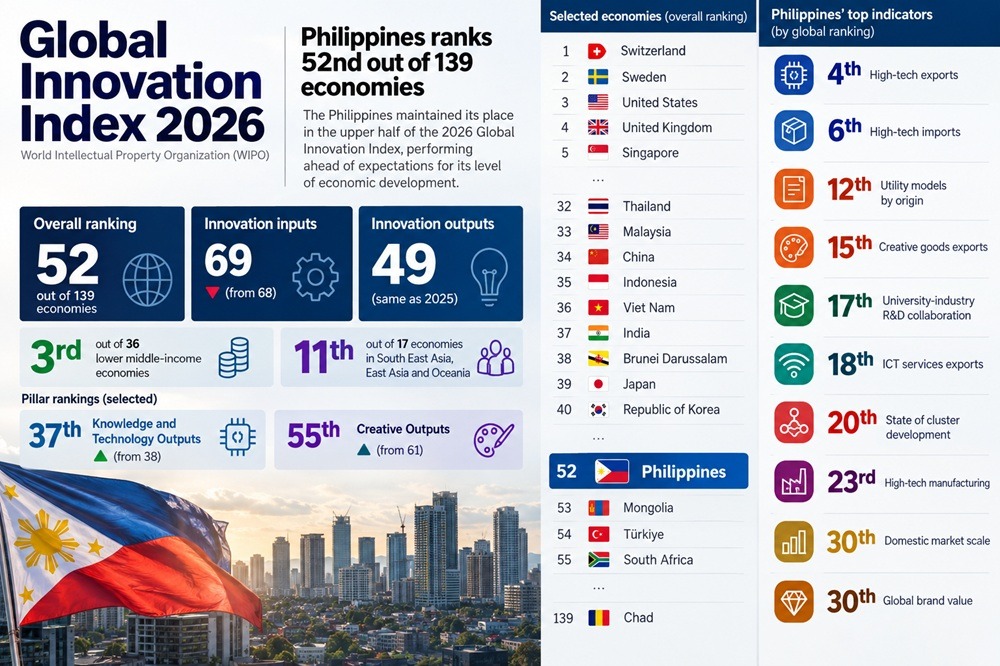
The Philippines ranked 52nd out of 139 economies in the 2026 Global Innovation Index (GII), maintaining relatively stronger performance in innovation outputs even as its ranking in innovation inputs slipped.
According to the index published by the World Intellectual Property Organization (WIPO), the Philippines retained its 49th-place ranking in innovation outputs, while its innovation inputs ranking fell to 69th.
The gap indicates that the country is generating comparatively stronger innovation results from its available resources and capabilities.
The Philippines also ranked third among 36 lower middle-income economies and 11th among 17 economies in South East Asia, East Asia, and Oceania.
Among the seven pillars measured by the index, Knowledge and Technology Outputs improved one place to 37th, while Creative Outputs recorded the country’s biggest gain, rising six places to 55th.
The Philippines’ strongest individual indicators included high-tech exports, where it ranked fourth globally, followed by high-tech imports at sixth and utility models by origin at 12th.
Creative goods exports ranked 15th, university-industry research and development collaboration 17th, ICT services exports 18th, state of cluster development 20th and high-tech manufacturing 23rd. The country ranked 30th in both domestic market scale and global brand value.
Intellectual Property Office of the Philippines (IPOPHL) director general Teodoro C. Pascua said the results showed areas where the country has developed competitive capabilities but also pointed to the need to move more research and creative output toward commercialization.
“Beyond the headline ranking, we see areas where the Philippines is already demonstrating global competitiveness, from utility models and patents to brands, creative goods, high-tech exports and research-industry collaboration. The task now is to build on these strengths and scale them further and faster,” Pascua said.
Several IP-related indicators improved in the latest index. Industrial designs by origin climbed to 63rd from 73rd, while patents by origin rose to 65th from 68th. Patent Cooperation Treaty patents by inventor origin improved to 85th from 89th.
The country’s university-industry R&D collaboration ranking also advanced six places to 17th.
IPOPHL said its Innovation and Technology Support Office network, which now has 109 members, works with universities and research institutions to identify, protect, manage and commercialize intellectual property and connect research with industry.
Creative economy indicators also posted gains.
Creative goods exports improved one place to 15th globally, while global brand value climbed three positions to 30th. Cultural and creative services exports rose to 90th from 100th, national feature films improved to 58th from 61st, and mobile app creation advanced to 54th from 59th.
The results nevertheless underscore the gap between the Philippines’ innovation inputs and the outputs it generates, with the country’s 69th-place input ranking trailing its 49th-place output performance by 20 positions.
“For IPOPHL, the next step is to connect and scale these gains across the innovation value chain, helping more products become protected IP, more IP move into commercialization, and more Filipino innovations, brands and creative works reach wider, global markets,” Pascua said.