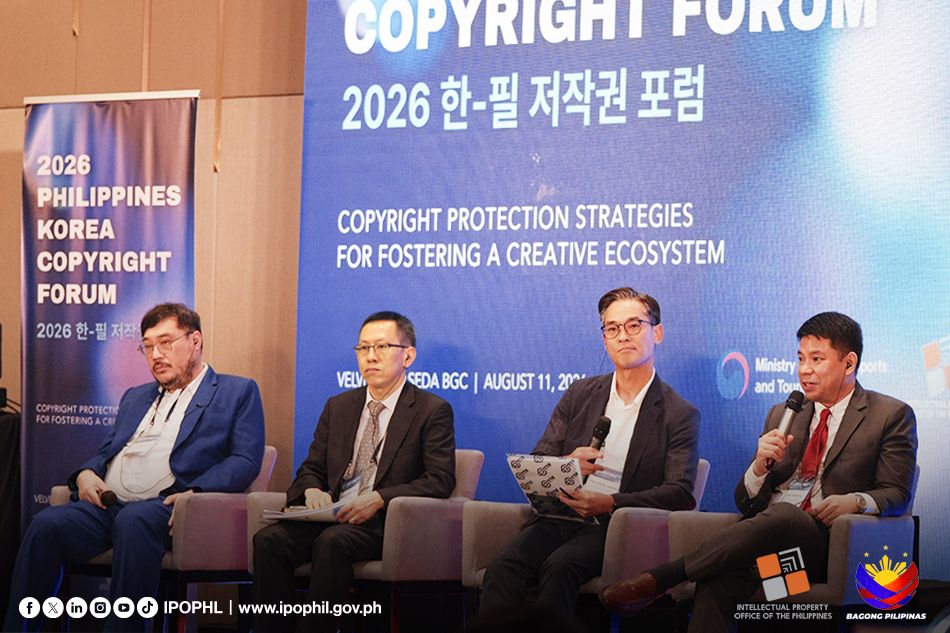
The growing volume of AI-generated music on streaming platforms is putting pressure on copyright and royalty systems, prompting Philippine and South Korean officials and industry representatives to push for stronger rights data management and enforcement mechanisms.
The issue was discussed at the 2026 Philippines-Korea Copyright Forum organized by the Intellectual Property Office of the Philippines (IPOPHL), South Korea’s Ministry of Culture, Sports and Tourism (MCST), and the Korea Copyright Protection Agency (KCOPA).
IPOPHL director general Teodoro Pascua said digital rights management has become increasingly important as artificial intelligence makes it easier to generate and distribute music at scale.
“In an era where an AI-generated song can reach millions of listeners and digital platforms can make available both human and AI-assisted creations, digital rights management is no longer just an administrative necessity, but the foundation for trust, accountability, and innovation,” Pascua said.
The forum focused on copyright enforcement, AI-generated content, data scraping, fair use, human authorship, and the role of collective management organizations (CMOs) in ensuring that songwriters, performers, broadcasters, and other rightsholders are properly compensated.
South Korea’s Mijung Ahn, director of the Copyright Industry Division at MCST, identified copyright protection in the digital environment and music rights management in the age of AI as major challenges confronting copyright authorities.
KCOPA Copyright Integration Division director general Sunghwan Lee said the rapid spread of digital technologies and AI has made the “search for copyright protection strategies aligned with these environmental changes has emerged as a task of the times.”
The forum also examined enforcement mechanisms being used against online piracy.
Lawyer Oliver Xavier Reyes, special counsel at Disini Buted Disini Law Offices, discussed Philippine rules on fair use, data scraping and human authorship, as well as online copyright enforcement measures such as takedowns of infringing material and protections afforded to internet platforms.
South Korea, meanwhile, has introduced an emergency blocking mechanism under its revised 2026 Copyright Act that allows MCST to order access to an infringing website blocked before committee deliberation when the infringement is clear, immediate intervention is necessary to prevent irreparable harm, and no other effective remedy is available.
According to KCOPA, the mechanism is particularly aimed at overseas piracy sites that frequently change their configurations to evade enforcement.
The discussion also highlighted the scale at which AI-generated music is entering streaming services. French streaming platform Deezer reported that AI-generated tracks account for 44% of daily uploads to its platform.
Ace Acosta, general manager of Philippines Recorded Music Rights Inc. (PRM), said mass uploads of AI-generated music create problems including royalty hijacking and fraud, manipulation of search algorithms, and the diversion of revenue pools away from human creators.
AI-generated tracks can also create metadata problems because information attached to mass-produced uploads may be inaccurate or conflict with existing music catalogs, making it harder to determine legitimate performance rights and royalty claims.
Participants said better metadata governance and integrated rights-management systems could improve identification of works and rightsholders and make royalty distribution more reliable.
South Korea has been developing such an infrastructure, establishing a comprehensive music rights database by 2020 and subsequently building a system capable of collecting music usage information through an integrated platform.
The system is intended to support transparent remuneration, verifiable royalty distribution, and data-based policymaking for the music industry.
The forum concluded that while AI is introducing new complications to copyright enforcement and royalty distribution, the underlying problem of maintaining accurate, interoperable and accessible information about music rights predates generative AI.
Strengthening that infrastructure, participants said, will become increasingly important as AI-generated content accounts for a larger share of music distributed through digital platforms.