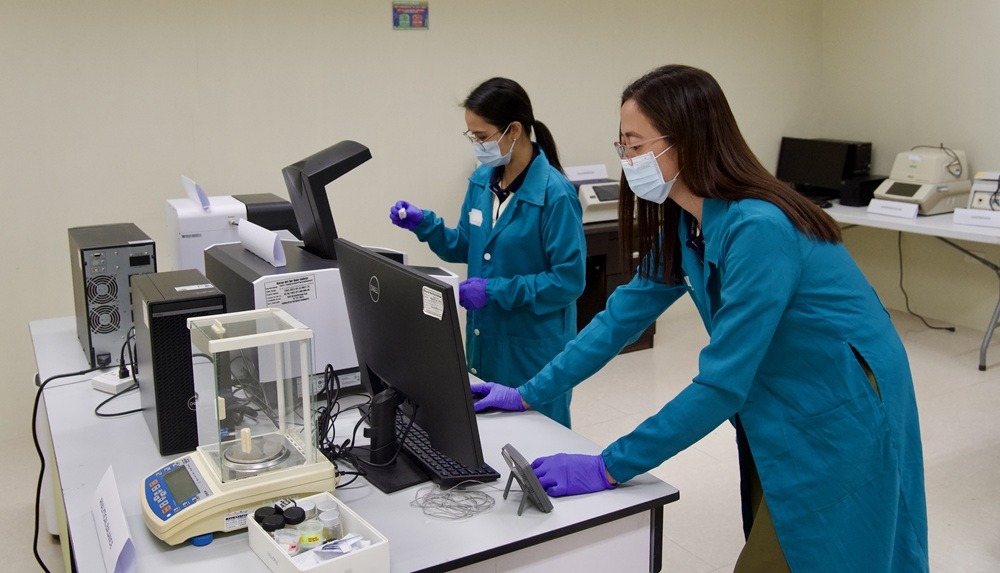
A P5-million research center in Davao del Sur will give local researchers access to laboratory equipment for detecting microplastics, heavy metals, and other contaminants, as concerns over drinking-water quality persist in the province.
The Davao del Sur State College Research Center for Emerging Pollutants (DSSC-RCEP) was launched on Sept. 24 through funding from the Department of Science and Technology-Philippine Council for Industry, Energy, and Emerging Technology Research and Development (DOST-PCIEERD).
The facility will analyze pollutants that may affect water resources, ecosystems, food sources, and public health, while generating scientific data for local governments, water service providers, and environmental agencies.
The center’s establishment comes as research by DSSC scientists found coliform contamination in 16 of 25 drinking-water sources surveyed in rural coastal communities in Davao del Sur.
Some samples tested positive for “Escherichia coli (E. coli)”, while all four sampling sites examined failed to meet microbiological standards, according to DOST-PCIEERD.
Davao del Sur’s rivers, groundwater, mangroves, and coastal waters support more than 705,000 residents, but contaminants can remain undetected without adequate monitoring and laboratory analysis.
The center was funded under DOST-PCIEERD’s Institution Development Program, which aims to strengthen the research capabilities of academic institutions.
Its equipment includes a Fourier Transform Infrared Spectrophotometer with a microplastic automatic preparation device and an ultra-low freezer. These will support the identification and analysis of environmental pollutants.
Beyond laboratory testing, DSSC-RCEP is expected to provide training and support collaboration among local governments, water districts, environmental agencies, farmers, fisherfolk, businesses, researchers, and students.
The facility expands access to environmental testing services in the province, where researchers and local authorities can use scientific data to assess contamination risks and inform decisions on water quality and environmental protection.