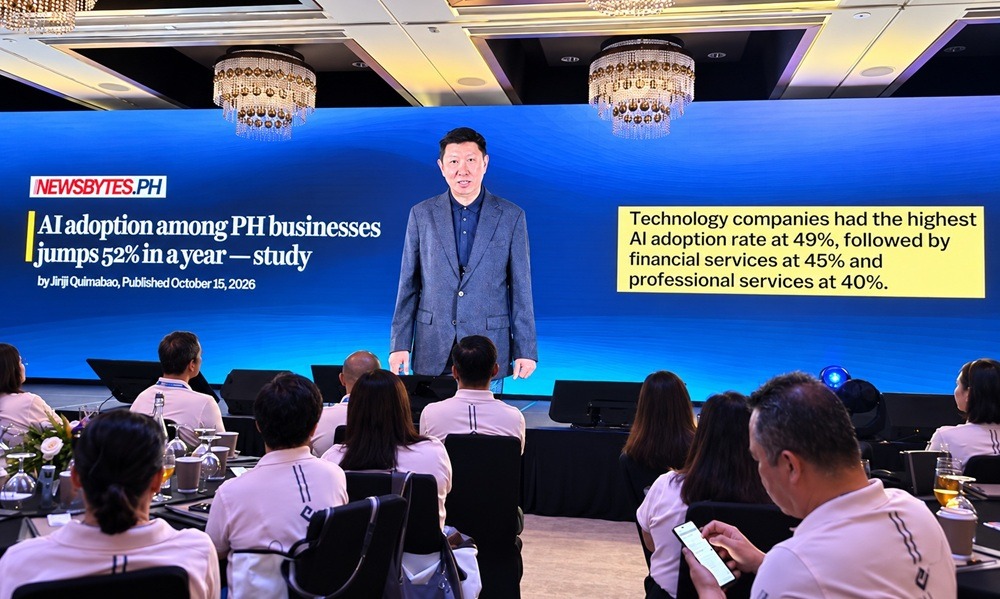
BORACAY — The artificial intelligence (AI) boom is driving up the cost of computers, servers, and memory chips, threatening to slow the Philippines’ push to adopt AI as businesses face higher technology costs and delays in upgrading their IT infrastructure.
The shortage comes as Philippine companies explore AI for customer service, financial services, manufacturing, logistics, and software development. But rising hardware prices could make it more expensive for businesses to move from pilot projects to full-scale deployment.
Jimmy Go, president and CEO of VST ECS Philippines, warned that surging demand for high-bandwidth memory and server DRAM is tightening supply as major cloud providers expand their AI infrastructure.
“Memory now fuels the intelligent enterprise,” Go said in his virtual welcome address at the 9th CXO Tech Summit 2026 in Shangri-la Boracay.
The crunch is already affecting hardware prices in the Philippines. Lenovo Philippines country general manager Michael Ngan earlier said laptops that previously sold for around P50,000 now cost more than P80,000, while server prices have surged by as much as 300% over the past 12 months.
Ngan said some corporate customers are requesting additional budgets to cover higher PC prices, while others are postponing equipment upgrades or limiting purchases to essential devices.
He also warned that the rising cost of computers is widening the digital divide, as consumers who previously could afford entry-level devices are priced out of the market.
The cost pressure could also undermine business plans to adopt AI. Companies that must spend more to replace aging computers and expand computing infrastructure may have less money available for AI software, employee training, and other digital transformation initiatives.
Hardware shortage threatens AI rollout
The supply crunch is linked to the rapid expansion of AI data centers, which require large quantities of specialized memory and other advanced components.
As manufacturers prioritize demand from major AI infrastructure operators, supplies of components used in conventional PCs, notebooks, and smartphones are becoming tighter.
Go said server high-speed DDR5 memory prices had risen nearly 100% quarter on quarter, raising enterprise IT costs and pushing some deployments into 2027.
He also cited Micron CEO Sanjay Mehrotra as saying that more than 75% of the company’s expected 2027 output had already been sold. Micron expects memory and storage supply-demand conditions to be tighter in 2027 and 2028 than in 2026.
The outlook suggests that Philippine companies may have to contend with elevated hardware costs while trying to scale AI applications.
For businesses that need additional servers and storage to process large volumes of data, higher prices could force them to reduce the scope of projects, defer implementation, or settle for less powerful equipment.
The shortage could also make it harder for smaller companies to compete with larger enterprises that have greater purchasing power and better access to limited component supplies.
Global PC, smartphone markets under pressure
The hardware crunch is already affecting shipments worldwide.
Global PC shipments fell 4.9% year on year to 68.2 million units in the second quarter of 2026, according to International Data Corp. (IDC). The research firm attributed the decline largely to memory shortages, with supply constraints in storage and other components also weighing on the market.
IDC said the shortage could dampen the broader PC upgrade cycle, even as demand grows for computers capable of running AI workloads locally.
The downturn intensified in the third quarter, when global PC shipments fell 20.1% year on year to 62.7 million units, according to preliminary IDC figures.
Smartphones have also been affected. Global shipments dropped 22% year on year to 255.3 million units in the third quarter, marking the steepest annual decline recorded for any quarter, IDC said.
Memory costs have surged approximately 350% since 2025, squeezing manufacturers’ margins and pushing up device prices. IDC expects smartphone market growth to remain constrained through 2027, with a possible recovery delayed until 2028 at the earliest.
Although these figures cover the global market rather than the Philippines alone, they point to a broader supply problem that could make computing devices more expensive for local consumers and businesses.
Higher prices could also delay device replacement cycles, leaving workers and organizations with older equipment that may not be suitable for newer AI applications.
Cost could widen the AI adoption gap
For the Philippines, the challenge is not simply whether businesses want to adopt AI, but whether they can afford the infrastructure needed to use it at scale.
Go said AI was already being deployed in areas such as customer service, credit scoring, demand forecasting, document processing, and software development. However, infrastructure bottlenecks, talent shortages, and organizational resistance remain obstacles to wider adoption.
Rising hardware costs add another constraint. Companies that postpone PC and server upgrades could find it harder to deploy AI tools that require more computing power, while smaller businesses may struggle to justify the upfront investment.
The pressure could also affect the broader digital economy if higher device prices make computers less accessible to students, workers, and small businesses.
The Philippines is seeking to attract investment in cloud and AI infrastructure, but local adoption will depend in part on whether businesses can obtain affordable computing resources.
Without sufficient access to hardware, the country’s AI ambitions risk advancing more slowly than planned, particularly among companies that lack the budgets and purchasing power of large enterprises.
The CXO Tech Summit 2026, organized by VST ECS Philippines, carried the theme “Rethinking IT: Powering the AI-Driven Enterprise.”