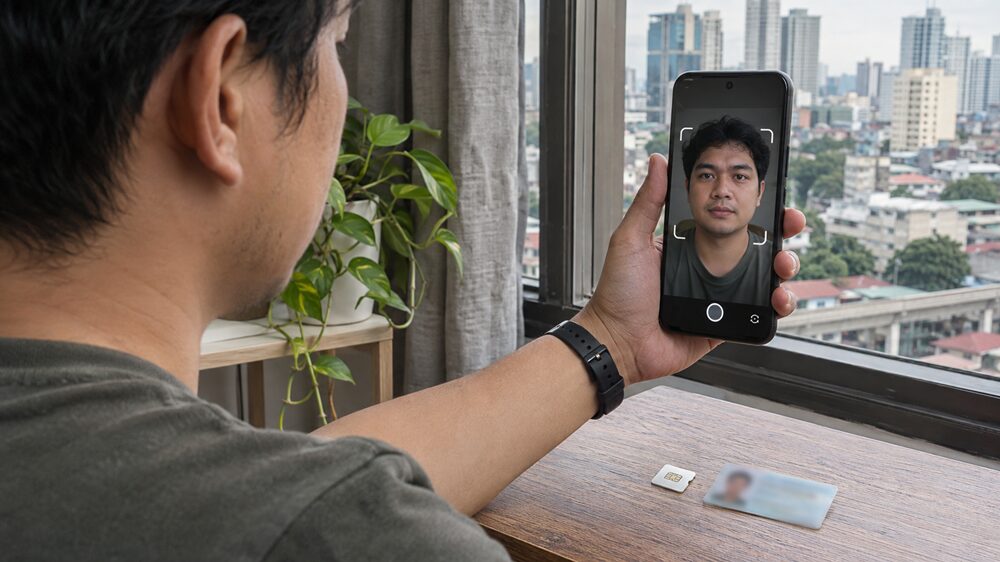
Smart Communications this week became the first Philippine telco to verify SIM registrations through the National ID system, letting Smart Prepaid and TNT users confirm who they are with their name and a live selfie instead of an uploaded card.
The portal checks that selfie against the Philippine Statistics Authority’s National ID eVerify service. According to the company, registration now takes under a minute, down from about three. The rollout lands while the National Telecommunications Commission is making telcos revalidate subscribers who have more than 100 SIMs listed under one name.
Telcos are not the first to make the switch. Maya said in August that it had built eVerify into its know-your-customer process earlier in the year, so eligible users can enter a National ID number and record a video selfie rather than photograph a physical ID.
The fintech said onboarding time fell by 84%. The Bangko Sentral ng Pilipinas has also floated a rule that would require the institutions it supervises to connect to National ID authentication.
A photographed ID card can be borrowed or doctored, then used for dozens of accounts. A live face matched against a government record is much harder to fake, and licensed online gaming is closing the same gap.
At a Senate Committee on Games and Amusement hearing in February, Jessa Mariz Fernandez, officer in charge of the Philippine Amusement and Gaming Corporation’s (PAGCOR) Electronic Gaming Licensing Department, said players must now submit their initial KYC requirements before they can make a deposit.
Trade publication AGBrief reported that the revised process asks for a name, contact details, a valid government-issued ID and a real-time selfie holding that ID.
That selfie settles age as much as identity. Casino gaming in the Philippines is limited to players aged 21 and over, and an outline of the age and ID rules for Filipino players notes that licensed operators are expected to run that age check themselves, while some lottery and bingo products can be played from 18. A real-time photo makes it much harder for a younger sibling to sign up with an older relative’s card.
Age checks may soon reach well beyond gaming. On Oct. 8 the Senate passed the SMART KIDS Act, which would bar users under 18 from high-risk platforms and require those services to adopt age-assurance tools.
The Department of Information and Communications Technology would decide which services count as high-risk once the measure becomes law. Email, private messaging, educational platforms, news services and online games not mainly used for social networking are exempt, so the bill on its own would not cover every service with a sign-up page.
Each new check also adds to the biometric data that companies and agencies keep. Earlier this month the National Privacy Commission confirmed it had received breach notifications from 10 government agencies, among them the Bureau of Internal Revenue, the Securities and Exchange Commission and PAGCOR.
Maya, for its part, said customers who cannot be verified through eVerify can still fall back to the regular ID upload without restarting their application.
Smart is already looking further ahead. Chief operating officer Menardo G. Jimenez Jr. said that once AI agents start transacting for users, companies will also have to authenticate “that person’s AI agent.”