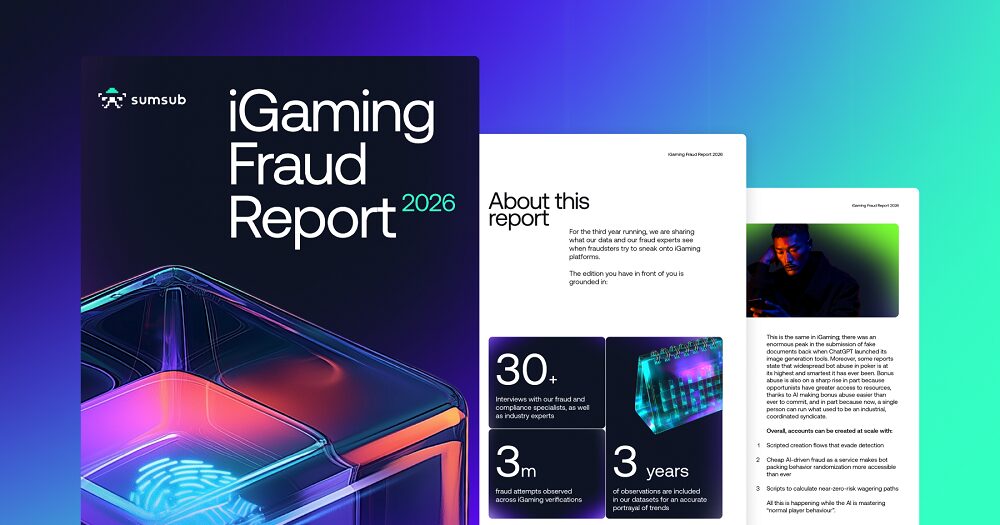
The volume of suspicious transactions in the global online gambling industry increased 4.5 times between the first quarter of 2025 and the first quarter of 2026, even as fraud rates declined across the Asia-Pacific region, according to a new report from identity verification firm Sumsub.
The company’s “iGaming Fraud Report 2026”, which analyzed more than three million fraud attempts across online gambling verification processes, found that fraudsters are increasingly shifting from attacking account registration to exploiting verified accounts using artificial intelligence and other sophisticated techniques.
According to the report, the average value of suspicious transactions also rose to $6,500 from $3,960 a year earlier.
Despite the increase in sophisticated attacks, Asia Pacific recorded the largest regional decline in fraud rates, falling 45% from 3.49% in 2024 to 1.92% in the first quarter of 2026.
Sumsub attributed the improvement to stricter regulatory oversight in markets including the Philippines, Australia, Macao, and New Zealand, although the regional fraud rate remains above the global average of 1.53%.
The report comes as the Philippine gaming sector tightens compliance requirements. Under new rules from the Philippine Amusement and Gaming Corporation (Pagcor), business-to-business online gambling infrastructure providers will be required to meet stricter anti-fraud standards.
However, Sumsub said fraud tactics have evolved, with 76% of all fraud cases in Asia Pacific now occurring after the initial Know Your Customer (KYC) verification process.
“Despite an overall decline in fraud rates within Asia Pacific, we’re observing a significant sophistication shift in the region, where the majority of all fraud now occurring after the KYC stage often in the form of money mulling and bonus abuse among others,” said Penny Chai, vice president for Asia Pacific at Sumsub.
“Fraudsters in Asia Pacific are increasingly creating identities designed specifically to clear initial onboarding filters. In fact, professional regional syndicates are among the most adept globally at creating synthetic videos capable of passing a one-camera check, designed with the intent of executing far more damaging, long-term fraud once inside a platform.”
The report identified Cambodia, American Samoa, Singapore, South Korea, Bangladesh, and Japan as the Asia Pacific markets with the highest fraud rates.
It also found that selfie fraud and deepfakes account for more than two-thirds, or 66.15%, of fraud cases in the region.
Fraudsters increasingly rely on AI-generated documents, face swaps, account farms, proxy networks, liveness bypass tools, and automated bots to evade detection.
Globally, the report said fraud has become more sophisticated. Fraudsters now spend 4.6 times longer completing identity verification than legitimate users, make 20% to 30% more verification attempts, and increasingly rely on repeated testing to bypass security systems.
Kris Galloway, iGaming product evangelist at Sumsub, said AI has significantly lowered the cost of conducting fraud at scale.
“Right now, the industry is seeing a huge amount of AI-generated or AI-assisted fraud content. An ‘industry-wide DDoS attack of AI-slop’, if we’re willing to put it into stronger terms. That includes: synthetic faces, edited documents, templated identities, and mass-generated applications,” Galloway said.
“Even when many of these attempts are low-quality individually, together, they create enormous operational pressure on verification systems, manual review teams, and fraud operations. AI dramatically lowers the cost and effort required to commit fraud at scale, and professional fraud groups are already taking advantage of it.”
Based on its findings, Sumsub said online gambling operators should move beyond one-time identity verification and adopt continuous monitoring throughout a customer’s lifecycle.
It also recommended combining device, IP address, email, phone number, and fraud intelligence into unified risk scoring, while strengthening onboarding through layered identity verification and digital identity systems.