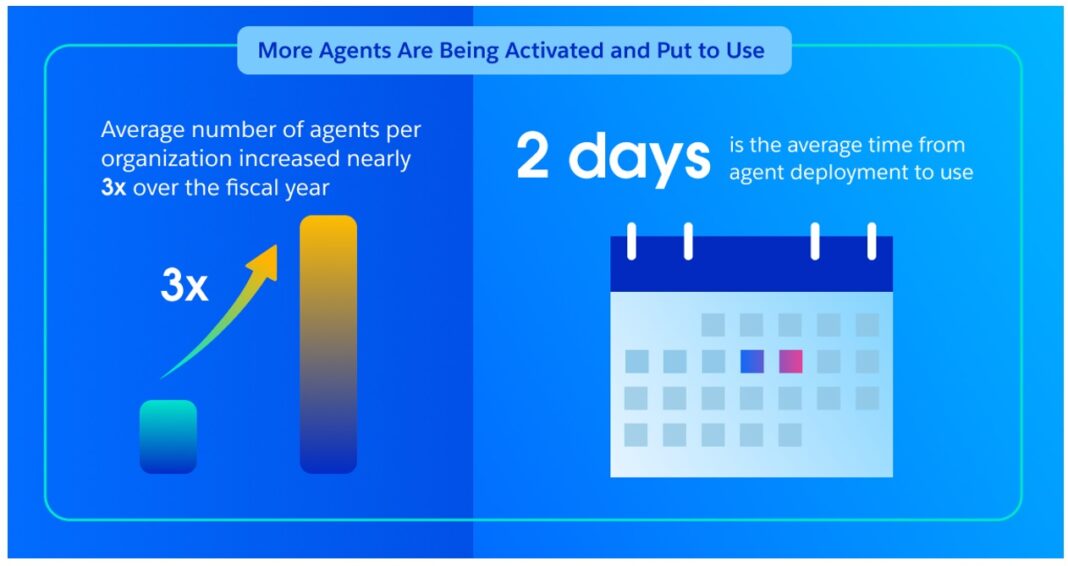
The average number of artificial intelligence agents activated by businesses nearly tripled over a 14-month period as companies moved the technology beyond chatbots and into business processes, according to an analysis released by Salesforce.
The 2026 Salesforce Agentic Enterprise Index examined aggregated usage data from companies that consistently operated AI agents on the company’s Agentforce platform from February 2025 to April 2026.
Salesforce said companies created agents within an average of two days after provisioning them. The time required to begin creating agents declined by 53% during the period covered by the analysis.
The volume of tasks completed by the agents grew at a compound monthly rate of 15% as of April. Salesforce measures these tasks through what it calls an “Agentic Work Unit,” defined as a discrete task completed by an AI agent.
Consumer-facing industries generally deployed agents at higher volumes for narrowly defined tasks, while manufacturing, financial services, healthcare and life sciences, and the public sector used agents for more complex and cross-functional processes.
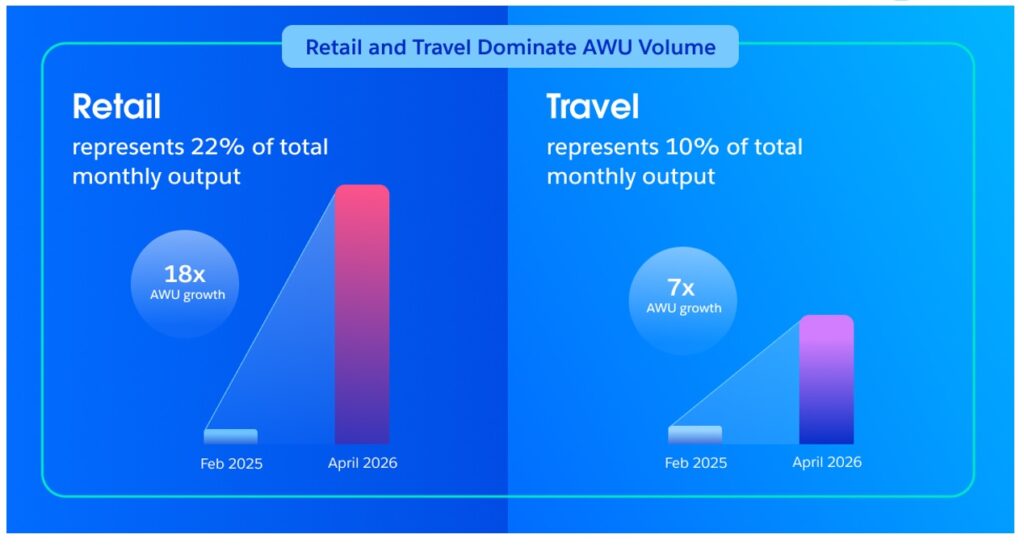
Retail agents, for example, typically performed one or two actions for much of the year. During peak shopping periods, however, the average retail agent used nine skills, up 350%, as companies assigned them more complicated customer-service tasks.
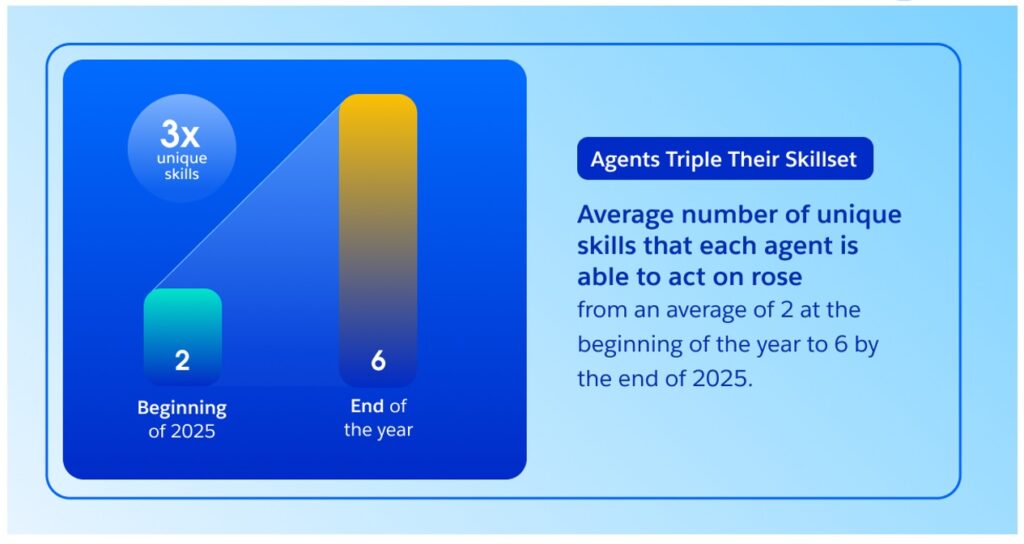
Across industries, the average agent could use six skills, compared with two at the beginning of 2025. These included retrieving and summarizing information, drafting communications, updating records, and extracting data from user inputs.
Salesforce said public-sector and healthcare and life-sciences organizations recorded 227-fold and 19-fold increases, respectively, in the volume of work completed by agents. Their total output, however, remained lower than that of consumer-facing industries.
Financial services accounted for about 10% of monthly agent task output, with activity rising during periods of heavier demand such as the US tax season.
PenFed Credit Union chief information officer Shree Reddy said the institution deployed agents capable of checking balances, tracking loan applications and transferring funds while operating within its compliance and security controls.
“Our vision has always been to use AI in a trusted, practical, and meaningful way to serve our members seamlessly across every channel. Bringing that vision to life meant going beyond simple chatbots to build sophisticated agent experiences with trust baked in,” Reddy said.
“By pairing robust governance with our unified platform, we’ve safely deployed multi-action agents like Ace and Echo that perform real, complex banking tasks —turning our goal of a truly connected, AI-enabled credit union into a reality.”
The analysis also found that employees interacted with AI agents 300% more frequently per week over the study period.
Salesforce said agents handled 170 times more customer-service conversations over the past five quarters and resolved seven out of 10 without human assistance.
Salesforce president of enterprise AI and technology Joe Inzerillo said companies were increasingly using agents to execute workflows instead of merely generating text.
“Whether you’re spinning up agents to operate at massive scale or orchestrating them through deep, multistep pipelines, the bottom line is they’re shipping real value,” Inzerillo said.
“That ROI isn’t just showing up on the top line in sales numbers but in execution efficiency. We are moving from passive chatbots and predictive models to execution-driven agents that actually roll up their sleeves and drive real value.”
The findings were based exclusively on organizations that used Salesforce products and had agents running in production during every month covered by the analysis. Salesforce said the results were not indicative of the company’s financial performance.