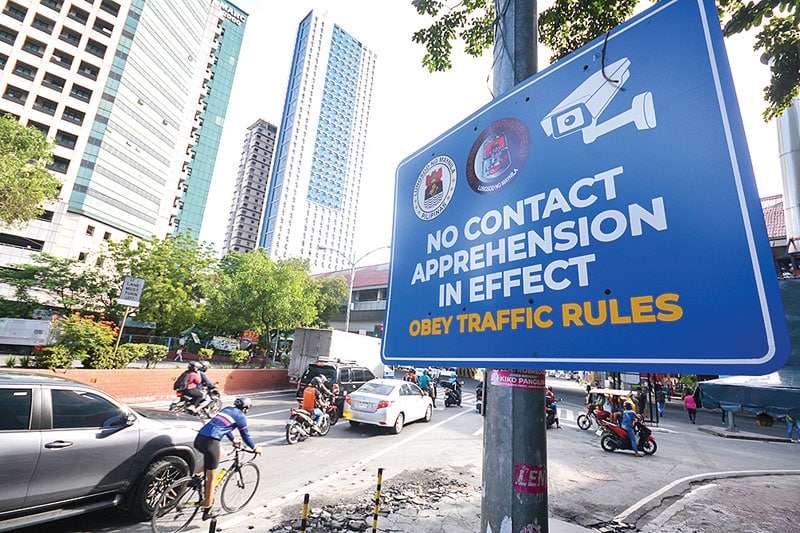
The Supreme Court (SC) has dismissed the consolidated petitions challenging the No Contact Apprehension Program (NCAP) in Metro Manila, ruling that the issues raised were rendered moot by the adoption of a new and uniform traffic enforcement framework under the Metro Manila Traffic Code of 2023 (MMTC 2023).
In a decision penned by SC associate justice Rodil V. Zalameda, the high court dismissed the petitions filed by Kilusan sa Pagbabago ng Industriya ng Transportasyon and others against the NCAP ordinances of Muntinlupa, Parañaque, Quezon City, Valenzuela, and Manila.
The ordinances implemented Metro Manila Development Authority Resolution No. 16-01, which introduced the use of digital cameras to detect traffic violations.
Apart from mootness, the court said the petitions also failed on procedural grounds, including lack of standing, failure to exhaust administrative remedies, violation of the hierarchy of courts, and forum shopping.
The petitioners had argued that NCAP was inconsistent with Republic Act No. 4136, or the Land Transportation and Traffic Code, because it dispensed with face-to-face apprehension and shifted liability from the actual driver to the registered vehicle owner.
They also claimed the system violated due process by allowing fines to accumulate before motorists were notified and given the chance to contest the alleged violations.
The court, however, said the cases had been overtaken by subsequent developments. It invoked the doctrine of constitutional avoidance, under which courts refrain from deciding constitutional questions when a case can be resolved on non-constitutional grounds.
The ruling pointed to the Metro Manila Traffic Code of 2023, adopted by the Metro Manila Council, which established a uniform framework for traffic regulation and NCAP implementation across Metro Manila.
The new code covers traffic adjudication procedures, periods for settling notices of violation, rules for tagging violations in the Land Transportation Office’s Land Transportation Management System, data privacy safeguards, uniform fines and penalties, online payment platforms, and mandatory authorization procedures.
The MMDA later issued Memorandum Circular No. 10, series of 2025, to implement MMTC 2023. Muntinlupa, Parañaque, Quezon City, and Valenzuela subsequently passed new ordinances adopting the updated framework.
Manila also adopted MMTC 2023, except for the provision on a Traffic Adjudication Board, since its own board continues to function.
According to the court, these developments effectively replaced the fragmented NCAP systems challenged in the petitions. Since neither MMTC 2023 nor the new ordinances were directly assailed before the court, any ruling on the validity of the earlier ordinances would no longer have practical or legal effect.
The SC also said none of the recognized exceptions to the mootness doctrine applied in the case, including grave constitutional violations, paramount public interest, the need to formulate controlling principles, or situations capable of repetition yet evading review.
At the same time, the court stressed that the dismissal should not be read as an endorsement of the old NCAP ordinances.
“Our dismissal of the Petitions is confined to the determination that petitioners failed to overcome threshold issues, and that the supervening adoption of a uniform regulatory framework has rendered the Petitions moot. There is no explicit determination regarding the prior issuances, nor a resolution of grievances based on specific facts,” the SC ruled.
The court added that the dismissal does not bar future challenges if the revised NCAP system later gives rise to an actual controversy.
It also lifted the temporary restraining order it issued on Aug. 30, 2022 against Manila, Quezon City, Valenzuela, Parañaque, Muntinlupa, the Land Transportation Office, and parties acting on their behalf.
Separate opinions, however, showed that some justices believed the court should still have ruled on the validity of NCAP as a mode of traffic enforcement.
SC senior associate justice Marvic Leonen agreed that the privacy and due process issues raised in the petitions had been mooted by MMTC 2023, but said the validity of NCAP itself remained ripe for resolution.
He concluded that the ordinances should be upheld, finding no violation of due process, privacy rights, or existing law.
SC associate justice Amy C. Lazaro-Javier, in a separate opinion, likewise agreed with the dismissal but said the court should still have addressed the validity of the ordinances because the issues could arise again.
She said the measures were valid exercises of local government authority over traffic regulation and were fair and reasonable tools for reducing human intervention, curbing corruption, and enabling continuous enforcement.
SC associate Justice Japar B. Dimaampao also disagreed with the majority’s finding that the case had become moot, saying NCAP remains in force and motorists continue to face fines under the system.
While he also voted to uphold the ordinances, he said a provision in the Valenzuela City ordinance allowing private funding of honoraria for NCAP implementers was unconstitutional because it created an appearance of impropriety and possible private influence over public officials.