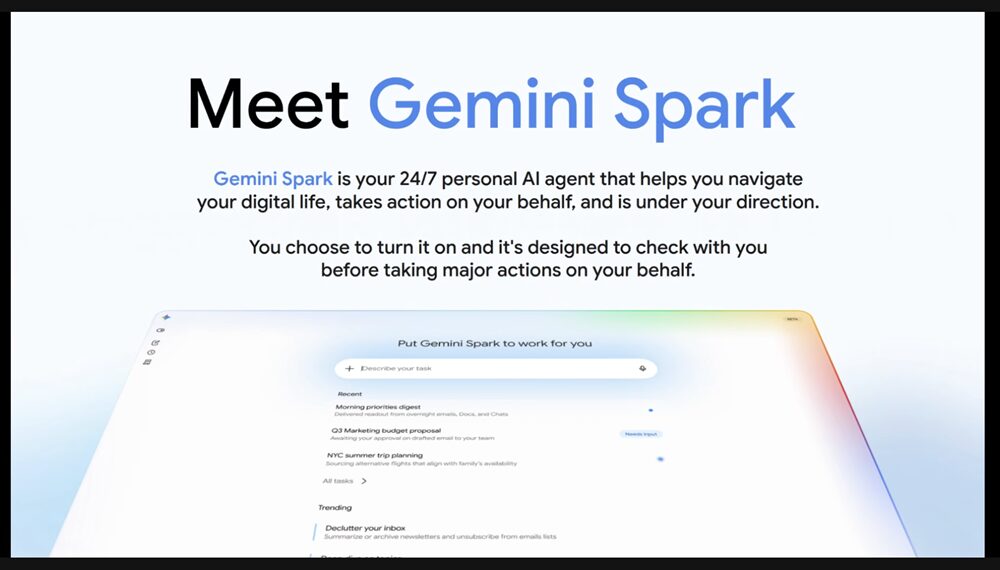
Google is expanding Gemini Spark, its personal AI agent capable of independently carrying out multi-step tasks, to subscribers across the Asia-Pacific region.
During a virtual media briefing on Wednesday, July 29, the company said Gemini Spark is now available in English and several regional languages to Google AI Ultra subscribers in Asia Pacific. Access will be extended to the lower-priced Google AI Pro tier in the coming weeks.
Gemini Spark was introduced at Google I/O on May 19 and was initially limited to AI Ultra subscribers in the US.
Unlike the standard Gemini chatbot, Spark is designed to work proactively and autonomously for extended periods. It appears in a separate tab within the Gemini app and can perform tasks across Google Workspace, the Chrome browser, and supported third-party applications.
Adam Coimbra, Gemini director of product management, said the distinction lies in moving beyond systems that only respond when prompted.
“It’s idea of moving from something that reacts to your input and requires you to wake it up, to something that automatically wakes up when it should, when there’s certain information or a something [specific] that happens, so it can act on your behalf,” Coimbra explained.
“The goal of Gemini Spark is to take your digital chores off your plate so you can focus on what matters most to you,” he added.
Spark can, for example, create and continuously update a Google spreadsheet using information from Gmail. It can also monitor websites through Chrome and alert users when lower-priced concert tickets or products from selected brands become available.
The agent can continue running assigned tasks in the background even when a user’s device is asleep or turned off.
Google said Spark is designed to seek confirmation before completing sensitive or consequential actions, such as sending a drafted email.
Users, however, cannot currently define which actions should require approval because those controls are determined by Google’s built-in application programming interfaces.
Google also added automatic browsing in Chrome on Thursday, July 30. The feature allows Spark to interact with websites instead of merely monitoring them, including filling out online forms, filing expense reports, and managing subscriptions.
Other planned capabilities include reading photos and PDF attachments in Gmail, connecting Spark to users’ preferred messaging applications, and handling more tasks within Gmail.
Google is also developing Spark Subagents, described by Coimbra as “baby agents” that can be created by Spark or by users and assigned specific tasks.
Spark already generates subagents to divide Web research into smaller tasks. Future versions could allow users to build customized agents that interact with them and other people.
“As we start using these agents more and more in our lives and our work. It becomes more important that it’s natural to interact with it… I’m excited to make Spark as natural and accessible for users to interact with as possible,” Coimbra stated.